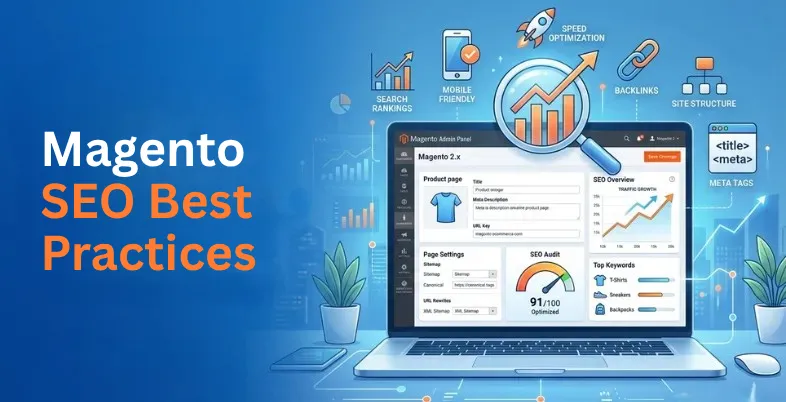
Magento is an advanced e-commerce software that is popular in the business sector to create scalable and feature-rich web stores. Nevertheless, the mere presence of a Magento store is not sufficient to attract traffic or produce sales. Search Engine Optimization (SEO) will be necessary in order to increase the visibility, attract organic traffic, and improve the user experience.
Magento SEO Best Practices focus on optimizing site structure, product pages, metadata, URLs, and technical aspects such as speed and mobile responsiveness. These measures help ensure that websites are easily discoverable by search engines while delivering a smooth shopping experience that drives conversions and long-term growth. Additionally, implementing these practices consistently can give your store a strong competitive edge in search rankings.
What is Magento SEO?
Magento SEO can be explained as the optimization of an online store, constructed on Magento, in order to be more visible in search engine marketing and to draw new traffic organically. It includes optimising different on-page, technical, and content factors, including product description, meta tags, URLs, site structure, and speed of pages.
Through application of SEO best practices in Magento, store owners would be able to make sure that search engines can easily crawl, index and comprehend the contents of their websites. SEO of Magento is also focused on improving user experience, in that it is mobile and responsive with optimised navigation and fast loading. AEO can also be applied to achieve successful rankings, increase targeted traffic, reduce bounce, and eventually result in conversion and sales in online businesses.
Magento SEO typically also includes image optimization, structured data, duplicate content control, and the utilisation of extensions or plug-ins to automate processes. It also involves using tools like SEO Reporting Software to track performance, analyse rankings, and ensure continuous improvement in search visibility across competitive product categories.
12 Magento SEO Best Practices For Your Websites
1) Crawling and Indexing
Magento websites tend to give rise to numerous URLs as a result of layered navigation, filters, and product variations. This may cause crawl inefficiencies and content duplication problems unless it is handled well.
To optimise crawling and indexing:
- Use canonical tags to point duplicate pages to the main version.
- Apply “noindex” tags to low-value or filtered pages.
- Configure robots.txt to block unnecessary parameter-based URLs.
- Submit XML sitemaps to guide search engines toward important pages.
- Regularly audit indexed pages in Google Search Console to remove thin or duplicate pages. You can also use White Label SEO Audit Tools to generate detailed site audit reports and identify indexing issues more efficiently.
2) Optimize Site Architecture
An easy-to-understand and logical site structure is a key part of Magento SEO Best Practices, as it helps both search engines and users navigate your Magento store with ease. Poor architecture can hide important pages and reduce crawl depth, ultimately affecting your rankings and visibility.
To improve site architecture:
- Keep a shallow hierarchy (homepage → categories → subcategories → products).
- Ensure important pages are accessible within 3 clicks.
- Use breadcrumb navigation for better usability and internal linking.
- Group related products into well-structured categories.
- Avoid orphan pages by linking all important pages internally.
3) Use SEO-Friendly URLs
Clean and descriptive URLs enhance search engine comprehension and user experience. The structures of the URLs can be tailored to incorporate the correct keywords in Magento.
Best practices include:
- Enable URL rewrites in Magento settings.
- Use hyphens instead of underscores in URLs.
- Include target keywords naturally in URLs.
- Avoid unnecessary parameters and session IDs.
- Keep URLs short, readable, and consistent across the site.
4) Optimize Product Pages
Product pages are very important for conversions and rankings, and as part of Magento SEO Best Practices, they need to be optimized to ensure better visibility in search engines.
To optimise product pages:
- Write unique and keyword-rich product descriptions.
- Add optimised meta titles and meta descriptions.
- Use high-quality images with descriptive alt text.
- Include structured data (schema markup) for rich snippets.
- Avoid duplicate content across similar product variants.
5) Improve Page Speed Performance
The speed of the page can have a direct effect on the user experience and search performance. The slow Magento stores may result in increased bouncing and reduced conversions.
Optimization techniques include:
- Enable caching (full-page cache in Magento).
- Use a content delivery network (CDN).
- Compress and optimise images.
- Minify CSS, JavaScript, and HTML files.
- Choose high-performance hosting optimized for Magento.
6) Mobile Optimization
Mobile-first indexing means that in order to succeed with SEO, it is necessary to make sure that your Magento store does not fail with mobile security.
Key steps include:
- Use a responsive Magento theme.
- Optimise images and layouts for smaller screens.
- Ensure buttons and navigation are mobile-friendly.
- Test mobile usability using Google tools.
- Improve mobile loading speed for better engagement.
7) Optimize Meta Tags
Meta titles and descriptions play a crucial role in click-through rates, and as part of Magento SEO Best Practices, they help search engines understand the relevance of your pages.
Best practices:
- Include primary keywords naturally in titles.
- Keep titles within recommended character limits.
- Write compelling meta descriptions to encourage clicks.
- Avoid duplicate meta tags across pages.
- Customise metadata for each product and category page.
8) Implement Structured Data (Schema Markup)
Well-organised information assists the search engines in getting more insight into your work and improves search results with rich information.
To implement:
- Add product schema for pricing, availability, and ratings.
- Use breadcrumb schema for navigation clarity.
- Implement review schema for user ratings.
- Validate schema using Google Rich Results Test.
- Use Magento extensions to simplify schema integration.
9) Optimize Images for SEO
Photos are significant in eCommerce SEO, yet they need to be optimised not only in terms of performance but also in terms of discoverability.
Best practices:
- Use descriptive file names with relevant keywords.
- Add alt attributes for accessibility and SEO.
- Compress images to reduce load time.
- Use appropriate formats like WebP where possible.
- Avoid using overly large image files.
10) Strengthen Internal Linking
Internal linking spreads link equity, and as part of Magento SEO Best Practices, it helps search engines identify and crawl important pages more effectively.
Implementation tips:
- Link related products and categories internally.
- Use descriptive anchor text with keywords.
- Add “related products” or “you may also like” sections.
- Avoid excessive or irrelevant internal links.
- Ensure all key pages are reachable through internal links.
- Include links to related topics, such as SEO H1 Tags Best Practices, to strengthen content structure and improve overall on-page SEO.
11) Manage Duplicate Content
One of the most frequent problems in Magento is the existence of duplicate content because of product variations, filters, and pagination.
To manage it:
- Use canonical tags to indicate preferred pages.
- Avoid duplicate product descriptions across listings.
- Configure layered navigation properly.
- Use noindex for filtered or faceted pages.
- Regularly audit for duplicate URLs and fix issues.
12) Leverage XML Sitemaps and Robots.txt
XML sitemaps and robots.txt files are used to tell search engines how to crawl and index your Magento store.
Best practices include:
- Generate and submit XML sitemaps via Google Search Console.
- Include only important pages in the sitemap.
- Use robots.txt to block unnecessary or low-value pages.
- Update sitemaps regularly when adding new products.
- Ensure no critical pages are accidentally blocked from crawling.
Common Magento SEO Mistakes To Avoid
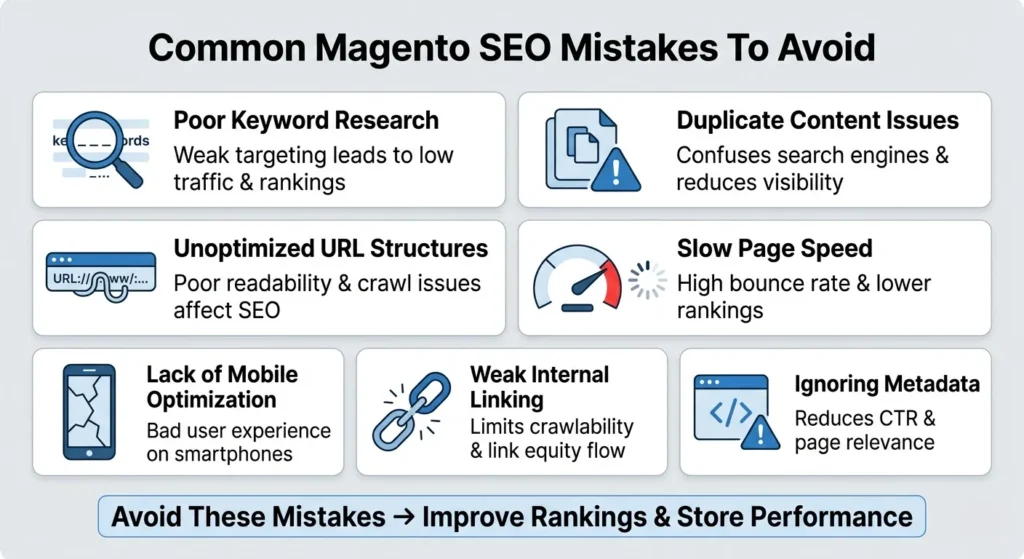
- Poor Keyword Research Practices: In Magento stores, in most cases, merchants do not focus on key word research hence relevant traffic and low ranking in general since the targeting strategies are not achieved.
- Duplicate Content Issues: Having the same content on the product pages confuses search engines, dilutes authority and does not index, resulting in low ranking and exposure.
- Unoptimised URL Structures: Dynamic URL structures are improperly formatted and are not easy to be crawled, lower readability, and decrease the performance of search engine optimisation.
- Slow Page Loading Speed: Slow loading speed is harmful to user experience, bouncing rate, and ranking particularly on mobile phones and search engines.
- Lack of Mobile Optimization: Lack of mobile optimization will result in usability, increased bounce rates, and lost opportunities because the majority of users today use smartphones to browse.
- Weak Internal Linking: Inadequate internal linking structure will restrict crawlability, distribution of link equity and make content navigation more difficult by the user.
- Ignoring Metadata Optimization: Neglecting metadata such as titles and meta descriptions decreases the number of clicks and undermines the relevance cues as well as severely restricting the overall search engine functionality.
Ending Thoughts
To sum up, the Magento SEO Best Practices will play a vital role in improving the visibility, efficiency, and performance of an eCommerce store. Businesses can take advantage of the potential of optimising their websites, URLs, meta tags, product pages, and page speed to ensure their store is SEO friendly and user friendly.
Rankings and user experience are further improved with technical search engine optimization, great content and mobile optimization. The constant use of these strategies will contribute to the attraction of organic traffic, low bounces, and more conversions. Finally, the optimised Magento store would not only be ranked higher in search engines but also provide customers with a more convenient and interesting shopping experience.
FAQs
Why is SEO Important For Magento Stores?
You can get your Magento store to show up near the top of search results by using SEO techniques. This helps your store show up at the top of search results pages. That way you get customers and you sell more things without having to pay for ads.
How Can I Optimise Product Pages in Magento for SEO?
You can make your product pages in Magento better for SEO by using keywords in the titles of your pages. You should also use descriptions for each product. Make sure your meta tags are good and your URLs are easy to read. Use tags for your images and add structured data so search engines can understand what you are selling.
What are The key Technical SEO Factors in Magento?
The big technical things for SEO in Magento are making your site load fast. Work well on mobile phones. You need to make sure search engines can find all your pages and that you use XML sitemaps. You should also use something called canonicalisation. Make sure your URLs are clean. Fix any problems you have with content.
Does Magento Support SEO-Friendly URLs?
Yes Magento lets you use SEO- URLs. You can do this by turning on something called URL rewriting. Take out any parameters you do not need in your URLs. Make sure your URLs are easy to read and understand. That way your Magento store can have URLs that’re good, for SEO.