
The next ecommerce success story may not begin in a warehouse—it could begin with a problem worth solving. In 2026, ecommerce offers entrepreneurs more ways to build lean, scalable businesses across physical products, digital services, subscriptions, and specialized niches. However, opportunity alone does not guarantee profitability. Rising customer acquisition costs, intense competition, logistics challenges, and changing consumer expectations make strategic selection essential.
The smartest entrepreneurs are evaluating demand, margins, repeat-purchase potential, startup investment, scalability, and differentiation before committing resources. Whether you are looking for a low-investment business digital model or a product-based brand with long-term growth potential, choosing the right ecommerce idea can shape your entire business trajectory.
This blog explores 20 promising ecommerce business ideas in 2026, helping business-minded entrepreneurs identify opportunities with practical commercial potential.
Why Start An Ecommerce Business?
Ecommerce offers entrepreneurs scalable access to customers, lower operating barriers, flexible business models, and valuable digital data for smarter decisions and sustainable growth.
- Lower Startup Costs: Ecommerce businesses generally require less investment than physical stores because entrepreneurs can avoid expensive retail premises, interiors, utilities, and extensive staffing costs.
- Wider Customer Reach: An online store can serve customers beyond its local market, allowing businesses to target national and international audiences without opening multiple physical locations.
- 24/7 Sales Opportunities: Unlike traditional stores, ecommerce websites can accept orders around the clock, enabling businesses to generate sales even outside conventional operating hours.
- Scalable Business Model: Entrepreneurs can expand product ranges, marketing campaigns, and customer reach gradually, making ecommerce suitable for both small startups and rapidly growing businesses.
- Data-Driven Decision Making: Ecommerce platforms provide valuable customer data, including purchasing behavior, preferences, traffic sources, and conversion patterns, supporting more informed business and marketing decisions.
- Flexible Business Operations: Ecommerce enables entrepreneurs to operate from different locations, manage digital processes remotely, and build business for housewives around flexible working arrangements and schedules.
- Multiple Revenue Opportunities: Entrepreneurs can combine product sales with subscriptions, bundles, memberships, digital products, affiliate marketing, or marketplace strategies to diversify potential revenue streams.
- Growing Digital Consumer Demand: Increasing consumer preference for online shopping creates opportunities for businesses offering convenient purchasing experiences, competitive pricing, personalized services, and reliable product delivery.
List Of 20 Best Ecommerce Business Ideas
A. Product-Based Ecommerce Business Ideas

1. Reusable & Sustainable Products
- Startup cost: ₹50,000–₹2 lakh
- Profit potential: 20%–40% gross margin
- Why is it a good ecommerce idea?: Growing consumer interest in reusable and environmentally conscious products creates opportunities for specialized brands with differentiated designs, quality, and sustainable positioning.
Reusable and sustainable products target consumers and businesses seeking practical alternatives to disposable goods. The opportunity spans household, travel, personal-care, and workplace products, allowing entrepreneurs to build focused collections rather than broad stores.
The strongest business case comes from combining functional design, credible sustainability claims, attractive packaging, and repeat-purchase opportunities. Entrepreneurs can start with a narrow product range, validate demand through marketplaces and social commerce, then expand based on customer feedback.
Margins can improve through private labeling, bundles, subscriptions, wholesale business, and direct-to-consumer sales, while differentiated branding helps avoid competing solely on price.
- Products you can sell: Reusable bottles, cloth bags, bamboo products, lunch boxes, metal straws, eco-friendly stationery, reusable kitchen products.
- How to start: Identify a sustainability-focused niche, source products from reliable suppliers, build a branded storefront, test demand, and gradually expand profitable product categories.
- Tips for success: Focus on genuine product benefits, transparent sustainability claims, attractive packaging, bundles, and content that demonstrates practical everyday use.
2. Pet Products
- Startup cost: ₹50,000–₹2.5 lakh
- Profit potential: 20%–45% gross margin
- Why is it a good ecommerce idea?: Pet owners often prioritize quality and convenience, creating opportunities for specialized brands, repeat purchases, premium accessories, and emotionally driven marketing.
Pet ecommerce benefits from emotionally driven purchasing, growing pet-care spending, and opportunities for recurring sales. Entrepreneurs can focus on practical categories such as grooming, feeding, enrichment, travel, or comfort rather than competing across every pet product.
The model can support both one-time purchases and repeat orders, especially when products are consumable or replaceable. Success depends on reliable quality, accurate product information, strong visual merchandising, and trust-building content.
A focused niche, such as products for puppies, senior pets, indoor cats, or active dogs, can make customer acquisition more efficient and create stronger brand positioning.
- Products you can sell: Pet beds, collars, toys, grooming tools, feeding accessories, travel products, training accessories.
- How to start: Choose a pet segment, identify reliable suppliers, test a limited product range, establish an online store, and market through pet-focused communities and social media.
- Tips for success: Prioritize safety and quality, use attractive product demonstrations, build trust through reviews, and create bundles for different pet-care needs.
3. Home Organization Products
- Startup cost: ₹40,000–₹2 lakh
- Profit potential: 25%–45% gross margin
- Why is it a good ecommerce idea?: Compact living spaces and productivity trends create demand for practical storage solutions that are easy to demonstrate and bundle online.
Home organization is a practical ecommerce niche driven by consumers seeking better use of limited living space. Entrepreneurs can build stores around storage, decluttering, kitchen organization, wardrobe solutions, workspace accessories, or compact-home products.
The category is visually demonstrable, making short-form videos and before-and-after content useful for customer acquisition. Business potential improves when products are lightweight, easy to ship, and suitable for bundles. Rather than selling generic organizers, entrepreneurs should identify specific customer problems and offer coordinated solutions.
Private labeling and attractive packaging can further strengthen margins, brand recognition, and perceived value.
- Products you can sell: Storage boxes, drawer organizers, kitchen racks, wardrobe organizers, desk organizers, cable-management products.
- How to start: Research common organization problems, source lightweight products, create solution-based bundles, establish an ecommerce store, and promote before-and-after demonstrations.
- Tips for success: Sell complete solutions instead of isolated products, use visual content, optimize packaging, and focus on lightweight products to control shipping costs.
4. Personalized Gifts
- Startup cost: ₹40,000–₹2 lakh
- Profit potential: 30%–50% gross margin
- Why is it a good ecommerce idea?: Customization creates emotional value and allows businesses to command premium pricing for products designed around specific occasions and customer preferences.
Personalized gifting combines ecommerce convenience with emotional value, allowing entrepreneurs to charge premiums for customized products. Customers may purchase for birthdays, weddings, anniversaries, festivals, corporate occasions, or milestones, creating multiple demand occasions throughout the year.
The business can operate with limited inventory by using made-to-order production or outsourced manufacturing. Profitability depends on controlling customization errors, production time, packaging, and delivery reliability. Entrepreneurs should build a streamlined ordering process that captures personalization details accurately.
Strong product photography, seasonal collections, occasion-based marketing, and gift-ready packaging can increase average order value and encourage referrals.
- Products you can sell: Customized mugs, photo frames, engraved accessories, personalized notebooks, nameplates, hampers, customized clothing.
- How to start: Select profitable occasions, partner with customization vendors, create product mockups, build an online catalog, and establish a simple personalization-ordering process.
- Tips for success: Minimize customization errors, offer gift packaging, create seasonal collections, and clearly communicate production and delivery timelines.
5. Beauty & Personal-Care Accessories
- Startup cost: ₹50,000–₹2 lakh
- Profit potential: 25%–50% gross margin
- Why is it a good ecommerce idea?: Beauty accessories are visually marketable, relatively easy to bundle, and can serve specialized customer routines without requiring entrepreneurs to manufacture cosmetic formulations.
Beauty and personal-care accessories offer ecommerce entrepreneurs a broad market without necessarily requiring them to manufacture cosmetics themselves. Products such as organizers, applicators, grooming tools, travel kits, mirrors, brushes, and reusable accessories can create focused collections around specific customer routines.
The opportunity benefits from visual content, influencer demonstrations, gifting, and repeat accessory purchases. Entrepreneurs should carefully evaluate product quality, material safety, supplier consistency, and applicable regulations before selling.
Building a specialized brand around convenience, travel, organization, or professional use can create stronger differentiation than operating as a generic beauty store.
- Products you can sell: Makeup organizers, grooming kits, brushes, mirrors, travel beauty cases, hair accessories, skincare accessories.
- How to start: Choose a specific customer segment, source quality accessories, build a focused product collection, create visual content, and launch through an ecommerce platform.
- Tips for success: Avoid generic positioning, demonstrate product utility, maintain quality standards, and build bundles around complete beauty or grooming routines.
6. Fitness & Wellness Accessories
- Startup cost: ₹50,000–₹2.5 lakh
- Profit potential: 20%–40% gross margin
- Why is it a good ecommerce idea?: Fitness participation creates demand for practical accessories, while specialized positioning and educational content can help new brands compete against larger retailers.
Fitness and wellness accessories can serve home exercisers, gym users, runners, yoga practitioners, and recreational athletes through practical, non-consumable products. The category supports bundles, seasonal campaigns, and content-led marketing because products can be demonstrated through workouts and routines.
Entrepreneurs can start with lightweight items that are simpler to store and ship, then expand into complementary equipment based on sales data. The strongest positioning focuses on a defined customer segment rather than attempting to serve everyone.
Quality, durability, accurate specifications, and credible product demonstrations are essential for reducing returns and protecting customer trust.
- Products you can sell: Resistance bands, yoga mats, skipping ropes, gym gloves, water bottles, fitness bags, recovery accessories.
- How to start: Select a fitness niche, source reliable products, test demand with a small inventory, create demonstration content, and sell through your own store and marketplaces.
- Tips for success: Target specific fitness communities, demonstrate products correctly, maintain quality control, and develop complementary product bundles.
7. Stationery & Study Products
- Startup cost: ₹30,000–₹1.5 lakh
- Profit potential: 20%–40% gross margin
- Why is it a good ecommerce idea?: Students, teachers, professionals, and productivity enthusiasts provide multiple customer segments, while curated collections can create differentiation beyond commodity pricing.
Stationery and study products provide an accessible ecommerce opportunity for students, professionals, teachers, creators, and productivity-focused consumers. Entrepreneurs can compete through curated collections rather than individual commodity products, combining notebooks, planners, desk accessories, organization tools, and study kits.
Demand can be stimulated through academic calendars, examination periods, gifting seasons, and productivity trends. Attractive design and social-media-friendly presentation can support organic discovery, while bundles can improve average order value.
Entrepreneurs should control inventory carefully because product preferences can change quickly, and differentiation through themes, customization, quality, or targeted audiences is more defensible than price competition.
- Products you can sell: Planners, notebooks, pens, study kits, desk organizers, sticky notes, revision stationery, journals.
- How to start: Identify a student or productivity niche, curate products, negotiate with suppliers, create attractive bundles, and sell through an optimized online storefront.
- Tips for success: Use themed collections, create study-related content, control seasonal inventory, and encourage repeat purchases through bundles and limited editions.
B. Service and Digital Ecommerce Business Ideas

8. Online Courses & Workshops
- Startup cost: ₹20,000–₹1 lakh
- Profit potential: 50%–80% gross margin
- Why is it a good ecommerce idea?: Expertise can be converted into scalable digital products, allowing entrepreneurs to sell knowledge repeatedly without physical inventory or traditional fulfillment costs.
Online courses and workshops convert expertise into scalable digital products with potentially high gross margins and minimal physical fulfillment. Entrepreneurs can teach practical skills such as software, languages, marketing, design, career preparation, hobbies, or professional development.
The business case becomes stronger when the topic solves a specific problem and learners can see a measurable outcome. Entrepreneurs should validate demand before recording extensive content by testing workshops, consultations, or small paid resources.
Credibility, structured learning, strong demonstrations, community support, and continuous updates can improve retention, referrals, and the long-term value of the digital product.
- Products you can sell: Video courses, live workshops, recorded classes, masterclasses, certification preparation programs, learning bundles.
- How to start: Choose an area of expertise, validate demand, create a structured curriculum, select a delivery platform, and launch a small paid course before expanding.
- Tips for success: Focus on outcomes, demonstrate expertise, collect learner feedback, update content regularly, and build an audience before launching expensive courses.
9. Digital Templates & Productivity Tools
- Startup cost: ₹10,000–₹50,000
- Profit potential: 60%–90% gross margin
- Why is it a good ecommerce idea?: Digital templates can be created once and sold repeatedly, creating attractive economics with negligible inventory, shipping, and fulfillment requirements.
Digital templates and productivity resources offer a low-overhead ecommerce model because products can be created once and sold repeatedly without inventory or shipping. Entrepreneurs can develop templates for budgeting, project management, presentations, resumes, content planning, education, business operations, or personal organization.
The opportunity is strongest when products save users measurable time or improve workflow quality. Businesses can create product bundles, premium versions, memberships, or customization services to increase revenue per customer.
Entrepreneurs should prioritize usability, clear instructions, compatibility, professional design, and regular updates while protecting intellectual property and avoiding dependence on a single marketplace.
- Products you can sell: Excel templates, Notion templates, resume templates, business planners, financial trackers, content calendars, presentation templates.
- How to start: Identify repetitive customer tasks, create professional templates, test usability, establish a digital storefront, and market through search, social media, and communities.
- Tips for success: Sell time savings, provide previews, include instructions, offer bundles, and continuously improve products based on customer feedback.
10. Stock Media & Creative Assets
- Startup cost: ₹20,000–₹1 lakh
- Profit potential: 40%–80% gross margin
- Why is it a good ecommerce idea?: Digital creative assets eliminate physical inventory and can generate cumulative revenue as entrepreneurs build larger, commercially useful libraries.
Stock media ecommerce allows creators to monetize original digital assets such as photographs, illustrations, video footage, music, sound effects, icons, and design elements. Unlike physical retail, digital delivery removes shipping and inventory constraints, while a growing library can create cumulative revenue opportunities.
Entrepreneurs should focus on commercially useful themes, consistent quality, searchable metadata, and clear licensing terms. Specialized collections for industries, creators, educators, or marketing teams can offer stronger positioning than generic libraries.
Long-term performance depends on continuously expanding the catalog, understanding buyer demand, maintaining rights ownership, and distributing assets through suitable channels.
- Products you can sell: Stock photographs, videos, illustrations, icons, music tracks, sound effects, presentation assets, design elements.
- How to start: Choose a commercially valuable theme, produce original assets, organize them professionally, define licensing terms, and sell through a digital storefront or suitable marketplaces.
- Tips for success: Prioritize licensing clarity, searchable metadata, consistent quality, niche collections, and continuous catalog expansion.
11. Freelance Digital Services Store
- Startup cost: ₹10,000–₹50,000
- Profit potential: 30%–70% gross margin
- Why is it a good ecommerce idea?: Productizing freelance services creates clear packages, predictable deliverables, and opportunities to scale professional expertise through standardized workflows.
A freelance digital services store packages professional expertise into clearly defined ecommerce-style offers that customers can purchase online. Services may include graphic design, copywriting, presentation creation, video editing, SEO support, research, or social-media content.
Productizing services makes pricing, deliverables, turnaround times, and customer expectations easier to communicate. Entrepreneurs can begin as solo providers and later use standardized processes or vetted freelancers to increase capacity.
Profitability depends on scope control, efficient workflows, strong portfolios, and repeat clients. Specialized services for a defined industry can command better pricing than broad, undifferentiated freelance offerings.
- Products you can sell: SEO packages, logo design packages, blog-writing packages, video-editing services, presentation design, social-media content packages.
- How to start: Select one specialized service, define packages and deliverables, create a portfolio, establish an online ordering system, and build repeatable delivery workflows.
- Tips for success: Control scope carefully, use standardized packages, set clear deadlines, collect testimonials, and prioritize recurring business clients.
12. Print-on-Demand Products
- Startup cost: ₹20,000–₹75,000
- Profit potential: 15%–35% gross margin
- Why is it a good ecommerce idea?: Print-on-demand reduces inventory risk because products are manufactured after orders, allowing entrepreneurs to test designs and niches with relatively limited upfront capital.
Print-on-demand enables entrepreneurs to sell customized designs on apparel, accessories, stationery, home décor, and other products without purchasing large inventories upfront. Production occurs after an order, reducing inventory risk and making experimentation easier.
The main challenge is differentiation because entry barriers are low and many sellers offer similar products. Entrepreneurs should build around a recognizable niche, audience, visual identity, or cultural interest rather than uploading generic designs.
Success also requires monitoring production quality, fulfillment times, platform fees, advertising costs, and intellectual-property risks to ensure that revenue translates into sustainable contribution margins.
- Products you can sell: T-shirts, hoodies, mugs, posters, notebooks, phone cases, tote bags, wall art.
- How to start: Choose a niche, develop original designs, connect with a print-on-demand provider, create an ecommerce storefront, and test designs with targeted marketing.
- Tips for success: Avoid copyrighted designs, focus on niche audiences, test multiple concepts, monitor fulfillment quality, and calculate contribution margins after all platform costs.
13. Educational Printables
- Startup cost: ₹10,000–₹50,000
- Profit potential: 50%–85% gross margin
- Why is it a good ecommerce idea?: Teachers, parents, tutors, and learners regularly seek ready-to-use educational resources, while digital delivery keeps production and fulfillment costs low.
Educational printables provide a low-cost digital ecommerce opportunity for teachers, parents, tutors, homeschoolers, and learners. Products can include worksheets, activity packs, lesson resources, revision materials, classroom organizers, flashcards, and subject-specific learning resources.
Entrepreneurs can build focused stores around age groups, curricula, skills, or learning outcomes rather than offering unrelated materials. Demand can be seasonal, so businesses should plan product releases around academic calendars and examination periods. .
Clear instructions, accurate content, attractive layouts, editable versions, and commercially appropriate licensing can increase perceived value while reducing customer support and refund issues.
- Products you can sell: Worksheets, flashcards, activity books, revision packs, lesson resources, classroom planners, educational games.
- How to start: Choose an educational segment, create high-quality resources, verify accuracy, package them digitally, and market through teacher communities and relevant online channels.
- Tips for success: Prioritize learning outcomes, maintain content accuracy, provide previews, create bundles, and respect copyright and licensing requirements.
C. Specialized Ecommerce Business Ideas

14. Subscription Boxes
- Startup cost: ₹75,000–₹3 lakh
- Profit potential: 20%–40% gross margin
- Why is it a good ecommerce idea?: Subscription models can generate predictable recurring revenue while increasing customer lifetime value when businesses deliver consistent quality and compelling monthly experiences.
Subscription boxes create recurring ecommerce revenue by delivering curated products at scheduled intervals around a specific customer interest. Possible niches include snacks, stationery, grooming accessories, hobby supplies, pet products, wellness items, or discovery-focused collections. The model can improve customer lifetime value, but profitability depends heavily on retention, fulfillment efficiency, product sourcing, and predictable demand. Entrepreneurs should define a clear value proposition for each box and avoid excessive product costs that make recurring pricing unattractive. Personalization, member benefits, flexible plans, surprise-and-delight elements, and strong unboxing experiences can support retention and word-of-mouth growth.
- Products you can sell: Snack boxes, grooming boxes, stationery boxes, hobby kits, pet boxes, self-care boxes, discovery boxes.
- How to start: Select a recurring-use niche, source products at negotiated rates, calculate unit economics, design subscription tiers, and launch with a limited customer base.
- Tips for success: Monitor churn, control fulfillment costs, negotiate supplier pricing, offer flexible plans, and continuously improve the customer experience.
15. Refurbished Electronics & Accessories
- Startup cost: ₹2 lakh–₹10 lakh
- Profit potential: 10%–30% gross margin
- Why is it a good ecommerce idea?: Demand for lower-cost technology creates opportunities for trusted sellers who can differentiate through testing, warranties, transparent grading, and dependable after-sales support.
Refurbished electronics and related accessories can address consumers seeking lower prices while supporting more sustainable product consumption. Entrepreneurs can focus on specific categories such as smartphones, laptops, gaming devices, peripherals, or accessories.
The business requires stronger operational controls than ordinary retail because testing, grading, warranty handling, data security, sourcing, and returns directly affect reputation and margins. Entrepreneurs should establish transparent condition grades and quality-control processes before scaling.
A trusted refurbishment brand can differentiate through warranties, verified testing, trade-in programs, reliable customer support, and transparent pricing rather than competing only on discounts.
- Products you can sell: Refurbished smartphones, laptops, tablets, gaming consoles, monitors, keyboards, accessories.
- How to start: Build reliable sourcing channels, establish testing and grading procedures, create warranty policies, set up secure data handling, and launch with a focused device category.
- Tips for success: Never compromise on testing, disclose product condition clearly, provide warranties, manage returns carefully, and maintain strong after-sales support.
16. AI-Powered Content Packs
- Startup cost: ₹10,000–₹75,000
- Profit potential: 50%–85% gross margin
- Why is it a good ecommerce idea?: Businesses increasingly seek practical AI workflows, creating opportunities for niche resources that save time rather than merely providing generic AI-generated content.
AI-powered content packs can package structured prompts, workflows, templates, content calendars, automation guides, or business resources for customers seeking productivity gains.
The opportunity lies less in selling generic AI outputs and more in delivering organized systems that solve specific professional problems. Entrepreneurs can target marketers, educators, recruiters, small businesses, creators, or sales teams. Products should be tested for accuracy, usefulness, originality, and compatibility with relevant tools.
Since AI capabilities change quickly, maintaining and updating products is essential. Strong positioning, practical examples, workflow documentation, and niche specialization can support premium pricing.
- Products you can sell: AI prompt libraries, content workflows, marketing templates, automation guides, business prompt packs, AI productivity systems.
- How to start: Select a professional niche, identify repetitive tasks, develop tested workflows, document usage instructions, and sell downloadable resources through a digital storefront.
- Tips for success: Focus on outcomes, update products frequently, test prompts thoroughly, avoid generic content, and clearly explain compatible AI tools.
17. Virtual Event Experiences
- Startup cost: ₹25,000–₹1 lakh
- Profit potential: 30%–60% gross margin
- Why is it a good ecommerce idea?: Virtual events allow entrepreneurs to sell experiences without physical venues, while standardized packages can support repeat bookings from companies and communities.
Virtual event experiences turn online participation into a packaged ecommerce offering for businesses, communities, schools, and private groups. Entrepreneurs can sell hosted workshops, virtual team activities, networking sessions, educational events, entertainment experiences, or themed celebrations.
The model is service-led but can be sold through standardized packages with clear pricing, participant limits, schedules, and deliverables. Success depends on reliable technology, engaging facilitation, professional communication, and repeatable event formats.
Entrepreneurs can improve margins by creating reusable content and partnering with facilitators, while corporate packages and recurring events can provide more predictable revenue than individual bookings.
- Products you can sell: Virtual workshops, team-building events, online games, networking sessions, educational experiences, corporate event packages.
- How to start: Choose an event niche, develop standardized packages, build facilitator partnerships, create an online booking system, and market directly to target organizations.
- Tips for success: Use reliable technology, create repeatable formats, collect feedback, target corporate clients, and develop recurring event contracts.
18. Niche Hobby Marketplace
- Startup cost: ₹75,000–₹3 lakh
- Profit potential: 15%–35% gross margin
- Why is it a good ecommerce idea?: Specialized hobby communities often value expertise and product discovery, giving niche marketplaces opportunities to build loyal customers and reduce direct price competition.
A niche hobby marketplace connects buyers with specialized handicraft business products that may be difficult to find through mainstream ecommerce stores. Potential niches include model building, board games, crafts, gardening, photography accessories, collectibles, musical hobbies, or outdoor interests.
Specialized communities can create strong customer loyalty when the marketplace offers expertise and relevant discovery rather than simply listing products. Entrepreneurs should validate community size, purchasing frequency, supplier availability, and competitive intensity before investing.
Reviews, educational content, curated collections, community engagement, and hard-to-find products can create differentiation and encourage repeat purchasing within the niche.
- Products you can sell: Model kits, craft supplies, collectibles, gardening tools, board-game accessories, photography products, hobby equipment.
- How to start: Select one passionate community, research its purchasing needs, source specialized products, build a niche store, and develop content around the hobby.
- Tips for success: Become a trusted niche expert, stock hard-to-find products, build community engagement, and use educational content to drive product discovery.
19. B2B Office Supplies Ecommerce
- Startup cost: ₹1 lakh–₹5 lakh
- Profit potential: 10%–25% gross margin
- Why is it a good ecommerce idea?: Businesses regularly replenish workplace essentials, creating opportunities for recurring orders, bulk sales, account-based pricing, and predictable B2B revenue.
B2B office-supply ecommerce serves companies purchasing recurring workplace essentials, allowing entrepreneurs to build revenue around repeat orders rather than individual consumer transactions. Opportunities include stationery, desk accessories, packaging materials, workplace organization products, and selected technology accessories.
The model becomes more attractive when businesses offer account-based pricing, bulk purchasing, invoicing, scheduled replenishment, and dependable delivery through a transport business. Entrepreneurs should focus on procurement convenience and service reliability rather than competing only on unit price.
A defined customer segment, such as startups, schools, clinics, or small offices, can make sales outreach and product selection more focused.
- Products you can sell: Stationery, printer supplies, packaging materials, office organizers, desk accessories, workplace consumables.
- How to start: Choose a B2B customer segment, establish supplier relationships, create bulk pricing, build an online ordering system, and approach businesses directly.
- Tips for success: Offer reliable delivery, bulk discounts, invoicing options, recurring-order systems, and dedicated customer support for business accounts.
20. Local Specialty Food Ecommerce
- Startup cost: ₹1 lakh–₹5 lakh
- Profit potential: 15%–35% gross margin
- Why is it a good ecommerce idea?: Distinctive regional foods can command premium pricing through authenticity, convenience, gifting, storytelling, and direct access to customers beyond traditional local markets.
Local specialty food ecommerce can help entrepreneurs start a cloud kitchen and connect regional producers and distinctive food products with customers seeking convenience, authenticity, and unique flavors. Potential offerings include packaged regional foods, gourmet ingredients, snacks, preserves, spice blends, and curated gift boxes, subject to applicable food regulations.
The opportunity benefits from storytelling because provenance and craftsmanship can strengthen perceived value. Entrepreneurs must prioritize shelf life, packaging, food safety, labeling, inventory rotation, and delivery economics.
Geographic targeting can simplify initial operations, while gift bundles, subscriptions, corporate orders, and seasonal collections can create additional revenue opportunities and improve average order value.
- Products you can sell: Regional snacks, spice blends, pickles, preserves, gourmet ingredients, traditional sweets, curated food hampers.
- How to start: Identify distinctive local products, verify regulatory and food-safety requirements, partner with producers, develop suitable packaging, and launch with a focused geographic market.
- Tips for success: Protect product quality, manage shelf life carefully, highlight authenticity, optimize packaging, and expand geographically only after validating unit economics.
Best Platforms To Start An Ecommerce Business
The right ecommerce platform can influence startup costs, customization, customer experience, payment processing, scalability, and operational efficiency. Entrepreneurs should compare platform capabilities against their business model, budget, technical expertise, and growth plans.
- Shopify: Shopify provides an all-in-one ecommerce platform with customizable storefronts, payment integrations, inventory management, marketing tools, analytics, and extensive apps, making it suitable for businesses seeking simplicity and scalability.
- WooCommerce: WooCommerce transforms WordPress websites into ecommerce stores, offering extensive customization, product management, payment options, and plugin support, making it particularly suitable for entrepreneurs wanting greater control.
- Wix: Wix combines website creation with ecommerce functionality, providing templates, drag-and-drop customization, payment integrations, marketing features, and inventory tools for entrepreneurs seeking straightforward store development without extensive coding.
- BigCommerce: BigCommerce focuses on scalable ecommerce operations, offering built-in selling features, product management, analytics, payment integrations, and multichannel capabilities designed for growing businesses with complex requirements.
- Squarespace: Squarespace provides professionally designed website templates alongside ecommerce capabilities, helping entrepreneurs create visually appealing online stores while managing products, payments, orders, marketing, and customer experiences from one platform.
- Amazon: Amazon enables entrepreneurs to access a massive established marketplace without building independent traffic initially, while providing seller tools, fulfillment options, advertising capabilities, and extensive customer reach.
- Etsy: Etsy specializes in handmade, vintage, creative, personalized, and craft-focused products, allowing entrepreneurs to access an established audience while benefiting from marketplace discovery and relatively straightforward store setup.
- Flipkart: Flipkart provides Indian sellers access to a large domestic marketplace, supporting product listings, payments, logistics, promotional opportunities, and seller services for businesses targeting India’s growing online shoppers.
- eBay: eBay supports businesses selling diverse products through marketplace listings, auctions, and fixed-price formats, providing international selling opportunities alongside seller tools for payments, shipping, promotions, and inventory management.
- Meesho: Meesho offers Indian entrepreneurs and small businesses a marketplace-oriented route into ecommerce, with seller tools and broad customer access particularly relevant for value-focused products and emerging online brands.
Common Ecommerce Business Challenges
Ecommerce creates significant opportunities, but entrepreneurs must manage operational, financial, technological, and customer-related challenges. Understanding these risks helps businesses build stronger strategies and protect profitability.
- High Competition: Crowded ecommerce markets make differentiation difficult, requiring businesses to compete through pricing, product quality, branding, customer experience, and distinctive value propositions.
- Customer Acquisition Costs: Paid advertising, influencer marketing, and promotional campaigns can become expensive, making profitable customer acquisition challenging, especially for new businesses without established audiences.
- Inventory Management: Poor inventory forecasting can cause stockouts, excess inventory, storage expenses, cash-flow pressure, and missed sales opportunities, particularly during unpredictable demand fluctuations.
- Shipping and Logistics: Delivery delays, damaged products, high shipping costs, and inefficient fulfillment processes can reduce customer satisfaction while directly affecting operational expenses and profitability.
- Customer Trust: New ecommerce businesses must establish credibility through secure payments, transparent policies, authentic reviews, quality products, responsive support, and reliable order fulfillment.
- Product Returns: Frequent returns can increase reverse-logistics costs, inventory complexity, processing expenses, and potential product losses, particularly for fashion, electronics, and size-sensitive categories.
- Cybersecurity Risks: Ecommerce businesses handle valuable customer and payment information, making them targets for fraud, data breaches, account attacks, and other cybersecurity threats.
- Changing Consumer Expectations: Customers increasingly expect competitive prices, faster delivery, personalized experiences, convenient returns, mobile-friendly shopping, and responsive support, forcing businesses to continuously improve operations.
Tips For Growing a Successful Ecommerce Business
Sustainable ecommerce growth depends on more than increasing sales. Businesses need strong customer relationships, efficient operations, differentiated positioning, data-driven marketing, and disciplined financial management to scale profitably.
- Build a Strong Brand: Develop consistent branding, compelling messaging, quality products, and distinctive positioning to create recognition, strengthen customer trust, and differentiate your ecommerce business from competitors.
- Optimize Your Website: Create a fast, mobile-friendly, intuitive website with clear navigation, compelling product descriptions, quality visuals, simple checkout, and multiple secure payment options to improve conversions.
- Invest in SEO: Optimize product pages, category pages, technical elements, and useful content around relevant search queries to attract qualified organic traffic and reduce long-term dependence on advertising.
- Use Social Media Marketing: Create valuable, platform-specific content across relevant social networks, combining organic engagement with targeted advertising to increase brand visibility, website traffic, customer acquisition, and sales.
- Prioritize Customer Experience: Offer accurate product information, responsive support, reliable delivery, convenient returns, and personalized communication to encourage satisfaction, repeat purchases, positive reviews, and stronger customer lifetime value.
- Monitor Business Analytics: Track conversion rates, customer acquisition costs, average order value, retention, cart abandonment, revenue, and profitability to identify weaknesses and make evidence-based growth decisions.
- Encourage Repeat Purchases: Use loyalty programs, personalized recommendations, email campaigns, subscriptions, exclusive offers, and post-purchase communication to increase retention and generate more revenue from existing customers.
- Expand Product Strategically: Introduce complementary products based on customer demand, sales data, and market opportunities while avoiding excessive inventory expansion that could increase operational costs and financial risk.
- Strengthen Fulfillment Operations: Improve inventory forecasting, warehouse processes, packaging, shipping partnerships, and order tracking to reduce delivery problems, control costs, and create a more reliable customer experience.
- Continuously Test and Improve: Experiment with pricing, product pages, advertisements, offers, checkout processes, and content while measuring results to identify scalable strategies and continuously improve ecommerce performance.
How To Choose The Right Ecommerce Business Idea?
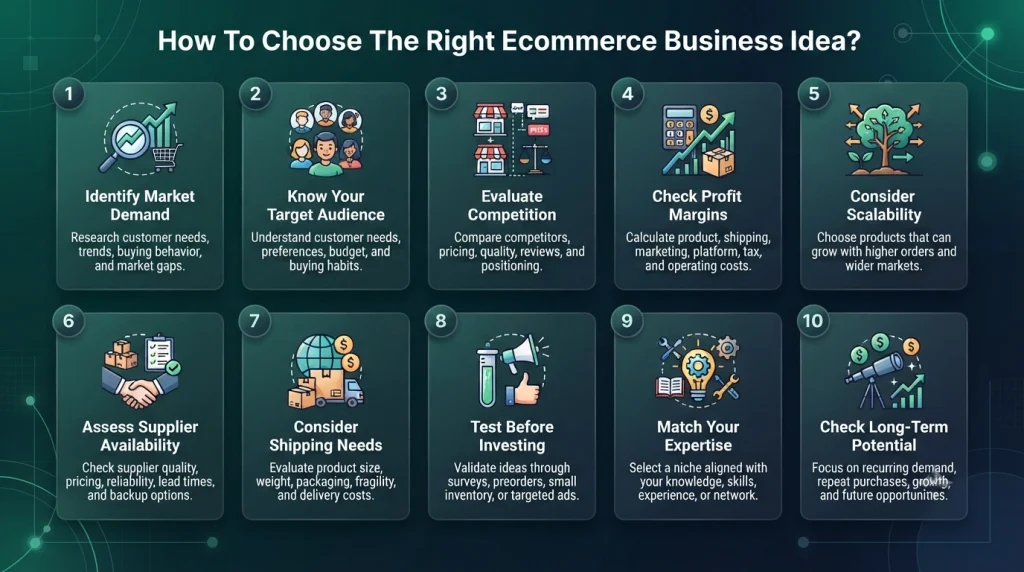
Choosing the right ecommerce idea requires more than spotting a trending product. Entrepreneurs should evaluate demand, competition, profitability, capabilities, and long-term scalability before investing capital in a franchise business.
- Identify Market Demand: Research customer problems, search trends, purchasing behavior, and market gaps to identify products with consistent demand rather than relying solely on temporary popularity.
- Analyze Your Target Audience: Define your ideal customers by demographics, needs, spending capacity, preferences, and buying behavior to develop products and marketing strategies that match expectations.
- Evaluate Competition: Study competing businesses, their pricing, product quality, customer reviews, marketing strategies, and weaknesses to identify opportunities for meaningful differentiation.
- Check Profit Margins: Calculate product costs, packaging, shipping, platform fees, marketing expenses, taxes, returns, and operational costs to determine whether the business can generate sustainable profits.
- Consider Product Scalability: Choose products that can support increasing order volumes, expanded product lines, broader geographic markets, and efficient fulfillment without creating disproportionate operational challenges.
- Assess Supplier Availability: Verify supplier reliability, minimum order quantities, product quality, lead times, pricing, and backup options before selecting an ecommerce idea dependent on external inventory.
- Consider Shipping Requirements: Evaluate product size, weight, fragility, shelf life, packaging requirements, and delivery costs because logistics can significantly influence customer satisfaction and overall profitability.
- Test Before Investing: Validate your idea through surveys, small inventory purchases, marketplace listings, preorders, or targeted advertising before committing substantial capital to the ecommerce business.
- Match Your Expertise: Select an ecommerce niche aligned with your knowledge, interests, professional experience, or network because expertise can strengthen product selection, branding, marketing, and customer support.
- Examine Long-Term Potential: Prioritize ecommerce ideas with recurring demand, expansion opportunities, repeat purchases, and evolving customer needs rather than businesses dependent entirely on short-lived trends.
Conclusion
Ecommerce is no longer simply a digital alternative to traditional retail—it is a competitive business environment where strategy, execution, and adaptability determine profitability. From choosing the right business idea and platform to managing inventory, logistics, customer acquisition, and cybersecurity, every decision can influence long-term returns. Entrepreneurs should therefore avoid chasing trends without validating demand, margins, and scalability.
A successful ecommerce business is built around a clear customer problem, differentiated value proposition, efficient operations, and disciplined use of data. As competition intensifies, sustainable growth will depend increasingly on customer retention, brand trust, technological adoption, and operational efficiency rather than sales volume alone. For business-minded entrepreneurs, ecommerce offers substantial opportunity—but the strongest returns will come from building a resilient, customer-focused, and financially sustainable business.
FAQs
Is ecommerce profitable in 2026?
Yes, but profitability depends on product margins, customer acquisition costs, operational efficiency, pricing, and repeat purchases.
What is the best ecommerce business to start?
The best idea combines strong demand, manageable competition, healthy margins, reliable suppliers, and clear opportunities for differentiation.
How much money is needed to start an ecommerce business?
Investment varies widely by business model, inventory, platform, marketing, packaging, and logistics requirements.
Which ecommerce platform is best for beginners?
Shopify is a strong option for beginners because it combines store-building, payments, inventory, analytics, and integrations in one platform.
How can an ecommerce business attract customers?
Businesses can combine SEO, social media, content marketing, paid advertising, partnerships, and referral strategies to acquire targeted customers.
What is the biggest ecommerce challenge?
Maintaining profitable growth is often the biggest challenge because rising competition, acquisition costs, returns, logistics, and customer expectations can pressure margins.