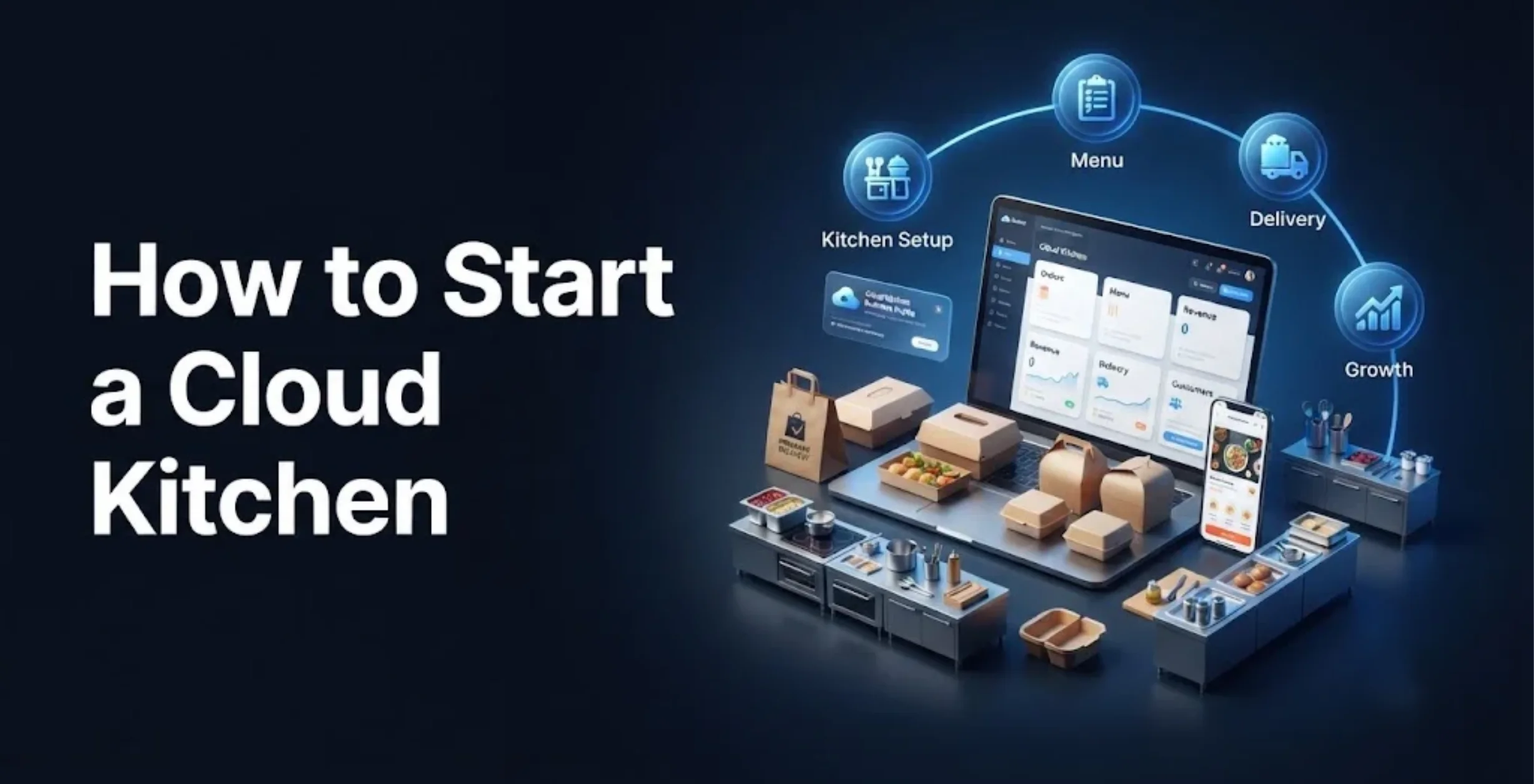
The food delivery sector is opening new opportunities for food techpreneurs looking to enter the food business without having a physical shop. How to Start a Cloud Kitchen is a useful starting point for understanding this business model, which allows you to cut down on your front-of-house costs and concentrate on your food preparation, packaging, and delivery.
IMARC Group predicts the Indian cloud kitchen market will reach USD 1.39 billion by 2026, up from USD 1.24 billion in 2025. The market is projected to grow at a CAGR of 12.28% from 2026 to 2034.
With growing demand for convenient meals, multiple food concepts, and online ordering, 2026 presents an opportunity to explore this business model. However, success depends on food quality, smart pricing, customer retention, and efficient daily operations.
What is a cloud kitchen?
A food business where the business primarily prepares food for delivery or for takeout without a sit-down dining option. They are purchasing through food delivery applications, websites, WhatsApp, or other purchasing order platforms. The kitchen is geared around preparing, packing, and delivering meals to customers.
A cloud kitchen doesn’t require a dining hall service or costly customer seats, unlike a restaurant. This might lower some setup and operating costs. One food brand can be taken, and it can be biryani, burgers, pizzas, healthy foods, or desserts.
Other companies use numerous virtual brands through a single kitchen too. The model is very useful for the apartment business, food startups, or restaurant owners who want to expand their delivery services.
Is a Cloud Kitchen Profitable in India 2026?
Yes, in 2026 it’s possible to be profitable with a cloud kitchen in India, but that’s not guaranteed. The business makes money when all the contribution made by orders exceeds their food, packaging, delivery, platform, rent, salaries, and all other expenses.
The Indian cloud kitchen market continues to grow, being supported by market research. IMARC projects a 2026 market size of USD 1.39 billion, whereas Grand View Research projects India’s market revenue to reach USD 10,945 million in 2026. The estimates vary due to differing definitions and methodologies applied by research companies.
A focused menu, repeat customers, controlled food waste, and good reviews can go to support profitability. High discounts, lack of good pricing, reliance on aggregators, and small order volumes, however, can cut profits or kill them outright.
Cloud Kitchen Investment in India 2026 Complete Cost Breakdown
The investment required to start a cloud kitchen in India depends on the city, kitchen size, cuisine, equipment, and business model. A small home-based operation may cost much less than a fully equipped commercial kitchen.
Estimated Startup Investment
| Expense | Estimated Cost |
| Kitchen rent deposit and initial rent | ₹30,000–₹1,50,000 |
| Kitchen renovation and setup | ₹50,000–₹2,00,000 |
| Cooking equipment | ₹75,000–₹2,50,000 |
| Refrigerator and storage | ₹25,000–₹80,000 |
| Utensils and small equipment | ₹15,000–₹50,000 |
| Licences and registrations | ₹5,000–₹25,000 |
| Packaging materials | ₹10,000–₹30,000 |
| Initial raw materials | ₹15,000–₹50,000 |
| Branding and menu photography | ₹10,000–₹40,000 |
| POS and technology setup | ₹5,000–₹30,000 |
| Launch marketing | ₹10,000–₹50,000 |
| Working capital reserve | ₹50,000–₹2,00,000 |
| Estimated total | ₹3 lakh–₹10.55 lakh |
Monthly Operating Expenses
| Expense | Illustrative Monthly Cost |
| Rent | ₹15,000–₹50,000 |
| Staff salaries | ₹30,000–₹1,00,000 |
| Raw materials | Depends on sales |
| Packaging | Depends on orders |
| Electricity, gas, and water | ₹8,000–₹25,000 |
| Marketing | ₹5,000–₹30,000 |
| Software and miscellaneous | ₹2,000–₹10,000 |
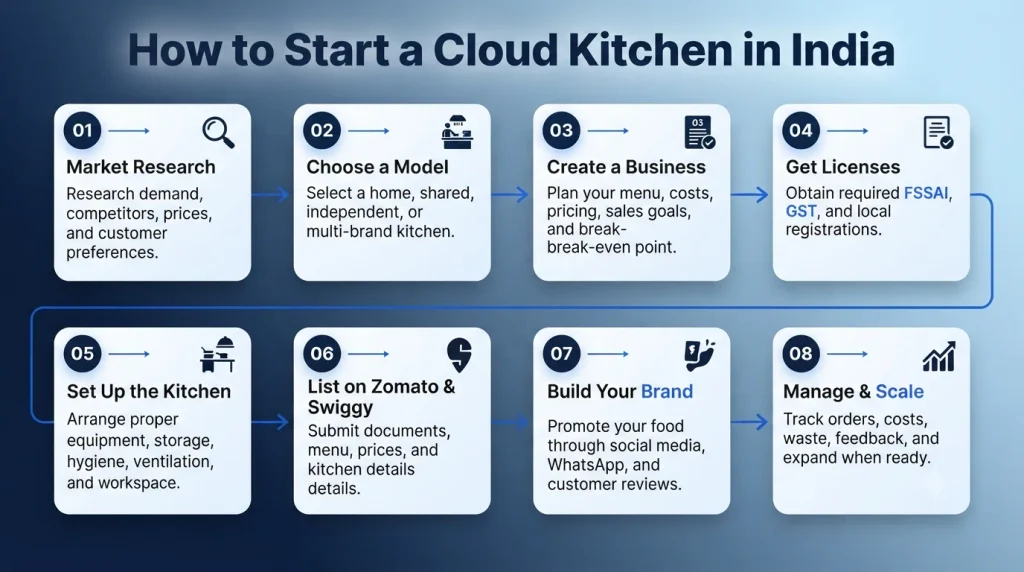
How to Start a Cloud Kitchen in India: Step-by-Step Guide
Step 1: Market Research
Research the amount of food needed for your area of investment before you invest. Look up what customers order, popular cuisine availability, average food or drink prices, the ratings of other food and beverage establishments, and delivery service times.
Identify needs like low-cost foods, nutritious foods, local foods, or foods for late-night snacking. Test your concept with a small menu/small order. By positioning yourself through research, you can decide on the right community, the cost, what to eat, and what types of customers that are best for you.
Step 2: Selecting Your Cloud Kitchen Model
Select a budget and experience an appropriate model. Choose from several options to get a culinary operation up and running, such as a home-based kitchen, a shared commercial kitchen, an independent delivery kitchen, or operating multiple virtual brands.
While there may be a lower initial cost for a home kitchen, a commercial kitchen will have more capacity and space. You will need to take into account local regulations, capacity to store, cooking equipment, and volume of orders before choosing your model.
Step 3: Develop a Business Plan
Create a basic business plan that includes your business idea, market, menu, price, competitor analysis, start-up costs, and monthly costs. Make a rough calculation of your food expenses, packaging, rent, employee wages, marketing, and platform delivery fees.
Establish attainable sales goals, and determine the break-even point. Pre-position a first few months’ cash buffer. In the absence of a clear plan, you can easily end up spending money that you can’t afford and struggling with growth.
Step 4: Collect all licenses and registrations
Fill out the business and location registrations. Typically, a food business requires an appropriate FSSAI registration or license. You will also need to register for GST and/or municipal health and/or trade obligations depending on the state, premises, and business structure. Do not open unless necessary needs are met. Maintain file, food safety documentation, and dates of renewal.
Step 5: Set Up Your Kitchen
Select a sanitary kitchen area that has an adequate water supply, drainage, ventilation, power, storage room, and waste disposal. Buy equipment based on your menu, not one and all at once. Design workspace organization for raw food, preparation, cooking, packing, and cleaning spaces. Store and keep in food-safe containers with temperature control. A functional flow minimizes movement, quickens preparation times, and ensures uniformity of food quality throughout the peak periods.
Step 6: Get listed on Zomato and Swiggy
Create business accounts on Submit any business or food license paperwork, menu, price list, bank account details, and kitchen information. Submit good pictures and descriptions of food. Review applicable commercial terms prior to taking orders.
After your listing goes live, watch the feedback from customers, the number of listings cancelled, and the amount of preparation time and order performance to make your delivery business even better.
Step 7: Build Your Brand Online
Define a recognizable food brand and have a memorable name, logo, packaging, and visual style. Connect with customers via Instagram, Google Business Profile (if applicable), WhatsApp, and any other appropriate platform.
Share pictures of food, recipes, offers, and feedback from customers. Maintain a customer base with appropriate promotions and service. Get as many honest reviews and helpful reviews/advice as possible, and not just discounts and advertising.
Step 8: Manage Operations and Scale
Monitor Orders, Revenue, Food Costs, Waste, Packaging, and Customer Complaints and Preparation Time on a daily basis. Prepare common recipes to ensure uniformity of taste and quantity of order. Train staff in handling hygiene.
Take a close look at your top sellers and consider taking out any products or dishes that frequently cause waste or cause a delay. If the first kitchen works but not optimally, try a second kitchen, sign up to cater, purchase kitchen memberships, another kitchen location, etc.
Suggested Read:
Technology Stack for Cloud Kitchen 2026 Tools
In the age of technology, How to Start a Cloud Kitchen can be made easier with digital solutions that streamline customer service and daily operations. In this era of technology, orders, inventory, payment, marketing, and customer relations are all managed in the cloud. There are tools available to help minimize manual efforts and increase visibility.
- Online Ordering Platforms: Target customers who are looking for food deliveries via Zomato & Swiggy. Target your customers looking for food delivery through Zomato and Swiggy. Discuss partner tools and order report options, along with commercial terms. Additionally, a business can use a direct ordering channel via their website or WhatsApp to strengthen customer relationships, depending on the relevant business needs.
- POS and Order Management: The critical thing for the cloud kitchen is to have a system that accepts and processes orders. There are tools like Petpooja and Restroworks that provide technology solutions for the restaurant. Some of the features that can be included are billing, menu management, kitchen order tracking, and sales reporting. See a plan and integration before making a selection.
- Inventory Management: Inventory software records such as ingredient stock, requirements, and waste. The simplest of spreadsheet applications will suffice for a small kitchen. With the rising orders, restaurant inventory software designed for the job can ensure that recipe costing and inventory management are more straightforward.
- Payments and Accounting: Process payments digitally and keep track of costs, invoices, and finances using accounts software. Some tools companies might consider include Razorpay and Zoho Books. Review any live attributes, costs, and suitability for your business.
- Marketing and Analytics: Design menus, social media, and marketing graphics with Canva. Ordering platform analytics and analytics from your own ordering platform can monitor sales, reorders, and customer activity.
Prominent Indian Cloud Kitchen Models
There are a number of businesses in India that illustrate different approaches to building a food brand that is built on delivery. While their models may be different and may not be your scale or resources, they can provide lessons for a new entrepreneur.
- Rebel Foods: Rebel Foods is famous for its several food brands with an integrated tech-based food delivery platform. Rebel Foods is famous for managing several food brands, all the way through having a technology-enabled food delivery platform. It’s well known for its brands like Faasos and Behrouz Biryani. The business illustrates how different ideas may be nurtured from delivery infrastructure. The take-home: To be a new entrepreneur is to start with a solid food concept and then expand into new brands when they are ready.
- Curefoods: There are a variety of food brands across Creating Products that Curefoods runs, such as healthy meals and other prepared foods. Strategy and multi-branding are the keys to its business, which is an example of specialized food concepts. Understand how a targeted food menu, food segment, and consistent food experience contribute to building a recognizable food brand.
- Didi’s Mealbox: An example of this is Didi’s Mealbox, in a community food enterprise initiative. PCI India’s annual report for 2024-25 stated that two supported food brands, Didi’s Mealbox and Heshel, had 25 units in Bengaluru, Delhi-NCR, Hyderabad, and Kolkata. Over the three-year period, between March 2023 and March 2025, the brands earned over ₹1.58 crore.
Challenges of Running a Cloud Kitchen in India 2026
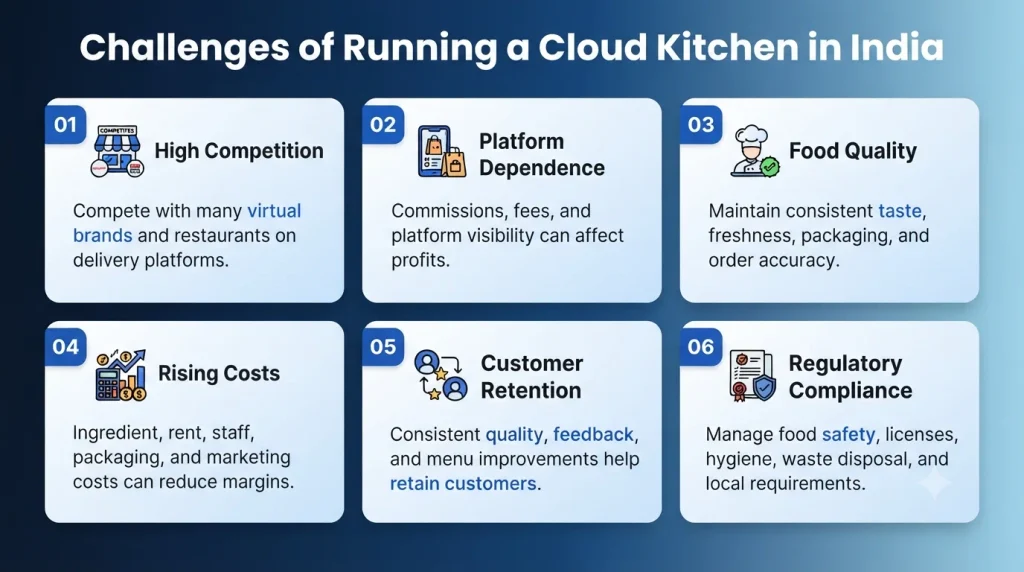
While cloud kitchens have a delivery-centric business model, they also have problems with operation, finances, and customers. Once you know about these issues, you can now plan better and prevent common mistakes that you may encounter.
- High Competition: There are numerous virtual brands and restaurants included in the list of food delivery platforms. If there’s a discount or a high rating in the other competitors’ kitchens, it may not be easy to draw in customers to your new restaurant’s kitchen. Food concept, lovable food options, reliable quality, and retaining customers are key points that can help a business gain interest.
- Reliance on delivery platforms: Platforms can offer customer reach, and their commercial terms, visibility, and promotional needs impact business economics. Adverse changes to commissions, fees, or customer acquisition costs could impact profitability. Overt channels of ordering and repeat customers can assist in scaling back dependency over time.
- Food Quality and Consistency: The food should be fresh, properly packaged, and appropriate for delivery. It could cause delays, wrong orders, leaking or inconsistent flavor, complaints, and bad reviews. Crucially, it is essential to offer standard recipes, quality checks, and appropriate packaging and staff education in order to keep consumer satisfaction.
- Rising Operating Costs: A rise in ingredient costs, rent, wages, packaging, and marketing costs can all add up to higher expenses for the business. Inadequate stock management and food waste can also cause a decrease in margins. Menu costings and comparisons of suppliers are regular to make sure spending is controlled.
- Customer Retention: A single order doesn’t mean the customer is a repeat customer. Consumers can change brands due to availability, cost, satisfaction, and/or promotions. A kitchen should measure feedback, make menu improvements where needed, and create uniformity of kitchen experience.
- Regulatory Compliance: All aspects of food safety, license, hygiene, disposal, and requirements within the local business need to be continually managed. Failure can lead to legal and/or operational risks. Important record keeping and policy review as the business expands.
Conclusion
Entrepreneurs looking to launch a food business in India in 2026, like cloud kitchens, could see How to Start a Cloud Kitchen as a great opportunity. It can cut down the requirement for standard restaurant seating and permit companies to try out different food concepts.
Building a successful kitchen doesn’t just happen, however. Market research, relevant permits, proper setup of the kitchen area, correct costing, and smart online marketing are all crucial steps. Keep the menu and stick to it, keep track of all expenditures, and track back feedback from customers.
Don’t overcommit resources without knowledge of need. As orders and operations become stable, consider expanding through new brands, catering, or additional locations. If done right, a cloud kitchen can be a sustainable food business.