Managing people shouldn’t mean drowning in endless resume piles, manual survey spreadsheets, and constant performance review chasing. Modern AI tools for HR departments strip away this administrative noise, automating routine workflows while surfacing real-time workforce insights.
From high-volume candidate screening and instant interview scheduling to continuous performance coaching and automated payroll, different platforms solve very specific HR challenges. With trending apps increasingly adding AI-powered HR features, businesses now have more options to automate workflows and improve employee experiences. This practical guide breaks down 10 leading AI HR tools, comparing their core capabilities, key integrations, verified pricing, and realistic limitations so you can quickly identify the best fit for your team.
How AI Is Changing HR Jobs And Careers?
Artificial intelligence is changing the practical daily workflows of people operations teams. Rather than replacing human practitioners, AI tools assist HR professionals by processing data faster and reducing manual overhead.
Routine administrative tasks like interview scheduling, record updates, and manual applicant tracking are increasingly automated. In recruitment, AI assists with resume analysis, initial candidate screening, and drafting job postings. For internal operations, AI sentiment analysis evaluates engagement surveys, while predictive analytics identify retention risks and support workforce planning. HR chatbots and self-service portals handle basic employee inquiries, enabling HR staff to focus on strategic initiatives.
As these technologies evolve, the skill requirements for HR careers are shifting. Successful HR professionals increasingly rely on specific capabilities:
- AI literacy: Understanding how automated software and machine learning models process workplace data.
- Data interpretation: Translating workforce analytics into clear strategic recommendations for business leaders.
- Critical thinking: Evaluating AI recommendations objectively before taking action.
- Ethical AI use: Guarding candidate and employee data while monitoring software output for potential bias.
- Human oversight: Maintaining final authority over hiring, performance evaluations, and workplace grievances.
- Communication and relationship management: Emphasising empathy, conflict resolution, and personal coaching that software cannot replicate.
Why Should HR Departments Use AI Tools?
HR teams handle high operational volumes across recruitment, onboarding, and performance tracking. Adopting AI tools for HR, including AI workflow tools that automate repetitive processes, gives professionals more time to focus on strategic initiatives and direct employee support. Key practical reasons to use AI in HR include:
- Streamlined recruitment: Manage large volumes of applicant data, automate candidate updates, and speed up initial screening workflows.
- Centralised workforce data: Unify records from multiple systems to eliminate administrative silos and reduce manual data entry.
- Smarter talent management: Track sentiment trends, support managers with structured feedback prompts, and create tailored onboarding journeys.
- Actionable workforce analytics: Cross-analyse department metrics using business intelligence tools to build accurate headcount forecasts and allocate resources effectively.
Important: AI tools exist to support HR professionals, not replace human discretion. Final hiring decisions, performance evaluations, and sensitive grievance handling must always be guided by human judgment and empathy.
Comparison Table Of Top AI Tools For HR
| AI HR Tool | Best For | AI Capabilities | Integrations | Pricing |
| Peoplebox.ai | Goal & performance tracking | Review summaries, OKRs, pulse surveys | Slack, MS Teams, Jira | $8/emp/mo |
| Workday | Enterprise core HR | Skills matching, predictive analytics | Salesforce, SAP | Contact sales |
| HireVue | High-volume video screening | Auto-scheduling, transcribing, skill tests | Workday, Greenhouse | Contact sales |
| Lattice | Continuous reviews & growth | AI review assistant, sentiment analysis | BambooHR, Rippling, Slack | $13/user/mo |
| Paradox (Olivia) | Conversational recruiting | Chat screening, auto-scheduling | Workday, SuccessFactors, iCIMS | Contact sales |
| 15Five | Manager coaching & check-ins | Review drafting, sentiment tracking | BambooHR, Slack, MS Teams | $4/emp/mo |
| Eightfold AI | Talent intelligence | Skills matching, candidate rediscovery | Workday, SuccessFactors | Contact sales |
| BambooHR | SMB core HR | Job description generation, workflows | Slack, Zapier, Greenhouse | $10/emp/mo |
| Visier | Enterprise workforce analytics | AI assistant (Vee), attrition risk | Workday, SAP, Oracle | Contact sales |
| Gusto | SMB payroll & basic HR | Automated payroll, AI policy drafting | QuickBooks, Xero, Slack | $49/mo + $6/user |
List Of 10 Best AI Tools For HR Departments
1. Peoplebox.ai
- Website: https://www.peoplebox.ai
- Best For: OKRs, performance reviews, and engagement for mid-market teams
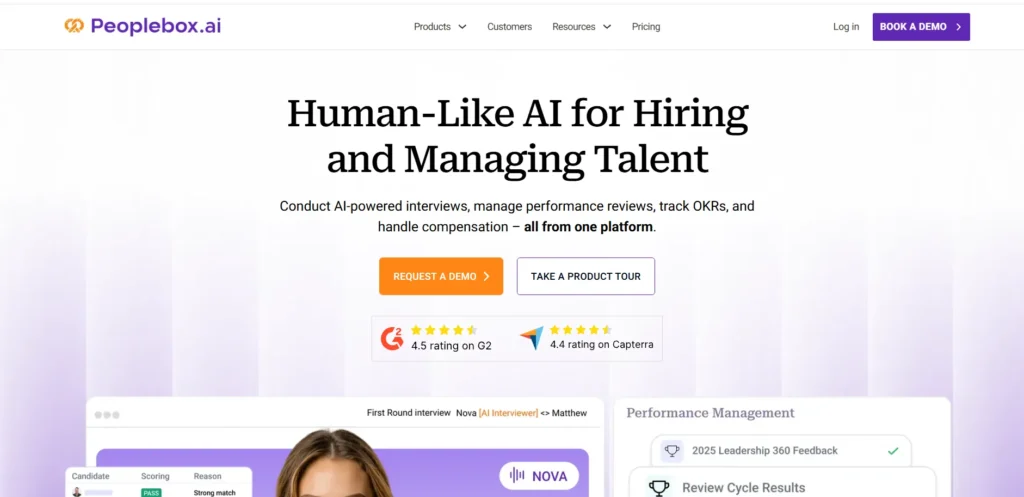
Peoplebox.ai is a broad-based AI-driven platform that transforms the HR processes through intelligent automation and data-driven insights. This new solution simplifies the recruitment activities with highly automated resume screening and candidate matching features, and also improves employee engagement with automated pulse survey and sentiment analysis.
The performance management capabilities of the platform are based on artificial intelligence that creates valuable feedback, goal progress, and actionable recommendations, which assist managers in holding more productive reviews. Peoplebox.ai provides an operational HR ecosystem, integrating smoothly into the most successful workplace applications such as Slack and Microsoft Teams, which removes data silos and improves productivity throughout the lifecycle of the entire employee.
Key Features
- AI performance summary generation
- Automated OKR goal tracking
- Native Slack integration support
- Real-time check-in performance dashboards
- Automated pulse survey analytics
Pros
- Seamless workplace tool integration
- Affordable per-user pricing options
- Fast setup implementation process
- Strong alignment on goals
Cons
- Limited reporting customisation options
- No native mobile application
- Occasional dashboard loading lags
- CSM requires higher tier
Pricing
- Demo available on request
- Performance Management: $8/emp/month
- Several add ons available
2. Workday
- Website: workday.com
- Best For: Enterprise workforce planning, core HR, and strategic talent intelligence.
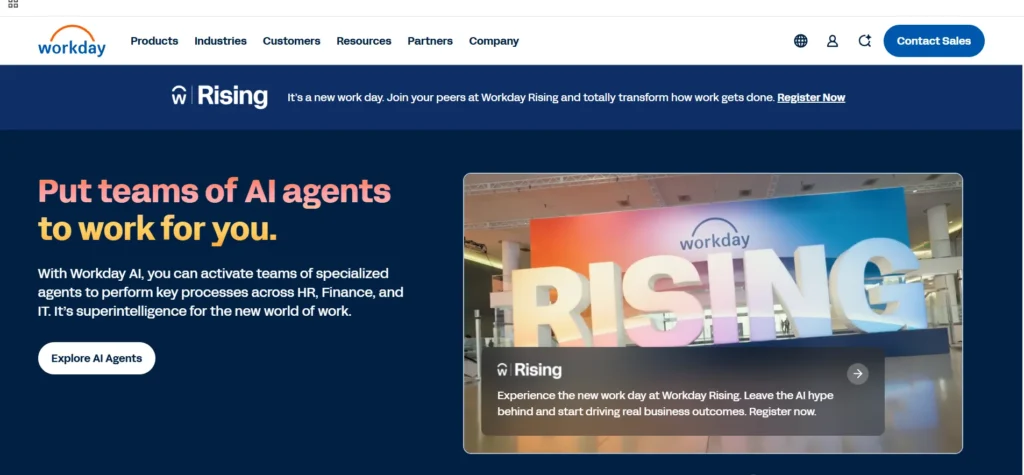
Workday is one of the top enterprise AI engines, which alters the manner in which organizations engage human resources and financial transactions via its pioneering Workday Illuminate technology just like Zoho Books alternatives. This powerful framework integrates artificial intelligence directly into the core HR operations to automatically streamline the more complicated activities, such as performance appraisal, workforce planning, and talent development, without losing the human factor at the heart of the decision-making process.
The platform uses massive quantities of organizational data to offer unmatched information on workforce tendencies, expertise gaps, and business performance. AI tools for HR departments help streamline these processes, enabling smarter insights and more efficient operations. The AI agents in Workday deal with administrative tasks that consume time, letting the HR professionals concentrate on strategic projects that can make organizations successful and their employees satisfied.
Key Features
- AI skills match engine
- Predictive workforce analytics tools
- Automated workforce process builder
- Unified global payroll system
- Generative document drafting tools
Pros
- Enterprise data security controls
- Unified core human resources
- Advanced workforce predictive modeling
- Extensive global partner network
Cons
- High total implementation cost
- Steep administrative learning curve
- Custom pricing quotes only
- Complex setup configuration steps
Pricing:
- Contacts sales for pricing.
3. HireVue
- Website: hirevue.com
- Best For: High-volume video interviewing, skills assessments, and candidate screening
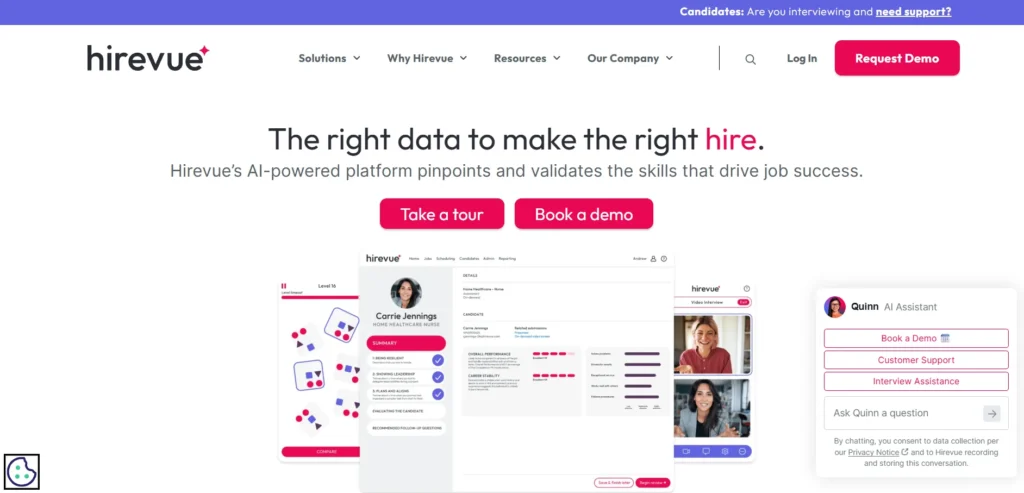
HireVue transforms the recruitment process by using innovative technologies of hiring via video interviews, which apply AI to analyze the reactions of candidates, their facial expressions, and their communication patterns to determine the fitness of the candidate according to the cultural and job characteristics. The new platform will allow organizations to carry out asynchronous video interviews, which can be self-administered by the candidate, and it will save a lot of time-to-hire and broaden the talent pool due to geographic constraints.
The AI programs also analyze thousands of data points in every interview, which gives hiring managers objective information to supplement human judgment and lessen unconscious bias. The technology of HireVue is implemented by hundreds of organizations worldwide that aim at updating their recruitment procedures and making better hiring decisions.
Key Features
- On-demand video screening tools
- Automated candidate interview scheduling
- AI video interview transcriptions
- Game-based candidate skill assessments
- Adverse impact audit reporting
Pros
- Scalable applicant volume screening
- Reduced time to hire
- Robust hiring audit tools
- Deep enterprise ATS connectivity
Cons
- High entry cost floor
- Long system implementation timeframe
- Dedicated platform administration required
- Rigid interview question templates
Pricing
- Demo available on request.
- Contacts sales for pricing.
4. Lattice
- Website: lattice.com
- Best For: Continuous performance management, career growth development, and sentiment analysis
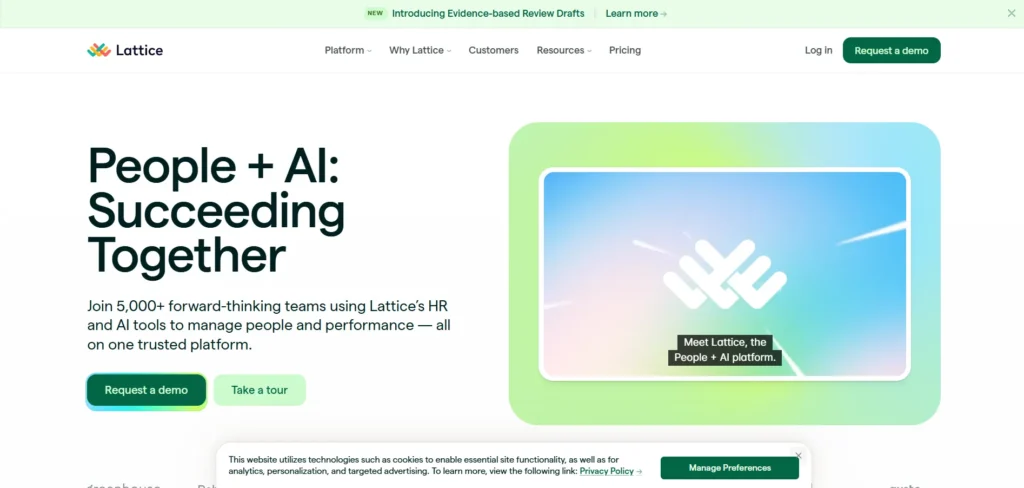
Lattice is a platform of advanced performance management with an artificial intelligence that assists organizations with the creation of high-performing cultures based on ongoing feedback, goal setting, and employee growth. AI tools for HR departments, like Lattice’s features, help managers streamline performance management and enhance employee development. Writing Assist is an AI-based feature of the platform that helps managers to write concise, practical, and unbiased performance reviews that inspire meaningful dialogue and personal development.
Lattice is a performance review that seamlessly merges with regular one-on-one meetings, engagement surveys, and career development planning, and gives a comprehensive perspective of both employee performance and satisfaction. Such an integrated mechanism allows HR specialists to observe the trends, proactively resolve problems, and develop an individual developmental strategy that would meet personal interests and the organizational goals.
Key Features
- AI review prompt suggestions
- Engagement survey sentiment tracking
- Employee competency growth mapping
- Goal and OKR tracking
- Structured agenda meeting tools
Pros
- Clean user interface design
- Modular talent management architecture
- Seamless HRIS system connectivity
- Strong employee engagement features
Cons
- High minimum annual contract
- Key modules sold separately
- Requires annual contract commitment
- Expensive for small organisations
Pricing
- Foundations plan: $13/user/mo
- Enterprise plan: custom pricing
- Demo available on request.
5. Paradox (Olivia)
- Website: paradox.ai
- Best For: Conversational recruiting, high-volume applicant screening, and interview scheduling
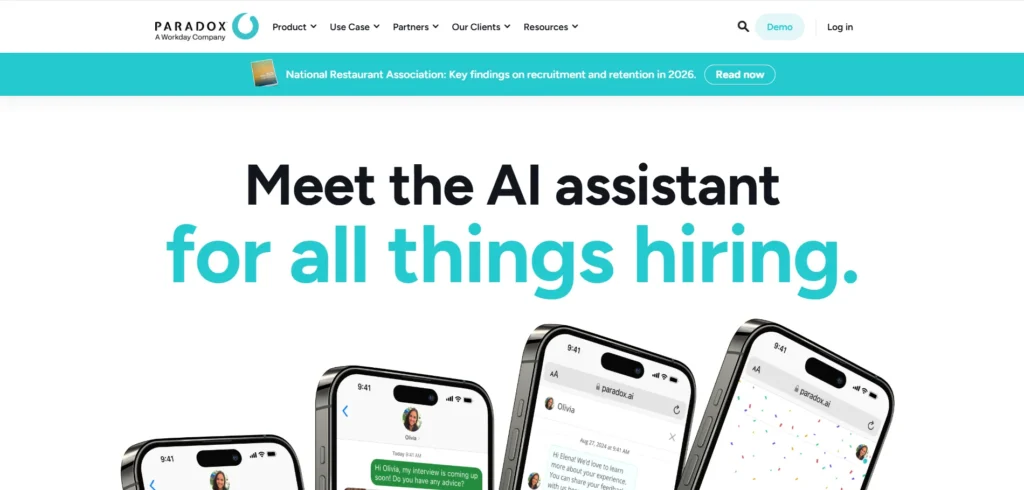
Paradox has redefined recruitment automation with Olivia, an AI-based conversational assistant that manages the engagement of candidates since their first inquiry up to the scheduling of interviews with no human involvement. This smart chatbot will be used to engage with candidates through text messaging, WhatsApp, or web chat and will respond to any questions, request application data, check availability, and schedule interviews automatically depending on the calendar of the recruiter.
Natural language processing capabilities allow Olivia to maintain human-like conversations, which provide positive candidate experiences and reduce recruiter workloads by an enormous margin. Paradox organizations have been seen to maintain a high level of application completion, time to hire, and recruitment efficiency, which is invaluable as a high-volume hiring tool.
Key Features
- Conversational SMS applicant screening
- Multi-calendar interview scheduling automation
- Multilingual candidate chat support
- Conversational career site search
- Automated recruiting event management
Pros
- Reduced time to apply
- Always-on candidate support
- Excellent mobile chat experience
- High candidate application completion
Cons
- High initial platform cost
- Enterprise focused sales model
- Custom pricing quotes required
- Unsuitable for low volume
Pricing
- Demo available on request.
- Contacts sales for pricing.
Suggested read:
6. 15Five
- Website: 15five.com
- Best For: Manager effectiveness, employee check-ins, and performance outcome tracking
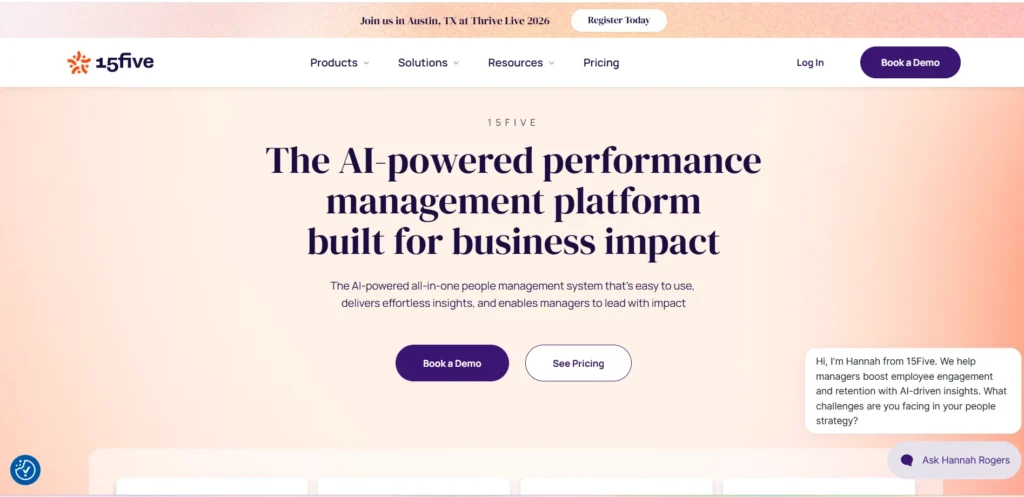
15Five is a complete performance management and employee engagement platform based on artificial intelligence principles that promotes unceasing development by using periodic check-ins, goal monitoring, and reward schemes. AI tools for HR departments like 15Five’s features help organizations align employee performance with company objectives more effectively. The AI features of the platform help to analyze the performance data in order to align individual employee goals with the larger company goals so that everyone pursues the same strategic priorities.
By performing weekly check-ins and pulse surveys, 15Five will receive real-time feedback on employee moods, workload, and challenges to respond to issues in a timely manner. The smart algorithms of the system detect the trends in the responses of the employees and offer relevant actions that can assist the HR departments to enhance the retention process, increase engagement, and make the workplace more conducive.
Key Features
- AI review draft generation
- Weekly check-in sentiment summaries
- Multi-rater performance review management
- Real-time eNPS survey tracking
- Outcome aligned goal management
Pros
- Effective manager coaching framework
- Simple weekly check-in workflow
- Clear HR outcomes dashboard
- Flexible HRIS integration support
Cons
- High multi-module plan costs
- Basic base plan capabilities
- Potentially repetitive weekly tasks
- Mobile app needs improvement
Pricing
- Free trial Available
- Engage plan: $4/employee/mo
- Perform plan: $11/employee/mo
- Total Platform plan: $16/employee/mo
7. Eightfold AI
- Website: eightfold.ai
- Best For: Talent intelligence, skills-based sourcing, and internal talent mobility.
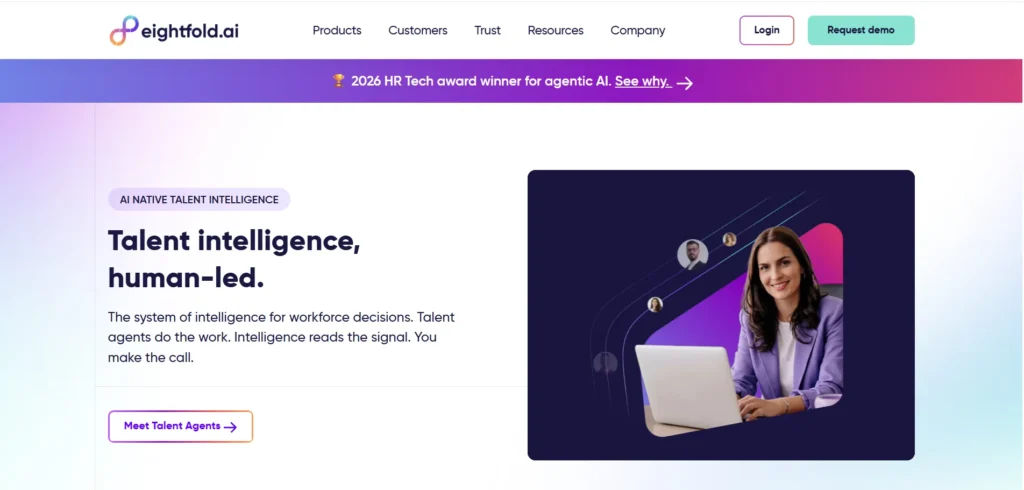
Eightfold AI is a new technology that promises talent intelligence, a domain where deep learning algorithms are used to connect employees with the most ideal career paths, suggest personalized growth strategies, and forecast the trends of the workforce with amazing precision. It is an advanced platform that examines billions of data points in resumes, job descriptions, skills tests and career histories to know the full potential of each employee and candidate.
The AI of Eightfold constantly receives updates based on the organizational hiring trends and flows of employees and improves its suggestions to minimize bias and enhance talent choices. The system is effective at recognizing internal mobility, identifying succession planning candidates, and analytics of skills gaps, making organizations utilize the talent they have effectively and make smarter decisions to remove an employee.
Key Features
- AI skills candidate matching
- Internal mobility career planning
- Diversity analytics and reporting
- Candidate talent rediscovery network
- Predictive workforce succession planning
Pros
- Extensive global skills dataset
- Highly accurate candidate matching
- Unlocks internal team mobility
- Connects with enterprise ATS
Cons
- Unsuitable for smaller organisations
- Complex system setup process
- Custom enterprise pricing only
- High data input requirements
Pricing
- Demo available on request.
- Contacts sales for pricing.
8. BambooHR

- Website: bamboohr.com
- Best For: All-in-one HR management, employee records, and HR administration for SMBs
BambooHR provides a human resources information system that is easy to use and access, and that includes the use of artificial intelligence functionalities, specifically targeting small and medium-sized businesses that want to professionalize their human resources operations. AI tools for HR departments like BambooHR streamline HR processes, making administrative tasks faster and more efficient. The platform automates many of the time-consuming administrative functions, such as employee record management, time-off, benefits management, and onboarding processes, and allows HR departments to concentrate on strategic efforts.
The AI capabilities of BambooHR help in managing the documents, workflow policies, and other self-service experiences of employees, where information can be readily accessed without compromising the accuracy of data. The system is user-friendly and has a low training requirement thus deployed quickly and adopted by both the employees and the managers.
Key Features
- AI job description generator
- Centralized employee data repository
- Applicant tracking system workflow
- Automated onboarding process checklists
- Employee eNPS sentiment surveys
Pros
- Intuitive clean user interface
- Rapid system implementation process
- Centralized core HR records
- Useful pre-built standard reporting
Cons
- Add-on modules add cost
- Limited custom workflow options
- Per-user fees scale quickly
- Basic performance management functionality
Pricing
- Free trial Available
- Core plan: Starts at $10/employee/mo
- Pro plan: Starts at $17/employee/mo
- Elite plan: Starts at $25/employee/mo
9. Visier
- Website: viser.com
- Best For: People analytics, workforce cost planning, and generative AI insights
Visier is one of the leading people analytics tools that utilizes artificial intelligence to convert raw workforce information into strategic implications that help make informed business decisions. This is an effective solution that brings together data from various HR systems, payroll systems, and business applications to formulate a whole picture of workforce, cost, and performance measures.
The predictive analytics feature of Visier predicts the future workforce requirement, points at areas where the organization may face retention risks, and models the effect of various HR efforts prior to their implementation. The visualizations and ready analytics templates allow the HR leader to respond to complex questions about the workforce in a few seconds, prove the business contribution of HR, and provide evidence-based suggestions to executive management, using the platform.
Key Features
- Conversational AI analytics assistant
- Predictive attrition risk modeling
- Total workforce cost planning
- Global industry workforce benchmarking
- Multi-source data engine consolidation
Pros
- Deep workforce intelligence insights
- Plain language query support
- Pre-built data model architecture
- Strict enterprise security controls
Cons
- Complex technical implementation process
- Strict source data requirements
- Custom quote pricing model
- High technical support dependency
Pricing
- Demo available on request
- Contact sales for pricing.
10. Gusto
- Website: https://www.gusto.com
- Best For: Small business payroll, automated benefits administration, and basic HR workflows
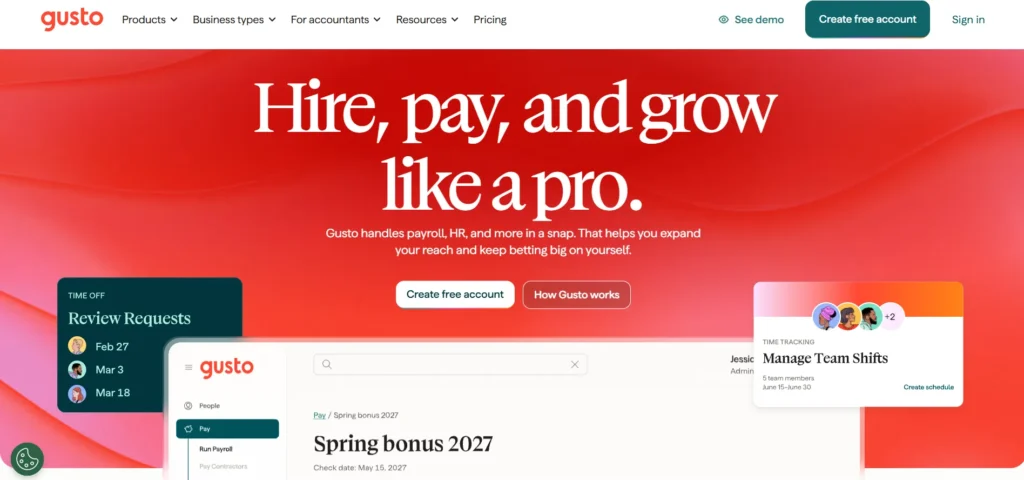
Gusto offers a payroll, benefits, and HR management platform with artificial intelligence, making it easier to perform complicated administrative tasks for small and medium-sized businesses. AI tools for HR departments like Gusto help streamline payroll and benefits management while ensuring compliance and efficiency. The AI features of the system give personalized recommendations that are personalized to the employee on the basis of demographics and preferences, of an employee and also automate compliance monitoring to keep employees in line with federal and state regulations.
Gusto also automates payroll processing, filing taxes, time tracking, and benefits administration with an easy-to-use interface and minimal human resource skills. The smart algorithms of the platform identify possible mistakes, offer the best benefit packages, and offer insights on the compensation competitiveness to help growing companies provide the full range of HR services without having to develop bulky HR departments.
Key Features
- Full automated payroll processing
- Automated health benefits administration
- AI policy draft generation
- Employee self-service onboarding portal
- Automated time tracking software
Pros
- Simple payroll management interface
- Predictable transparent monthly pricing
- Automated tax filing compliance
- Quick employee self-onboarding process
Cons
- Limited enterprise HR capabilities
- Add-on features increase price
- Processing delays for deposit
- Entry plan lacks time-tracking
Pricing
- Simple plan: $49/mo base + $6/employee/mo
- Plus plan: $80/mo base + $12/employee/mo
- Premium plan: $180/mo base + $22/employee/mo
- Contractor Only plan: $35/mo base + $6/contractor/mo
Key Features To Look For In AI HR Tools
Selecting HR software requires matching core capabilities against your department’s workflows. Focus on these essential features to ensure the tool directly supports your business goals.
- Workflow Automation and Analytics: The software should eliminate repetitive administrative tasks like interview scheduling while providing predictive data models for headcount, turnover risk, and future skill gaps.
- Comprehensive Talent Management: Look for AI capabilities that support the full employee lifecycle, including automated candidate screening, ongoing engagement sentiment analysis, and AI-assisted performance reviews.
- System Integrations and Scalability: Ensure your HRIS, ATS, and communication tools integrate smoothly, while vendor management tools can help coordinate external recruiters, payroll providers, and benefits partners.
- Data Security and AI Transparency: Vendors must protect sensitive employee records with strict compliance standards like GDPR. Furthermore, transparent AI models ensure HR professionals retain final authority over critical employment decisions.
How To Choose The Right AI Tool For HR Department?
Selecting the right AI platform requires matching software capabilities directly with your department’s specific operational bottlenecks. Following a structured evaluation process prevents overspending on unnecessary features and ensures smooth team adoption.
- Define your core needs: Pinpoint whether your main bottleneck is applicant screening, performance tracking, or payroll, and focus on platforms that offer genuine analytical AI rather than basic template automation.
- Verify technical compatibility and security: Ensure the software integrates natively with your existing ATS and HRIS platforms while verifying that vendor data privacy controls protect sensitive employee records.
- Calculate total cost and scalability: Look beyond base subscription fees to include implementation, setup, and add-on module costs, while confirming the platform can scale as your team grows.
- Test usability and vendor support: Request a live demo or sandbox trial to evaluate ease of use for managers and verify available technical support tiers before signing a contract.
Challenges Of Using AI In HR Departments
Integrating automated systems into human resource workflows offers clear operational benefits, but departments must address notable risks during implementation.
- Data Privacy and Compliance: HR departments store highly sensitive employee, financial, and personal details. Storing candidate information or employee check-ins in vendor systems creates regulatory risks, especially as employment laws surrounding AI usage, hiring consent, and data protection change rapidly.
- Algorithmic Bias and Fairness: AI algorithms trained on historical hiring data can unintentionally preserve past organizational biases. HR teams must audit software vendor methodologies continuously to prevent adverse impacts on applicant screening and ensure fair hiring outcomes.
- Lack of Human Judgment: Software tools evaluate numerical patterns and text strings but lack context regarding interpersonal dynamics or personal hardship. Over-reliance on automated recommendations for promotions or terminations can lead to poor employment outcomes. Software metrics should serve as supporting evidence, not final verdicts.
- Transparency and Explainability: Some complex machine learning models act as opaque systems. This lack of visibility makes it difficult for HR professionals to explain why a candidate was ranked lower or why an employee was flagged as a retention risk.
- Employee Trust: Staff may feel uncomfortable if they suspect AI is monitoring their communication sentiment or evaluating their performance without human intervention. Transparent communication regarding exactly how software is used is essential to maintain workplace trust.
- Implementation and Integration Costs: Connecting modern AI tools with legacy HR databases often requires custom technical development and ongoing IT maintenance. Enterprise platforms frequently involve high setup fees and administrative overhead that easily exceed base subscription costs.
Conclusion
AI transforms modern HR by replacing routine administrative tasks with automated workflows and actionable workforce data. To maximize return on investment, HR leaders must recommend AI tools for HR departments tailored to specific operational bottlenecks, such as adopting Paradox for high-volume recruiting or implementing Lattice and Peoplebox.ai for performance tracking and employee retention.
Before committing, teams should conduct sandbox trials to verify seamless HRIS integration, strict data privacy compliance, and true ownership costs. Most importantly, HR leadership must enforce clear governance, keeping human professionals at the center and ensuring AI insights inform rather than replace human judgment, empathy, and ethical decision-making.
FAQs
1. How Is AI Used In HR Departments?
AI supports the entire employee lifecycle, from screening applications and scheduling interviews to summarizing performance feedback and identifying retention risks.
2. What Is The Best AI Tool For HR?
It depends on your specific needs. For instance, Paradox excels at conversational recruiting, Lattice leads in performance management, and Visier is top-tier for workforce analytics.
3. Can AI Replace HR Professionals?
No. AI automates admin tasks and data processing, but human judgment, empathy, and strategic thinking remain essential for final decisions, conflict resolution, and employee development.
4. How Can AI Help With Recruitment?
It accelerates hiring by automatically screening resumes, matching applicant skills, answering candidate questions 24/7, and coordinating interview schedules.
5. Are AI HR Tools Safe To Use With Employee Data?
Generally, yes. Most enterprise platforms enforce strict encryption and GDPR/SOC 2 compliance, though HR teams must always verify vendor privacy policies regarding how data is stored.
6. How Much Do AI HR Tools Cost?
Prices vary widely by platform and company size. Basic plans start around $4–$13 per user/month, while enterprise-grade systems can require custom contracts costing tens of thousands annually.
7. What Should HR Departments Consider Before Adopting AI?
Identify core operational bottlenecks, confirm integrations with your existing HRIS/ATS, verify data security standards, evaluate total costs, and establish human oversight protocols for AI outputs.