

Gujarat has long been one of India’s strongest states for entrepreneurship, manufacturing, exports, and small businesses. Its advantage comes from a combination of industrial clusters, ports, strong road connectivity, established supplier networks, and a business-friendly ecosystem. The state has major strengths in chemicals, pharmaceuticals, textiles, engineering, gems and jewellery, food processing, dairy, and automobiles. It is also developing newer sectors such as semiconductors, electronics, renewable energy, biotechnology, and green manufacturing.
The scale of Gujarat’s economy also creates opportunities for smaller businesses. Gujarat’s GSDP at current prices is estimated at ₹33.24 trillion for FY2027, while the secondary sector contributed 42.87% of the state’s GSDP in 2025-26. The state also had more than 4.5 lakh MSMEs according to the latest state-level industry data compiled by IBEF. This combination of manufacturing and MSME activity creates demand for suppliers, service providers, distributors, logistics companies, food businesses, and specialised local businesses.
This does not mean that every business will automatically succeed in Gujarat. Competition can be strong, particularly in established markets such as textiles, trading, food, and jewellery. The better approach is to identify a specific customer group and solve a clear problem for them. The following business ideas in Gujarat have been selected around sectors where the state already has strong infrastructure, customer demand, or growing investment.
Why Start A Business In Gujarat In 2026?
Gujarat has a strong combination of industrial infrastructure, ports, highways, skilled workers, established supply chains, and government support. The state has a coastline of around 1,600 km and major ports such as Mundra, Kandla, and Dahej, which support manufacturing, logistics, and exports. Gujarat also has major industrial clusters covering chemicals, pharmaceuticals, textiles, engineering, automobiles, food processing, and gems and jewellery.
The state also has a growing startup and MSME ecosystem. Its industrial base makes it easier for new businesses to find suppliers, manufacturers, distributors, skilled workers, and B2B customers. Gujarat’s FY2027 GSDP is estimated at around ₹33.24 trillion, showing the scale of its overall economy and business activity.
Government support is another important advantage. Entrepreneurs can explore schemes such as PMEGP, Aatmanirbhar Gujarat, Gujarat Startup support, MSME incentives, textile-related incentives, and sector-specific assistance. However, eligibility, investment limits, and subsidy conditions vary by business type, location, and entrepreneur category.
List Of 20 Best Business Ideas In Gujarat
A. Manufacturing & Industrial Business Ideas

1. Industrial Packaging Manufacturing
Industrial packaging is a practical business opportunity because Gujarat has a large manufacturing base across chemicals, pharmaceuticals, food processing, engineering, textiles, and automobiles. Businesses in these sectors regularly need corrugated boxes, plastic packaging, pallets, protective packaging, drums, and customised packaging materials. An entrepreneur can begin with one product category and gradually expand. Ahmedabad and Vadodara are particularly suitable because of their large industrial clusters. The business can also target smaller manufacturers that prefer local suppliers for faster delivery and customised packaging rather than depending entirely on large packaging companies.
Investment Required
- Small-scale setup: ₹5 lakh–₹15 lakh
- Medium-scale setup: ₹15 lakh–₹40 lakh
Profit Potential
- Indicative net profit margin: 10%–20%
- Profit can increase with long-term B2B contracts and bulk orders.
Skills Required
- Basic manufacturing and production knowledge
- Supplier and inventory management
- B2B sales and negotiation
- Quality control
- Cost calculation and pricing
How to Start
- Identify one packaging category with strong local demand.
- Find reliable raw material suppliers and machinery vendors.
- Register the business and complete applicable GST and Udyam requirements.
- Start with a small production facility and limited machinery.
- Approach local manufacturers, wholesalers, and industrial distributors.
Tips to Make It Profitable
- Focus on recurring B2B customers rather than one-time orders.
- Offer customised sizes and packaging designs.
- Keep wastage of raw materials under control.
- Provide reliable delivery timelines.
- Gradually add eco-friendly packaging options.
Best City in Gujarat: Ahmedabad, Vadodara, Rajkot
Government Scheme Applicable: Aatmanirbhar Gujarat MSME incentives, PMEGP, CGTMSE-linked credit support
2. Auto Component Manufacturing
Gujarat has developed into an important automobile and engineering manufacturing hub, particularly around Ahmedabad, Sanand, Vadodara, and Rajkot. The presence of major automobile manufacturers and their supplier networks creates opportunities for businesses producing smaller components. Entrepreneurs can manufacture items such as brackets, fasteners, metal parts, rubber components, wiring-related parts, or fabricated components. Instead of trying to supply large automobile companies immediately, a new business can begin by supplying Tier-2 and Tier-3 suppliers and gradually build its quality certifications and production capacity.
Investment Required
- Small unit: ₹15 lakh–₹40 lakh
- More specialised manufacturing: ₹40 lakh–₹1 crore+
Profit Potential
- Indicative net profit margin: 8%–18%
- Higher margins are possible for specialised or precision components.
Skills Required
- Mechanical or production knowledge
- Quality control
- CAD or technical drawing knowledge
- Vendor management
- B2B relationship management
How to Start
- Research components with consistent demand.
- Identify automobile suppliers in Sanand and nearby industrial areas.
- Decide whether to manufacture or outsource specialised processes.
- Invest in appropriate machinery and testing equipment.
- Start with smaller supplier contracts before approaching larger buyers.
Tips to Make It Profitable
- Maintain strict quality standards.
- Reduce production defects and material wastage.
- Build relationships with multiple automobile suppliers.
- Invest in precision machinery as orders increase.
- Obtain relevant quality certifications when required.
Best City in Gujarat: Sanand, Ahmedabad, Rajkot
Government Scheme Applicable: Aatmanirbhar Gujarat incentives and manufacturing-sector support
3. Engineering Fabrication Business
Engineering fabrication is suitable for Gujarat because of the state’s large manufacturing, construction, automobile, chemical, and industrial sectors. A fabrication business can manufacture or customise metal structures, machine parts, frames, storage systems, industrial platforms, gates, racks, and other components. Rajkot has a particularly strong engineering ecosystem, while Ahmedabad and Vadodara provide access to large industrial customers. Entrepreneurs can start with welding, cutting, drilling, and basic fabrication equipment before investing in advanced machinery. The business can become more profitable by specialising in customised industrial orders instead of competing only on standard products.
Investment Required
- Small workshop: ₹5 lakh–₹15 lakh
- Medium-scale setup: ₹15 lakh–₹35 lakh
Profit Potential
- Indicative net profit margin: 12%–25%
- Custom fabrication can offer better margins than standard products.
Skills Required
- Welding and fabrication knowledge
- Reading technical drawings
- Material selection
- Production planning
- Quality inspection
How to Start
- Select the type of fabrication work you want to specialise in.
- Rent a workshop close to industrial customers.
- Purchase basic fabrication machinery.
- Hire skilled workers where necessary.
- Approach factories, contractors, and engineering companies.
Tips to Make It Profitable
- Specialise in high-demand industrial products.
- Reduce material wastage through accurate measurements.
- Quote customised projects carefully.
- Maintain fast turnaround times.
- Build long-term contracts with industrial clients.
Best City in Gujarat: Rajkot, Ahmedabad, Vadodara
Government Scheme Applicable: PMEGP and Aatmanirbhar Gujarat MSME support
4. Solar Equipment and Installation Services
Solar energy is one of the emerging business opportunities in Gujarat because of the state’s strong renewable-energy ecosystem and high demand from homes, farms, commercial buildings, and industries. A new entrepreneur does not necessarily need to build a solar farm. Smaller businesses can focus on rooftop solar installation, solar equipment distribution, maintenance, system design, or project coordination. Gujarat’s renewable-energy ecosystem and industrial customer base provide opportunities for both B2C and B2B businesses. Entrepreneurs with technical knowledge can gradually move from installation services into larger commercial and industrial projects.
Investment Required
- Solar dealership: ₹5 lakh–₹15 lakh
- Installation business: ₹10 lakh–₹30 lakh
Profit Potential
- Indicative service margin: 10%–20%
- Installation, maintenance, and AMC services can create recurring revenue.
Skills Required
- Basic electrical knowledge
- Solar system design
- Installation and maintenance
- Sales and customer service
- Knowledge of applicable regulations
How to Start
- Learn the basics of rooftop solar systems.
- Partner with established solar equipment manufacturers.
- Register the required business and electrical certifications.
- Start with residential and small commercial installations.
- Build a portfolio before targeting industrial clients.
Tips to Make It Profitable
- Focus on complete installation packages.
- Offer annual maintenance contracts.
- Target commercial buildings and factories.
- Build partnerships with builders and electricians.
- Keep up with changes in solar policies and technology.
Best City in Gujarat: Ahmedabad, Surat, Rajkot
Government Scheme Applicable: Gujarat renewable energy policies and applicable solar incentives
B. Food, Agriculture & Agro-Processing Business Ideas
5. Spice Processing and Packaging
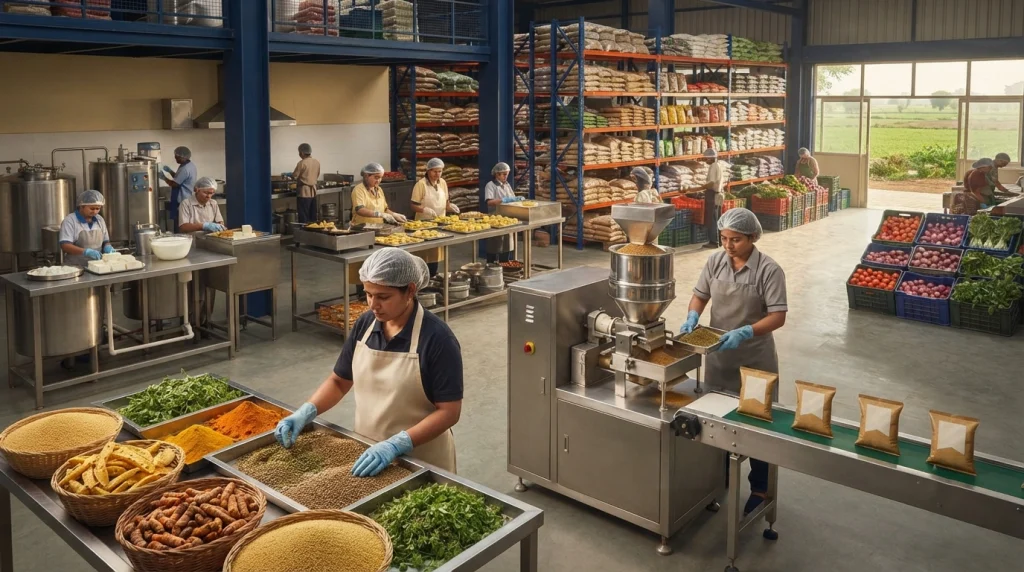
Spice processing is a practical business opportunity because Gujarat has strong agricultural production and an established trading ecosystem. Entrepreneurs can source cumin, coriander, fennel, turmeric, chilli, and other spices and sell them as whole spices, powders, or blended masalas. A small unit can begin with cleaning, grinding, blending, and packaging before expanding into branded retail products. Businesses can sell through local grocery stores, supermarkets, restaurants, online marketplaces, and their own websites. Creating Gujarati-specific blends such as dhana-jeera can also help the business develop a clear local identity.
Investment Required
- Small setup: ₹3 lakh–₹8 lakh
- Medium setup: ₹8 lakh–₹20 lakh
Profit Potential
- Indicative net profit margin: 10%–25%
- Premium and branded products can generate higher margins.
Skills Required
- Food processing knowledge
- Quality control
- Packaging and labelling
- Basic marketing
- Supplier management
How to Start
- Select two or three products initially.
- Find reliable farmers or wholesale suppliers.
- Purchase basic grinding and packaging equipment.
- Complete FSSAI and other applicable registrations.
- Test the products through local stores and online channels.
Tips to Make It Profitable
- Focus on consistent taste and quality.
- Use attractive and practical packaging.
- Create smaller trial-size packs.
- Build a strong local retail network.
- Develop premium or specialised spice blends.
Best City in Gujarat: Rajkot, Ahmedabad, Unjha
Government Scheme Applicable: PMFME and applicable MSME support
6. Dairy Product Business
Gujarat has one of India’s strongest dairy ecosystems, making dairy products a natural business opportunity in the state. Instead of competing directly in the packaged milk market, entrepreneurs can focus on value-added products such as paneer, ghee, flavoured yoghurt, lassi, buttermilk, sweets, and traditional dairy products. Anand and surrounding areas offer access to dairy suppliers and an established milk-processing ecosystem. A small entrepreneur can begin with a low investment business model and gradually expand into restaurants, hotels, supermarkets, and online sales.
Investment Required
- Small dairy processing setup: ₹5 lakh–₹15 lakh
- Larger processing operation: ₹15 lakh–₹40 lakh+
Profit Potential
- Indicative net profit margin: 10%–20%
- Value-added products can offer better margins than selling raw milk.
Skills Required
- Dairy processing
- Food safety
- Quality control
- Packaging
- Distribution management
How to Start
- Select one or two dairy products.
- Identify reliable milk suppliers.
- Set up a hygienic processing facility.
- Complete required food-related registrations.
- Test products with local retailers and consumers.
Tips to Make It Profitable
- Focus on value-added products.
- Maintain strict hygiene standards.
- Build a reliable cold-chain system.
- Sell directly to local customers where possible.
- Create a recognisable regional brand.
Best City in Gujarat: Anand, Mehsana, Rajkot
Government Scheme Applicable: Dairy and food-processing support schemes, PMFME where applicable
7. Ready-to-Eat Gujarati Food Brand
Gujarati food has a strong identity across India, creating an opportunity for entrepreneurs to build a packaged food brand around traditional recipes. Products can include khakhra, thepla, fafda, gathiya, dry snacks, ready-to-cook mixes, farsan, pickles, and regional sweets. The business can begin with a small product range and sell locally as a business for housewives before moving to online marketplaces and other cities. Shelf-stable products are particularly useful because they are easier to transport. Good packaging, consistent taste, hygiene, and a strong brand story can help a new business compete with established food brands.
Investment Required
- Home or small-scale setup: ₹2 lakh–₹7 lakh
- Commercial setup: ₹7 lakh–₹20 lakh
Profit Potential
- Indicative net profit margin: 15%–30%
- Premium packaged products can offer stronger margins.
Skills Required
- Food preparation
- Recipe standardisation
- Packaging
- Branding
- Inventory management
How to Start
- Select products with good shelf life.
- Standardise recipes and portion sizes.
- Set up a hygienic production area.
- Complete required food registrations.
- Test the products with local customers.
Tips to Make It Profitable
- Start with products that are easy to transport.
- Sell combo packs to increase order value.
- Use regional storytelling in branding.
- Explore corporate gifting.
- Expand into online marketplaces after establishing local demand.
Best City in Gujarat: Ahmedabad, Surat, Vadodara
Government Scheme Applicable: PMFME and applicable food-processing MSME schemes
8. Fruit and Vegetable Processing
Fruit and vegetable processing can help entrepreneurs convert agricultural produce into products with longer shelf life. Depending on the local supply chain, a business can produce fruit pulp, juices, dehydrated vegetables, pickles, sauces, purees, or frozen products. Gujarat’s agricultural and food-processing ecosystem provides access to raw materials and potential B2B customers. Restaurants, hotels, food manufacturers, retailers, and wholesalers can all become customers. Starting with one product and a limited production capacity can reduce initial risk before expanding into multiple processed food categories.
Investment Required
- Small unit: ₹5 lakh–₹15 lakh
- Medium unit: ₹15 lakh–₹40 lakh
Profit Potential
- Indicative net profit margin: 10%–20%
- Value-added products can provide better margins.
Skills Required
- Food processing
- Quality control
- Packaging
- Procurement
- Distribution
How to Start
- Identify locally available fruits or vegetables.
- Select a product with a longer shelf life.
- Arrange suitable processing equipment.
- Complete applicable food registrations.
- Build B2B relationships with retailers and food businesses.
Tips to Make It Profitable
- Buy raw materials during favourable seasonal periods.
- Reduce processing waste.
- Focus on products with repeat demand.
- Develop institutional customers.
- Use attractive, durable packaging.
Best City in Gujarat: Anand, Surat, Rajkot
Government Scheme Applicable: PMFME and applicable food-processing incentives
C. Textile, Fashion & Handicraft Business Ideas
9. Garment Manufacturing
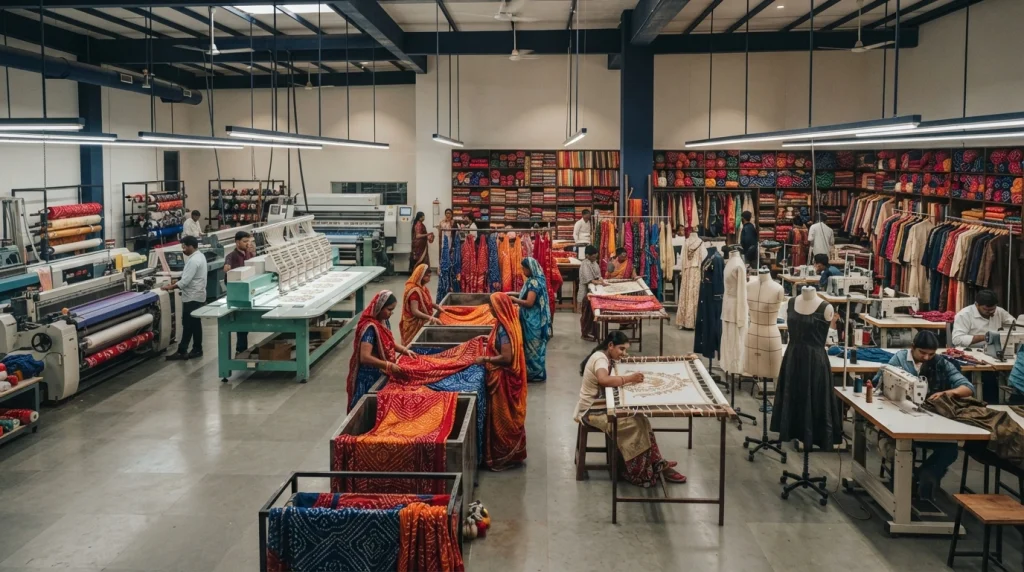
Garment manufacturing is one of the most practical manufacturing opportunities in Gujarat because the state has a large textile ecosystem. Surat is particularly strong in synthetic textiles and garment-related activities, while Ahmedabad has an established textile and apparel ecosystem. A new business can manufacture uniforms, kurtis, ethnic wear, children’s clothing, workwear, or private-label fashion products. Entrepreneurs can start with a small production team and outsource specialised processes such as embroidery or printing. Selling directly to brands and retailers can provide more stable orders than relying only on wholesale business markets.
Investment Required
- Small unit: ₹8 lakh–₹20 lakh
- Medium unit: ₹20 lakh–₹50 lakh+
Profit Potential
- Indicative net profit margin: 10%–20%
- Private-label and specialised garments can offer better margins.
Skills Required
- Garment production
- Fabric sourcing
- Fashion and product development
- Quality control
- B2B sales
How to Start
- Select a specific garment category.
- Find reliable fabric and accessory suppliers.
- Purchase sewing and finishing equipment.
- Hire skilled tailors and production workers.
- Approach boutiques, brands, retailers, and uniform buyers.
Tips to Make It Profitable
- Focus on a specific customer segment.
- Reduce fabric wastage.
- Accept private-label manufacturing orders.
- Maintain consistent sizing and quality.
- Add online B2C sales after establishing production.
Best City in Gujarat: Surat, Ahmedabad
Government Scheme Applicable: Gujarat textile-sector support and PM MITRA-related opportunities
10. Textile Printing and Embroidery
Textile printing and embroidery services can benefit from Gujarat’s extensive textile manufacturing ecosystem. Rather than producing complete garments, entrepreneurs can provide specialised services to garment manufacturers, boutiques, fashion labels, wholesalers, and exporters. Digital printing, screen printing, embroidery, sequins, and customised designs can be offered depending on the machinery available. Surat is especially suitable because of its large fabric and synthetic textile ecosystem. The business can begin with one specialised service and add other services as the customer base grows.
Investment Required
- Small setup: ₹5 lakh–₹15 lakh
- Advanced setup: ₹15 lakh–₹40 lakh+
Profit Potential
- Indicative net profit margin: 12%–25%
- Customised and premium work can generate higher margins.
Skills Required
- Textile printing knowledge
- Embroidery or machine operation
- Design understanding
- Quality control
- Customer coordination
How to Start
- Choose a specific textile service.
- Purchase suitable machinery.
- Develop sample designs.
- Approach local garment and textile businesses.
- Build relationships with designers and manufacturers.
Tips to Make It Profitable
- Offer quick turnaround.
- Keep sample books ready for customers.
- Invest in modern designs.
- Accept small as well as bulk orders.
- Build recurring relationships with garment manufacturers.
Best City in Gujarat: Surat, Ahmedabad
Government Scheme Applicable: Gujarat textile incentives and applicable MSME support
11. Bandhani and Traditional Textile Brand
Bandhani, traditional embroidery, Patola-inspired products, and other Gujarati textiles provide an opportunity to build a specialised fashion or handicraft business brand.. Instead of manufacturing everything internally, entrepreneurs can work with skilled artisans and focus on product selection, quality control, branding, packaging, and online sales. This model can operate with comparatively lower fixed costs than a conventional manufacturing business. Products can be sold through Instagram, websites, marketplaces, ecommerce business channels, exhibitions, boutiques, and corporate gifting. Authenticity and storytelling are particularly important because customers often buy traditional textiles for their cultural and handmade value.
Investment Required
- Home-based model: ₹1 lakh–₹5 lakh
- Small brand setup: ₹5 lakh–₹15 lakh
Profit Potential
- Indicative gross margin: 25%–50%
- Premium positioning can generate stronger margins.
Skills Required
- Product curation
- Textile knowledge
- Branding
- Digital marketing
- Artisan management
How to Start
- Identify reliable artisan groups.
- Select a focused product range.
- Develop a brand identity.
- Create professional product photographs.
- Start selling through social media and online channels.
Tips to Make It Profitable
- Clearly communicate the origin of products.
- Use premium packaging.
- Offer limited collections.
- Target customers outside Gujarat.
- Build a strong online presence.
Best City in Gujarat: Jamnagar, Kutch, Ahmedabad
Government Scheme Applicable: Applicable handicraft, textile, MSME and artisan-support schemes
12. Textile Waste Recycling
Textile waste recycling is becoming increasingly relevant in a state with a large textile manufacturing base. Businesses can collect fabric scraps, rejected materials, yarn waste, and other textile leftovers and sell sorted or processed material to recyclers and manufacturers. With additional investment, entrepreneurs can produce recycled fibres, wiping cloths, insulation material, or other textile-based products. Surat offers a strong opportunity because of its large textile ecosystem. The key to profitability is maintaining a reliable supply of waste material and finding buyers before investing heavily in processing machinery.
Investment Required
- Collection and sorting model: ₹5 lakh–₹15 lakh
- Processing unit: ₹15 lakh–₹50 lakh+
Profit Potential
- Indicative net profit margin: 10%–20%
- Profitability depends heavily on sourcing costs and recycling technology.
Skills Required
- Waste sorting
- Textile knowledge
- Supply-chain management
- Recycling processes
- B2B sales
How to Start
- Identify textile units generating regular waste.
- Start with collection and sorting.
- Find buyers for different waste categories.
- Establish a small processing unit if demand supports it.
- Gradually invest in recycling machinery.
Tips to Make It Profitable
- Secure regular waste-supply contracts.
- Separate waste carefully by material type.
- Build multiple buyer relationships.
- Reduce transportation costs.
- Explore higher-value recycled products.
Best City in Gujarat: Surat, Ahmedabad
Government Scheme Applicable: Gujarat MSME incentives and applicable sustainability-related support
D. Logistics, Tourism & Service Business Ideas

13. B2B Logistics and Transportation
Gujarat’s industrial clusters, ports, manufacturing units, e-commerce businesses, and trading companies create consistent demand for transport business services. Entrepreneurs can begin with an asset-light model by coordinating third-party vehicles instead of purchasing a large fleet. Services can include full truckload, part truckload, local transportation, factory-to-warehouse movement, and last-mile B2B delivery. Ahmedabad, Vadodara, Surat, and Rajkot provide access to large numbers of industrial customers. Over time, a business can build its own fleet and technology platform as volumes increase.
Investment Required
- Asset-light model: ₹5 lakh–₹15 lakh
- Own vehicle fleet: ₹20 lakh–₹50 lakh+
Profit Potential
- Indicative net profit margin: 8%–18%
- Contract-based transportation can provide more predictable revenue.
Skills Required
- Logistics management
- Route planning
- Customer management
- Driver and vehicle coordination
- Cost management
How to Start
- Choose a specific transportation segment.
- Build a network of reliable vehicle owners.
- Approach manufacturers and distributors.
- Use basic technology for tracking and documentation.
- Move toward long-term contracts.
Tips to Make It Profitable
- Reduce empty return trips.
- Focus on repeat B2B customers.
- Track fuel and maintenance costs carefully.
- Negotiate annual transportation contracts.
- Use technology to improve vehicle utilisation.
Best City in Gujarat: Ahmedabad, Vadodara, Surat
Government Scheme Applicable: Aatmanirbhar Gujarat MSME support where eligible
14. Tourist Guide and Local Experience Business
Gujarat has a diverse tourism offering that includes the Rann of Kutch, Statue of Unity, Somnath, Dwarka, Gir, Ahmedabad’s heritage areas, and traditional handicraft communities. This creates opportunities for entrepreneurs who can offer more than conventional sightseeing. A local experience business can organise heritage walks, food tours, handicraft workshops, village experiences, photography tours, cultural activities, and customised itineraries. The business can operate without a large physical office by using online bookings and partnerships with hotels, homestays, drivers, and local guides.
Investment Required
- Basic setup: ₹1 lakh–₹3 lakh
- Larger experience business: ₹3 lakh–₹10 lakh
Profit Potential
- Indicative net margin: 15%–30%
- Premium private experiences can provide higher margins.
Skills Required
- Communication
- Local knowledge
- Tour planning
- Customer service
- Digital marketing
How to Start
- Choose a specific tourism experience.
- Research local attractions and customer preferences.
- Build partnerships with local vendors.
- Create simple online booking options.
- Promote the experiences through social media and travel platforms.
Tips to Make It Profitable
- Offer specialised experiences rather than generic tours.
- Partner with hotels and homestays.
- Create packages for different budgets.
- Collect customer reviews.
- Focus on seasonal experiences during high-tourism periods.
Best City in Gujarat: Ahmedabad, Kutch, Vadodara
Government Scheme Applicable: Applicable Gujarat tourism support schemes
15. Homestay and Boutique Accommodation
Homestays and boutique accommodation can benefit from Gujarat’s growing tourism activity. Instead of competing with large hotels, entrepreneurs can offer smaller properties with local food, cultural experiences, traditional interiors, or location-specific activities. Kutch can be attractive for cultural and seasonal tourism, while Ahmedabad can target heritage and business travellers. A successful property needs more than comfortable rooms. Cleanliness, online reviews, photography, customer service, local experiences, and easy booking can strongly influence occupancy.
Investment Required
- Basic homestay: ₹5 lakh–₹15 lakh
- Boutique property: ₹15 lakh–₹50 lakh+
Profit Potential
- Indicative net margin: 15%–30%
- Profitability depends on occupancy, location, and property costs.
Skills Required
- Hospitality management
- Customer service
- Property management
- Digital marketing
- Basic accounting
How to Start
- Choose a location with tourism or business demand.
- Prepare the property according to applicable regulations.
- Develop a clear theme or positioning.
- List the property on relevant booking platforms.
- Build relationships with local tour operators.
Tips to Make It Profitable
- Maintain excellent cleanliness standards.
- Offer local experiences.
- Use professional property photography.
- Manage seasonal pricing carefully.
- Encourage guests to leave reviews.
Best City in Gujarat: Kutch, Ahmedabad, Vadodara, Dwarka
Government Scheme Applicable: Applicable Gujarat tourism incentives and hospitality support
16. Cold Storage and Warehousing Services
Cold storage and warehousing can be attractive in Gujarat because of its agriculture, dairy, food-processing, pharmaceutical, manufacturing, and logistics sectors. Businesses need organised storage for raw materials, finished goods, perishable products, and inventory. A new entrepreneur can focus on general warehousing or specialise in temperature-controlled storage depending on available capital. Location is extremely important because customers prefer facilities close to industrial clusters, highways, markets, and production centres. Adding inventory management, packaging, dispatch, and transportation can help create a broader 3PL service.
Investment Required
- Small warehouse: ₹15 lakh–₹40 lakh+
- Cold storage: ₹40 lakh–₹1 crore+
Profit Potential
- Indicative net profit margin: 10%–20%
- Long-term contracts can improve revenue stability.
Skills Required
- Warehouse management
- Inventory control
- Logistics planning
- Equipment management
- B2B sales
How to Start
- Identify a high-demand industrial or agricultural location.
- Research the required storage specifications.
- Choose between general and temperature-controlled storage.
- Set up the facility and required equipment.
- Approach manufacturers, distributors, and food businesses.
Tips to Make It Profitable
- Prioritise long-term contracts.
- Keep storage utilisation high.
- Add value-added services.
- Monitor electricity and maintenance costs.
- Use warehouse-management technology.
Best City in Gujarat: Ahmedabad, Rajkot, Anand
Government Scheme Applicable: Aatmanirbhar Gujarat and applicable food-processing/agriculture infrastructure schemes
E. Digital, Technology & Emerging Business Ideas

17. Digital Marketing Agency for Local Businesses
Gujarat has a large base of manufacturers, retailers, restaurants, professional services, textile businesses, exporters, and local brands that need digital marketing support. A specialised agency can provide SEO, social media marketing, website development, Google Ads, content marketing, local SEO, and lead generation. The business can start from home with a small team and serve clients across Gujarat or India. Rather than offering every possible service, a new agency can specialise in helping one customer segment, such as manufacturers, textile businesses, restaurants, or local retailers.
Investment Required
- Home-based agency: ₹50,000–₹2 lakh
- Small agency: ₹2 lakh–₹7 lakh
Profit Potential
- Indicative net profit margin: 20%–40%
- Monthly retainers can create recurring revenue.
Skills Required
- SEO
- Social media marketing
- Content writing
- Paid advertising
- Analytics
How to Start
- Select a target business category.
- Build a simple website and portfolio.
- Create sample campaigns or case studies.
- Contact local businesses directly.
- Convert initial clients into monthly retainers.
Tips to Make It Profitable
- Focus on one or two specialised services.
- Target businesses with recurring marketing needs.
- Offer monthly packages.
- Track measurable results.
- Build case studies before increasing prices.
Best City in Gujarat: Ahmedabad, Surat, Vadodara
Government Scheme Applicable: Startup Gujarat and applicable MSME/startup support
18. Electronics and Semiconductor Support Services
Gujarat is developing a stronger semiconductor and electronics ecosystem, particularly around Sanand and other industrial areas. This creates opportunities not only for semiconductor manufacturing but also for supporting businesses. Entrepreneurs can explore equipment maintenance, testing support, component sourcing, industrial electronics, cleanroom-related services, packaging support, technical staffing, and specialised maintenance. These businesses require stronger technical knowledge than conventional service businesses, but they can also face less competition. Entrepreneurs should identify a specific technical requirement within the ecosystem instead of trying to compete directly with large semiconductor manufacturers.
Investment Required
- Technical service business: ₹5 lakh–₹15 lakh
- Specialised manufacturing/support unit: ₹15 lakh–₹50 lakh+
Profit Potential
- Indicative net profit margin: 10%–25%
- Specialised technical services can generate higher margins.
Skills Required
- Electronics knowledge
- Technical maintenance
- Quality control
- Industrial safety
- B2B sales
How to Start
- Identify a specific semiconductor or electronics support requirement.
- Build the required technical expertise.
- Invest in specialised tools and equipment.
- Connect with industrial suppliers and manufacturers.
- Start with smaller service contracts.
Tips to Make It Profitable
- Focus on specialised technical services.
- Maintain strict quality and safety standards.
- Build relationships with industrial parks.
- Train employees regularly.
- Avoid investing heavily in equipment before securing demand.
Best City in Gujarat: Ahmedabad, Sanand, Gandhinagar
Government Scheme Applicable: Gujarat Semiconductor Policy and Gujarat Electronics Policy, subject to eligibility
19. E-Waste Collection and Recycling
The increasing use of smartphones, computers, electronics, appliances, and industrial equipment is creating a growing need for responsible e-waste management. An entrepreneur can begin by collecting discarded electronics from offices, households, retailers, schools, and businesses. Instead of immediately establishing a recycling plant, a new business can work with authorised recyclers and generate revenue through collection and sorting. As the business grows, it can invest in dismantling and material recovery, subject to applicable environmental regulations. Corporate e-waste collection contracts can provide a reliable source of volume.
Investment Required
- Collection model: ₹2 lakh–₹8 lakh
- Recycling/processing setup: ₹10 lakh–₹30 lakh+
Profit Potential
- Indicative net profit margin: 10%–20%
- Profitability depends on collection volume and resale value of recovered materials.
Skills Required
- Waste management
- Collection logistics
- Sorting
- B2B sales
- Regulatory awareness
How to Start
- Research applicable e-waste regulations.
- Partner with authorised recycling facilities.
- Build collection channels with offices and retailers.
- Create a sorting and storage system.
- Develop corporate collection contracts.
Tips to Make It Profitable
- Focus on bulk corporate collections.
- Maintain proper sorting systems.
- Reduce transportation costs.
- Build partnerships with authorised recyclers.
- Offer periodic e-waste collection plans to businesses.
Best City in Gujarat: Ahmedabad, Surat, Vadodara
Government Scheme Applicable: Applicable MSME and environmental-sector support
20. Biotechnology and Laboratory Support Services
Gujarat has established strengths in pharmaceuticals, chemicals, agriculture, and biotechnology, creating opportunities for specialised laboratory and technical services. Entrepreneurs with the right scientific background can explore testing support, quality-control services, laboratory equipment maintenance, sample collection, documentation services, and research support. This is a more specialised business than a general service agency, so technical expertise and compliance are important. Entrepreneurs should first identify a specific gap in the local pharmaceutical, chemical, food, or biotechnology ecosystem and build their service around that requirement.
Investment Required
- Small support business: ₹10 lakh–₹25 lakh
- Specialised laboratory setup: ₹25 lakh–₹1 crore+
Profit Potential
- Indicative net profit margin: 10%–25%
- Specialised testing and technical services can offer higher margins.
Skills Required
- Biotechnology or laboratory knowledge
- Quality control
- Regulatory compliance
- Documentation
- Technical equipment handling
How to Start
- Identify a specific laboratory service with local demand.
- Research applicable regulatory requirements.
- Build the required technical team.
- Invest in equipment based on confirmed demand.
- Approach pharmaceutical, food, chemical, and biotech companies.
Tips to Make It Profitable
- Specialise in a high-demand testing service.
- Maintain strong quality-control systems.
- Build long-term B2B contracts.
- Keep equipment calibrated and maintained.
- Expand services only after establishing a stable customer base.
Best City in Gujarat: Ahmedabad, Vadodara, Gandhinagar
Government Scheme Applicable: Gujarat biotechnology support and applicable MSME incentives
Government Schemes For Businesses In Gujarat
Gujarat offers several schemes that can support entrepreneurs, but the benefits depend on factors such as business category, location, investment size, employment generation, and sector. Entrepreneurs should always verify the latest eligibility conditions before including a subsidy in their financial plan.
Aatmanirbhar Gujarat MSME Support
Aatmanirbhar Gujarat provides different forms of support to eligible MSMEs. Depending on the category and location of the enterprise, benefits can include SGST reimbursement, interest-related support, employment incentives, quality certification support, technology acquisition assistance, patent-related assistance, and other benefits.
For eligible new employees, the scheme can also provide reimbursement of the employer’s statutory EPF contribution subject to specified limits and conditions.
PMEGP
The Prime Minister’s Employment Generation Programme is designed to support new micro-enterprises in the non-farm sector. Women entrepreneurs are included in the special category under the scheme.
The margin-money subsidy is generally higher for special-category applicants, including women, compared with the general category. The exact project limits, subsidy structure, own contribution, and other conditions should be checked on the current PMEGP portal before applying.
Gujarat Textile and PM MITRA Support
Textile entrepreneurs can explore incentives associated with Gujarat’s textile ecosystem and the PM MITRA textile park. Support can include capital assistance, interest support, power-related incentives, payroll assistance, and other benefits depending on the type of project and eligibility.
This can be particularly relevant for garment manufacturing, textile processing, technical textiles, and related businesses.
Gujarat Startup Support
Technology-focused entrepreneurs and startups can explore Gujarat’s startup ecosystem and incubation support. Depending on eligibility, startups may receive assistance related to incubation, mentoring, seed support, innovation, and business development.
MSME Credit and Guarantee Support
Entrepreneurs who do not have sufficient collateral can also explore credit-guarantee mechanisms such as CGTMSE through eligible lending institutions. This does not mean that every applicant automatically receives a loan or guarantee, so entrepreneurs should discuss eligibility and financing terms with their lender.
How To Choose The Right Business Idea In Gujarat
Choosing a business idea should start with your skills, available capital, location, and customer demand rather than simply selecting the business with the highest expected profit. A manufacturing business may have strong long-term potential but require significantly more capital and operational knowledge than a digital agency or local service business.
Your location should also influence your decision. Surat is particularly suitable for textile and garment-related opportunities, Anand has a strong dairy ecosystem, Sanand is becoming important for automobile and electronics-related activities, while Ahmedabad provides a broad customer base across manufacturing, services, technology, and trade.
Consider Your Investment Capacity
If your budget is limited, consider franchise business opportunities such as digital marketing, traditional food products, handicrafts, tourism experiences, or small-scale food processing. Larger investments can be considered for manufacturing, warehousing, cold storage, automobile components, and specialised technical businesses.
Look for Existing Demand
A good business idea solves an existing problem. Speak to manufacturers, retailers, restaurants, distributors, farmers, and local customers before investing. Understanding what customers already buy and where they face problems can help you find a more profitable business opportunity.
Use Gujarat’s Industrial Strengths
Instead of starting a completely unrelated business, consider building around an existing local ecosystem. Textile businesses can supply garment manufacturers, food businesses can work with farmers and retailers, logistics companies can serve industrial clusters, and technology businesses can provide services to local MSMEs.
Check Government Eligibility
Government schemes can reduce the financial burden of setting up a business, but they should not be the only reason for choosing an idea. Check the latest scheme guidelines, eligible locations, investment limits, documentation, and application process before making financial commitments.
Start Small and Scale
Testing your idea on a smaller scale can help you understand demand before making a large investment. Once you have repeat customers, stable margins, and predictable operations, you can expand your product range, team, machinery, marketing, or geographical reach.
How To Start A Business In Gujarat
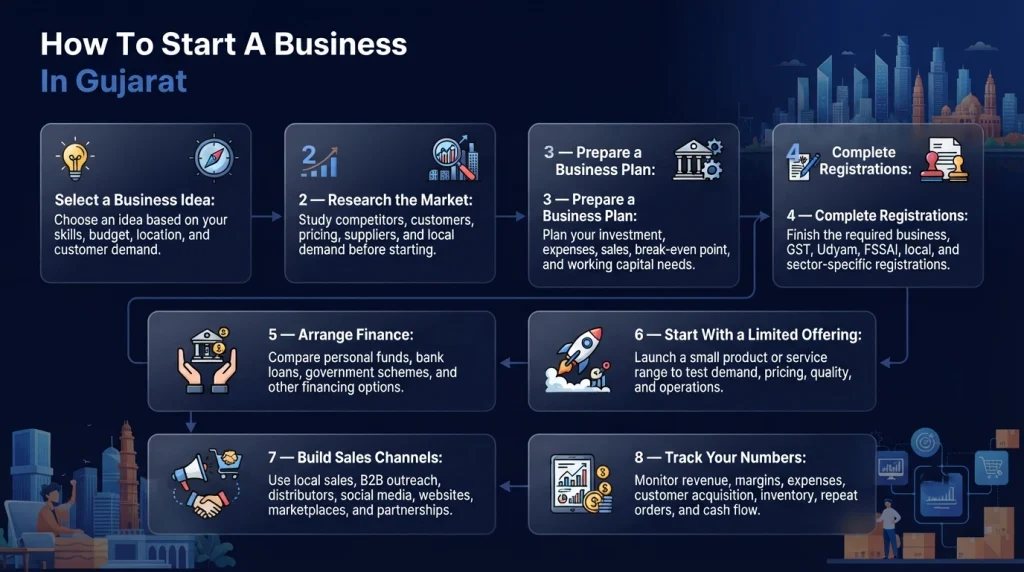
Starting a business requires more than selecting a profitable idea. You need to validate the market, understand the costs, complete registrations, arrange financing, and build a reliable customer acquisition system.
Step 1: Select a Business Idea
Choose an idea based on your skills, budget, location, and customer demand. Avoid choosing a business only because it appears profitable for someone else.
Step 2: Research the Market
Study competitors, suppliers, customers, pricing, and demand. Visit local markets and industrial areas where possible and speak directly with potential customers.
Step 3: Prepare a Business Plan
Estimate your initial investment, monthly operating expenses, expected sales, break-even point, and working capital requirement. Keep enough money aside to manage the first few months of operations.
Step 4: Complete Registrations
Depending on the business, you may need business registration, GST registration, Udyam registration, FSSAI registration, local permissions, environmental approvals, or sector-specific licences.
Step 5: Arrange Finance
Compare personal capital, bank loans, government-supported schemes, and other eligible financing options. Do not assume that a government subsidy will be received immediately.
Step 6: Start With a Limited Offering
Launch a small product or service range first. This makes it easier to identify customer preferences, pricing problems, operational issues, and product quality concerns.
Step 7: Build Sales Channels
Use a combination of local sales, B2B outreach, distributors, social media, websites, marketplaces, exhibitions, and partnerships depending on your business model.
Step 8: Track Your Numbers
Monitor revenue, gross margin, operating expenses, customer acquisition cost, repeat orders, inventory, and cash flow. A business can have strong sales and still struggle if cash flow is poorly managed.
Conclusion
Gujarat offers a wide range of business opportunities because of its strong industrial base, established supply chains, ports, skilled workforce, entrepreneurial culture, and growing technology ecosystem. Entrepreneurs can explore everything from small food and digital businesses to manufacturing, logistics, tourism, renewable energy, and specialised technology services.
The best business idea is not necessarily the one requiring the largest investment. It is the one that matches your skills, available resources, local demand, and ability to build a sustainable customer base. Starting small, testing demand, controlling costs, and using suitable government support can help reduce the risks involved in building a new business in Gujarat.
FAQs
1. Which business is most profitable in Gujarat?
Manufacturing, textiles, logistics, food processing, renewable energy, and specialised B2B services can be profitable in Gujarat. However, profitability depends on investment, location, competition, operating costs, and customer demand rather than the industry alone.
2. Which business can I start in Gujarat with low investment?
Digital marketing, handicrafts, traditional food products, tourism experiences, spice packaging, and small-scale online businesses can be started with relatively low investment. The exact amount depends on whether you operate from home or establish a separate facility.
3. Which city in Gujarat is best for starting a business?
There is no single best city for every business. Ahmedabad is suitable for diverse businesses and services, Surat is strong for textiles and fashion, Anand is known for dairy, Rajkot has a strong engineering ecosystem, and Sanand is developing around automobiles, electronics, and manufacturing.
4. Are there government schemes for new businesses in Gujarat?
Yes. Entrepreneurs can explore schemes such as Aatmanirbhar Gujarat, PMEGP, Gujarat startup support, textile-sector incentives, and other sector-specific programmes. Eligibility and benefits vary by business type, location, investment, and entrepreneur category.
5. Is Gujarat good for first-time entrepreneurs?
Yes. Gujarat can be suitable for first-time entrepreneurs because it has established supplier networks, industrial clusters, logistics infrastructure, skilled workers, and a strong business culture. Starting with a smaller business model and expanding after validating demand can help reduce the initial risk.