Every day, AI workflow transforms the way business is done. These intelligent software tools can be used to automate menial duties, integrate various applications, and work at a lower speed without necessarily having to do it manually. Just consider the tedious duties you have to go through each day. Moving data amongst systems, organising mails, preparing reports, or handling customer requests. AI workflow tools do all these tasks automatically as you concentrate on more valuable work that requires human thinking.
AI workflow instruments are no longer simple automation in 2026. Through artificial intelligence, they get to know your work habits, make intelligent decisions, and enhance themselves as time goes by. These AI productivity tools are able to comprehend situations, anticipate what you require, and accomplish complicated tasks once at several systems without having to be monitored at all times. This article discusses the top 10 AI workflow tools of 2026. You can find the right solutions to suit your needs and budget, as well as your technical incompetence, be you are a small business or a large enterprise. We will find out how these tools can change the way you do your daily activities and enhance productivity in the team.
What to Look for in the Best AI Workflow Tools
- Simple to Barefoot Interface: Search for the identifier of the visual builders that do not need knowledge of code.
- Powerful Integration Country of Origin: The Tool must be linked with applications used daily.
- Intelligent AI Proprieties: Platform should not be restricted to easy tasks but ought to be able to process complex cases.
- Adequate Customization: Get time to change workflows according to your specific business requirements.
- 1000 Percent proper security measures: Good data protection, compliance capabilities, as well as access controls.
Read More: Best Social Media Monitoring Tools
10 Best AI Workflow Tools in 2026
1. Lindy.ai

Lindy. Human intelligence is an autonomous agent that acts as a virtual employee for your business. It is as easy as explaining to the platform what you desire using ordinary words, and the site develops a smart robot to manage it. These agents analyze text, images, and documents and learn something new every time to enhance their work.
The platform will be compatible with your email, calendar, and document systems. The agents of Lindy can process and maintain a variety of data at the same time and make rational decisions depending on the context. They become conscientious with time as they analyze the results and modify the strategy. That is why Lindy.ai is ideal with companies that do not require technical support when using AI.
Key Features
- Helpful bots qualify as conversational agents, know natural language commands.
- Multi-modal processing is when the text, documents, and images are considered.
- Self-improving agents acquire by experience.
Pros
- Very easy setup process
- No coding skills required
- Agents improve over time
Cons
- Lack of higher customization possibilities.
- Fewer integration libraries on offer.
- Fittest for less complicated tasks.
Best For: Solopreneurs
Pricing: Free plan available; paid plans start at $49.99 monthly
Website: https://www.lindy.ai
2. Relevance AI
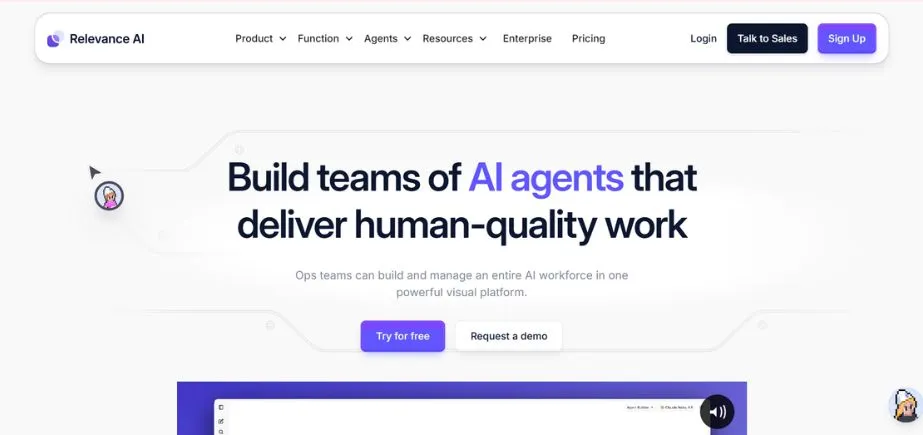
Relevance AI is all about creating AI agents as opposed to conventional automation processes. This platform is a modular architecture where teams can produce, test, and run special AI agents together. Different agents are involved in unique business roles and can either operate separately or in collaboration with other agents.
The system contains canned deals of templates that serve the common business requirements, such as research support and business development. It combines with existing key business tools and databases. Teams of technical-sophists do not need to write prices of software to build a strong automation. Its modular design allows you to expand its capabilities as your needs expand.
Key Features
- By using a modular agent architecture, it is possible to compose a complex workflow.
- Ready-crafted templates on typical business functions were provided.
- It has seamless integration with key business applications.
Pros
- Joint building of agents is underpinned.
- Design of Flexible modular architecture.
- Available good template libraries
Cons
- Some technical expertise is necessary.
- Steeper learning curve in the first instance.
- Little encouragement for novices.
Best For: Operations
Pricing: Free plan available; paid plans start at $19 monthly
Website: https://relevanceai.com
3. VectorShift
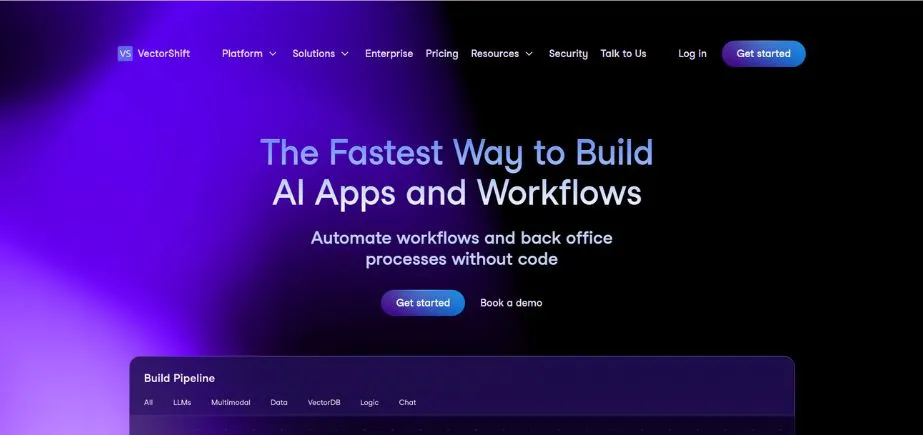
The VectorShift assists companies in creating and implementing AI applications without encountering significant data programming. The platform has a drag-and-drop interface that is no-code and a Python SDK that lets developers gain more access. It embraces different data types and incorporates all kinds of large language models in all sorts of tasks.
Enterprise capabilities are secure infrastructure, the ability to support high-volume automation, and integration with popular tools, such as Salesforce, Notion, and Airtable. VectorShift is outstanding in processing unstructured data using a sophisticated combination of a vector database. This simplifies semantic search and the smart processing of data. The platform allows businesses to balance both ease of use and enhanced business-growth capabilities.
Key Features
- Flexible information integration copes with numerous formats with ease.
- Visual workflow builder has integrated AI-native elements.
- Security Enterprise-grade is used to provide compliance and protection of data.
Pros
- Processes unstructured data.
- Good security features were provided.
- No-code and coding.
Cons
- Greater costs for the corporation.
- Training is needed to acquire complex features.
- Perhaps extravagant when working with small teams.
Best For: Enterprises
Pricing: Free plan available; paid plans start at $20 monthly
Website: https://www.vectorshift.ai
4. Gumloop
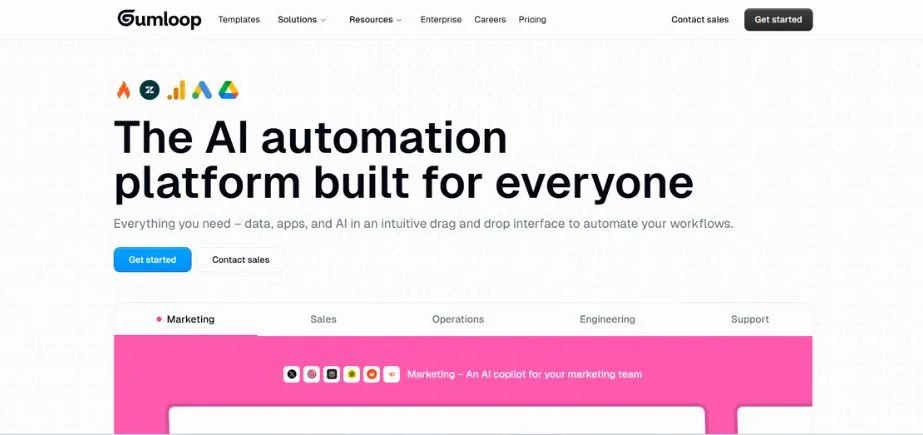
Gumloop is AI workflow software, which is coded to think, and it is used by the team with no coding experience. Business departments might design chatbots as part of marketing, sales, and operations, route work using AI, as well as create content and automate menial labor. The platform is aimed at promoting AI to the non-technical community.
Enterprise is added, like audit logging, virtual private cloud implementation, the controls of AI models, the autoscaling of the compute, and personal one-on-one support. Gumloop offers templates of AI agent resources (marketing) to enable teams to be set up quickly. It is possible to deploy the workflow to your own cloud and have improved security and control. It can be easily and quickly adopted because of its integration with popular marketing and sales tools.
Key Features
- Templates of AI agents oriented to marketing decrease the time of deployment.
- Use your own cloud to ensure security.
- Fluent contact between marketing and sales tools.
Pros
- Very marketing-friendly interface design.
- No coding skills needed
- Available good template library.
Cons
- Seldom customized technologically.
- Focuses mainly on marketing
- Reduced integration environment at the moment.
Best For: Marketing
Pricing: Free plan available; paid plans start at $37 monthly
Website: https://www.gumloop.com
5. n8n
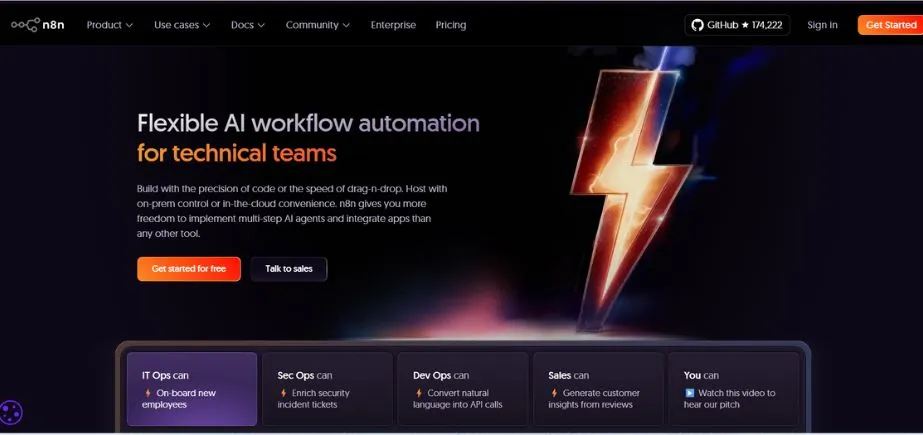
n8n is an open-source automation platform that allows AI to be applied to a broad range of technical tasks and gives the team total control. The platform allows complete flexibility by offering a visual drag-and-drop builder in addition to the option to write complete code. Users have an opportunity to build multi-step AI agents and combine more than 500 applications.
Teams may operate workflows in a local server or in the cloud and retain all data under control and protection. n8n supports the most popular tools, such as Slack, Teams, and Salesforce, with a wide range of possibilities to customize them. The platform also has features such as fast debugging, replaying, and testing that are efficient in development. The node-based architecture that permits limitless customization is liked by technical teams.
Key Features
- Workflow builder with API visual workflow nodes.
- Intensive customization and 500-plus integrations.
- Complex developer capabilities of custom nodes.
Pros
- Full management of the workflows.
- A bad option of self-hosting is available.
- Powerful support of developer communities.
Cons
- Needs technical knowledge, certainly.
- Steeper learning curve in the first instance.
- More complex setup process
Best For: Developers
Pricing: Free trial available; paid plans start at $28 monthly
Website: https://n8n.io
6. Make (formerly Integromat)
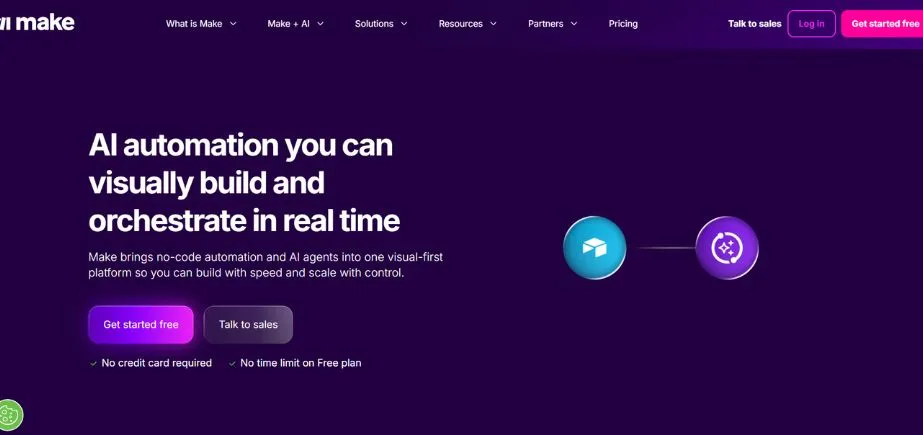
Make is an AI no-code editor that enables building flexible AI workflows through technical expertise. There are more than 400 AI applications and 2,500 ready-to-use tools that can be integrated into teams to automate the processes in the IT, marketing, sales, finance, and operations departments. The graphical interface opens up complicated automation to all.
He is a team player and can split his duties among several colleagues who work on the same automations. This simplifies refining processes, changes tracking, and scaling operations without in-depth technical expertise. It has a large number of library templates and artificial intelligence workflows on board. Flexible workflow error handling and debugging features assure a relaxed workflow even in the case of any issues.
Key Features
- The visual scenario builder is intuitive and has AI-native modules.
- Since it has advanced error handling and debugging.
- Large template library containing artificial intelligence workflows.
Pros
- Superior visual workflow design.
- Very robust team co-operation aspects.
- GA good template library is present.
Cons
- It can get expensive quickly
- Complex situations should be planned.
- Seldom-reported performance problems.
Best For: Agencies
Pricing: Free plan available; paid plans start at $10.59 monthly
Website: https://www.make.com
7. Zapier
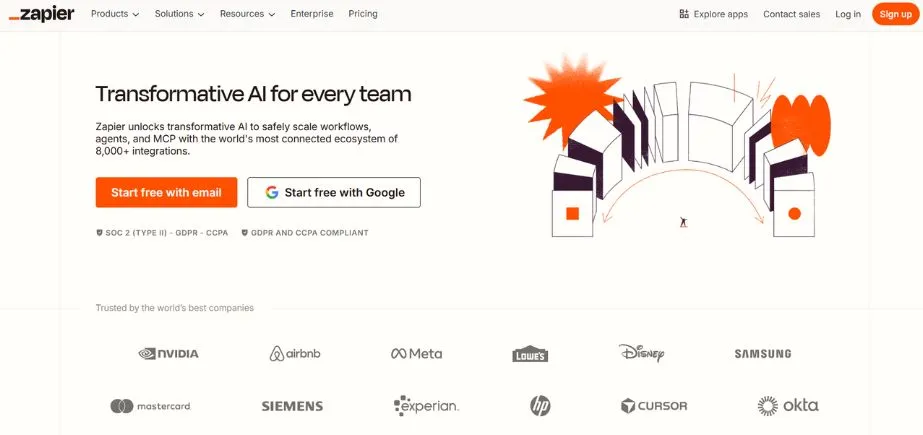
Zapier is among the most popular workflow-based AI tools that offer the largest app ecosystem. Teams have been able to develop AI assistants to work on tasks in thousands of apps, including managing emails and scheduling meetings, as well as leads and data summaries. These intelligent robots are updated with the new company data.
The platform also employs natural language in the development of the workflow, and this makes automation available to all. The AI-assisted Zap creation proposes the relationships between your applications. Zapier features pre-built AI actions and templates, massive as well, and requires you to begin using them instantly. The integration library is huge, implying that you can integrate nearly every tool that you use in your daily routine.
Key Features
- Largest appposition that consists of 6,000+ integrations.
- Zap creation and optimization included AI.
- It is easily built with a Natural language workflow description.
Pros
- Massive application integration library.
- Very easy to start
- Great for simple workflows
Cons
- Gets expensive with volume
- Minimal sophisticated features.
- It can be slow sometimes
Best For: Startups
Pricing: Free plan available; paid plans start at $50 monthly
Website: https://zapier.com
Read More: Best All SMO Tools
8. SnapLogic Agentic
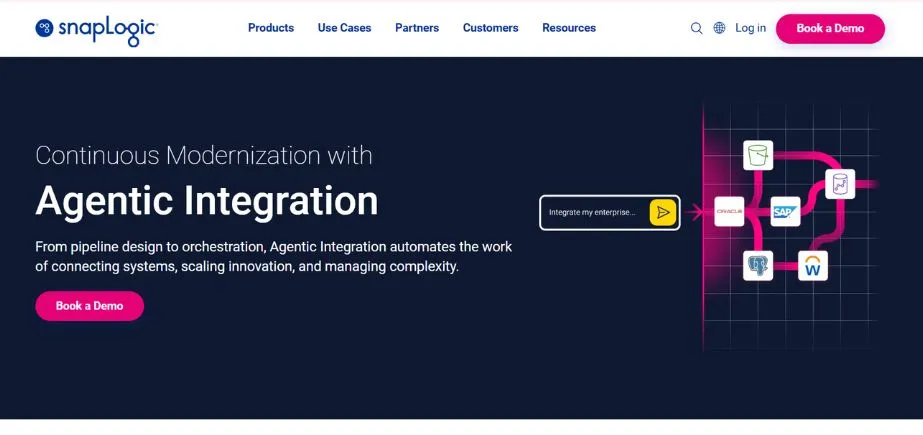
SnapLogic enables business entities to build an AI agency that manages multidisciplinary workflows in diverse teams and systems. Prompt Composer is used to allow teams to test and modify how the agents react in real time. SnapLogic integrates with any type of AI model, allowing the ability to change or upgrade without lock-in.
The system has end-to-end encryption, data masking, and granular governance over the enterprise security. Companies are able to optimize the agent operations on-the-fly, and observe the outcomes right away. The flexibility of SnapLogic is relevant to big firms with intricate data and numerous systems. The platform deals with advanced workflows that involve the coordination of departments and technologies.
Key Features
- Interactively test and debug agent behavior.
- Supports any AI model flexibility.
- Data masking and end-to-end encryption.
Pros
- SecurityEnterprise-level security is robust.
- Lock-in is produced by model flexibility.
- Available real-time testing capabilities.
Cons
- Only enterprise pricing is available.
- Difficult installation in the first place.
- Ruthlessness toward small businesses.
Best For: Enterprises
Pricing: Contact for pricing
Website: https://www.snaplogic.com
9. Workato
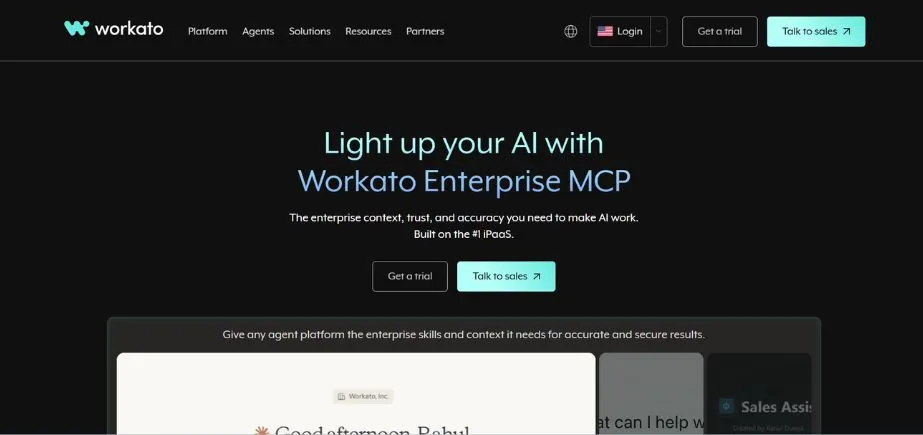
Workato is an integration platform comprising enterprise-scale integration with AI-based workflow automation software built into one platform. It allows teams to design AI agents according to the roles and KPIs, and fits perfectly into a variety of systems. The platform manages processes that are intricate and multi-system, and has centralized control and visibility.
Workato experiences acceleration and automation on a large scale with more than 1,200 pre-made connectors and ready-made accelerators. Its no-code interface enables workflow designing without any knowledge of code. Monitoring and real-time visibility are useful in tracking the automation performance and achieving reliable results. This is why Workato is ideal in the case of enterprise teams that are processing large data and complex workflows.
Key Features
- No-code interface has a visual interface that allows one to easily design the workflow.
- Powerful iPaaS engine deals with multi-system operations.
- Automation performance can be monitored in real-time.
Pros
- Effective built-in integration capabilities of the enterprise.
- Large connector library in place.
- Good surveillance and transparency.
Cons
- Enterprises are highly priced.
- Multi-faceted characteristics must be trained.
- Not ideal for small teams
Best For: Enterprises
Pricing: Contact for pricing
Website: https://www.workato.com
10. Microsoft Power Automate
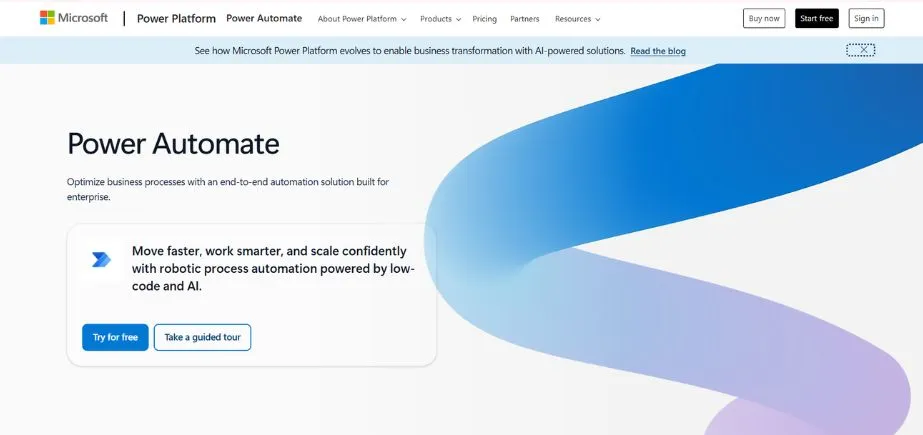
Microsoft Power Automate is an automation platform that mixes no-code automation with AI, and exists within the Microsoft ecosystem that you already know. It is possible to create workflows in Teams, Excel, or SharePoint without having to alternate between applications. The platform uses AI capabilities such as process mining and Copilot to automatically determine the bottlenecks.
AI-based workflow optimization occurs through the existing processes since the system is analyzing your processes and recommending ways to improve them. Teams are informed about work areas in which work stalls, and ways of doubling the working pace. Adaptable Microsoft integration implies the workflow is naturally working in all your familiar tools. This makes Power Automate the easy decision to make among businesses that have already adopted the Microsoft products in their day-to-day activities.
Key Features
- Workflows are fast to construct using low-code automation.
- Real-time bottlenecks in AI-driven insights.
- Fluency among the whole tools of Microsoft.
Pros
- Perfect for Microsoft users
- Touchscreen interface at the team level.
- Good AI capabilities are comprised
Cons
- Poor ecosystem outside Microsoft.
- Can be complex initially
- Premium licenses are required for some of the features.
Best For: Microsoft users
Pricing: Free plan available; paid plans start at $15 monthly
Website: https://powerautomate.microsoft.com
Comparison Table: Best AI Workflow Tools
| Tool | Best For | Starting Price | Key Strength | Integration Count |
| Lindy.ai | Solopreneurs | $49.99/month | Self-improving agents | Moderate |
| Relevance AI | Operations | $19/month | Modular architecture | Good |
| VectorShift | Enterprises | $20/month | Unstructured data handling | Extensive |
| Gumloop | Marketing | $37/month | Marketing templates | Good |
| n8n | Developers | $28/month | Complete customization | 500+ |
| Make | Agencies | $10.59/month | Visual workflow design | 2,500+ |
| Zapier | Startups | $50/month | Largest app ecosystem | 6,000+ |
| SnapLogic | Enterprises | Custom | Enterprise security | Extensive |
| Workato | Enterprises | Custom | Integration platform | 1,200+ |
| Power Automate | Microsoft users | $15/month | Microsoft ecosystem | Extensive |
Use Cases: How AI Workflow Tools Transform Operations
- Customer Support Automation: AI agents are able to sort the tickets and assign them automatically.
- Hr Onboarding Processes: The new employees are automatically taken through forms and schedules.
- IT Incident management: Issues are identified, captured, and addressed automatically.
- Sales Lead Qualification: AI AIintelligences leads and directs the right salespeople.
- Content Creation Workflows: Marketing teams create and post content with the help of AI.
Step-by-Step Guide: Setting Up Your First AI Workflow
- Identify Repetitive Task: Select a simple, mundane task that you perform over and over again daily.
- Issue: Select the AI workflow tool to use based on the level of technical expertise.
- Map Current Process: List all the steps in your own process of manual work.
- Create the Workflow: Automatically recreating your process in the platform is possible in the builder.
- Test and Refine: Perform some tests, repair errors, and enhance your process.
Conclusion
In 2026, AI-based workflow applications will have already started to change the business operating methods. With the use of AI productivity tools, the whole range of businesses is benefiting from this technology, and every day, the teams are getting smarter, faster, and more efficient through these tools. The 10 tools we discussed have a variety of attributes and correspond to different needs. Zapier is very helpful for connecting startups requiring simple links. n8n empowers programmers totally. In case of businesses already relying on Microsoft products, Microsoft Power Automate is the right fit. Workato and SnapLogic serve as the enterprise options that deal with complicated multi-system workflows at scale.
The selection of an AI task automation platform is dictated by factors like the size of the team, technical capabilities, budget, and individual requirements. Initiate with a basic workflow for testing purposes with the platform. After a certain level of comfort is reached, the automation can be extended to cover more processes in the entire organization. Collaboration between AI and humans will be the future of work. The AI workflow automation tools perform the usual tasks and allow the human team to concentrate on the more demanding areas of creative or strategic work, which require human insight. This synergy leads to the creation of more fruitful and enjoyable work environments for all.
FAQs
What are AI workflow tools?
AI workflow tools are applications that implement machine learning to this end. They connect several applications, manage repetitive tasks, and make intelligent choices without having to be monitored continuously by humans.
So, would I require coding skills for using workflow tools powered by AI?
The majority of the next-generation AI-based workflow tools have no-code platforms that anyone and everyone can operate. For instance, tools such as Zapier, Make, and Gumloop do not require any programming skills at all and can be used with complete ease.
What is the price range of AI workflow tools?
The pricing of AI productivity tools differs greatly among them. Some provide free plans for very basic usage. The starting point for paid plans for small teams is generally in the range of $10-50 per month, and it can go up to custom enterprise pricing for mega firms.
Can my present software be integrated with AI workflow tools?
Absolutely, most AI workflow automation software integrates with hundreds or even thousands of the most popular applications. Be sure to check the integration list of each platform to confirm that it works with your particular tools before you invest.
Which is the best AI tool for workflow for a novice user?
Zapier and Make are perfect beginner’s AI workflow tools as they have visual interfaces, many templates, and do not require technical expertise to generate an efficient automation quickly.
Continue Reading for More: Best White Label SEO Audit Tools