
Today, utilizing the digital world, companies have to make decisions that are smart and data-driven. It is at this point that the Business Intelligence Tools are involved. These applications assist businesses in gathering, processing, and interpreting their information to make superior decisions. You can make a difference in the way you work, regardless of having a small startup or a large company, because there is the right BI tool. Business Intelligence Tools convert raw data into valuable information.
They can assist in viewing trends, monitoring performance, and predicting future trends. A wide variety of tools in the market makes it easy to be confused about which one to use. This guide will make you see what the things to look, what tools are the best in 2026.
Business Intelligence Tools are now very important to the contemporary business, from the simple dashboard to the sophisticated analytics. They assist in making teams work not hard but smart. You should also see what is so special about these tools and which of them should attract your attention.
What to Look for in the Best Business Intelligence Tools
- User Friendly: The Tool does not always require one to have coding skills.
- Good Connections: Need to be compatible with your current software and databases without any difficulty.
- Affordable Prices: Are expected to be within the budget of your company without any hidden expenses.
- Goodwill Support: Help should be given by the company when you encounter any issue.
- Grows with You: The Tool should be able to process increasing data with the business.
Key Features to Look for in BI Tools
- Visual Dashboards: Displays data in graphs and charts to understand it fast.
- Real-Time Updates: It always shows the current information, as opposed to old information.
- Mobile Access: Evables you to examine reports on a phone or a tablet.
- Data Security: It safeguards business-sensitive information against threats and unauthorized access.
- Custom Reports: Allows you to build custom reports to suit your business.
Types of BI Tools
- Traditional BI: Complex tools, which need the assistance of the IT team to use and install.
- Self-Service BI Tools: These are straightforward platforms that a user does not require to have the technical know-how to operate.
- Cloud-Based Tools: This is software that can be used online, and it does not require any software to be installed on the local computer.
- Open-Source Tools: Free utilities that you can alter and customize to whatever you please.
- Mobile BI: Applications that are specific to smartphone and tablets.
Read More: Best White Label SEO Audit Tools
10 Best Business Intelligence Tools in 2026
1. Microsoft Power BI
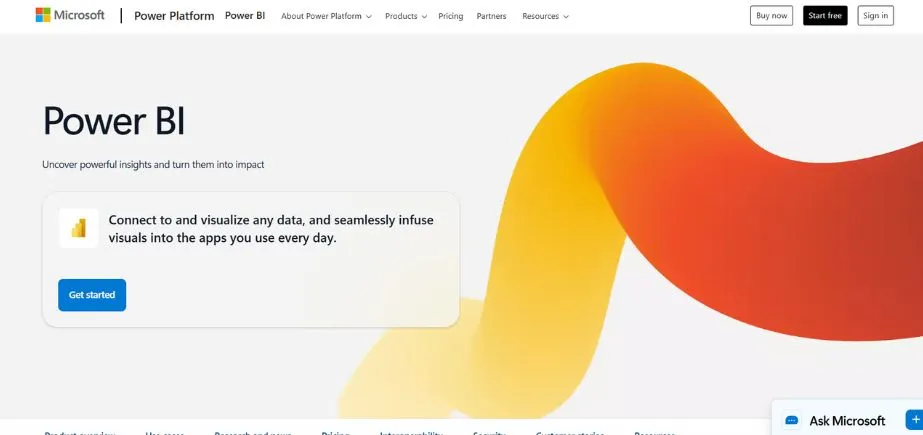
One of the widely used Business Intelligence Tools in the current world is Microsoft Power BI. It is compatible with other Microsoft compatibility products, such as Excel and Azure. It is an effective tool to develop reports and analyze them. Power BI is used by many big companies as it is able to process complex data. The instrument employs calculations with the help of DAX language.
Organizations that are already using the Microsoft products will find it best. It is not easy, but it needs some learning. Power BI comes in the form of free and paid. The interface is similar to that of Excel. It is an all-encompassing solution to data visualization and business analytics systems.
Key Features
- Blends with the Microsoft products.
- DAX programming language for data modeling.
- Well-developed data processing skills.
Pros
- Excel users adapt quickly
- Superior data modelling characteristics.
- Handles large data volumes
Cons
- Expensive initial learning curve.
- Requires IT expertise for the setup
- Has some frustrating quirks
Best For: Enterprises
Pricing: Free version available; Pro costs $10/user/month; Premium starts at $20/user/month
Website: https://powerbi.microsoft.com
2. Atlassian Analytics
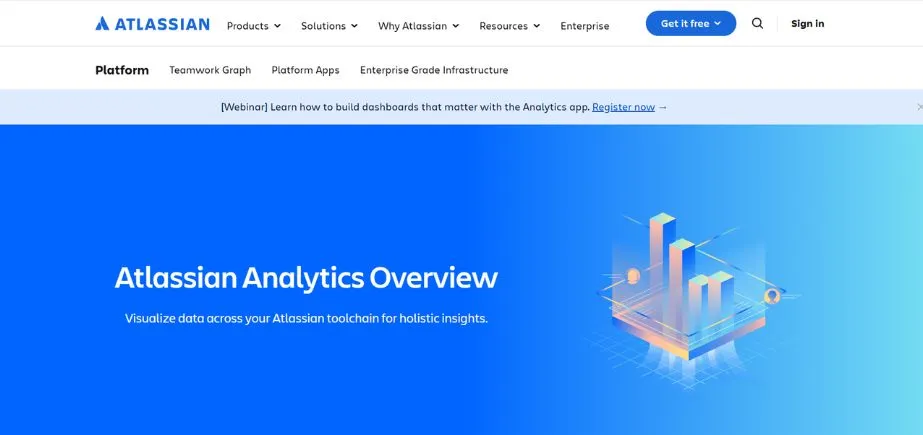
Atlassian Analytics is one of the modern Business intelligence tools that can be used by all people. Thanks to Visual SQL, you do not have to have any coding skills to use it. The tool is strong and cheap, hence ideal for both startups and big companies. Installation is only a day, at a phenomenally fast rate. The interface is easy, and there is a drag-and-drop feature.
The teams are able to work together on dashboards with comments. It is HIPAA compliant for healthcare data. The tool automatically updates dashboards as a result of your queries. The complex reports can be built even by non-technical users. Ease of use is the top priority at Atlassian Analytics, with no harm to power.
Key Features
- Visual SQL for everyone
- Drag and drop query constructor.
- In-dashboard collaboration commenting.
Pros
- No coding knowledge needed
- Extremely rapid implementation cycle.
- Frees up technical teams
Cons
- Overall lack of advanced features of an analyst.
- Limited compared to Tableau
- Continuous development of capabilities.
Best For: Everyone
Pricing: Starts at $10/user/month; free trial available
Website: https://www.atlassian.com/platform/analytics/what-is-atlassian-analytics
3. Tableau Desktop
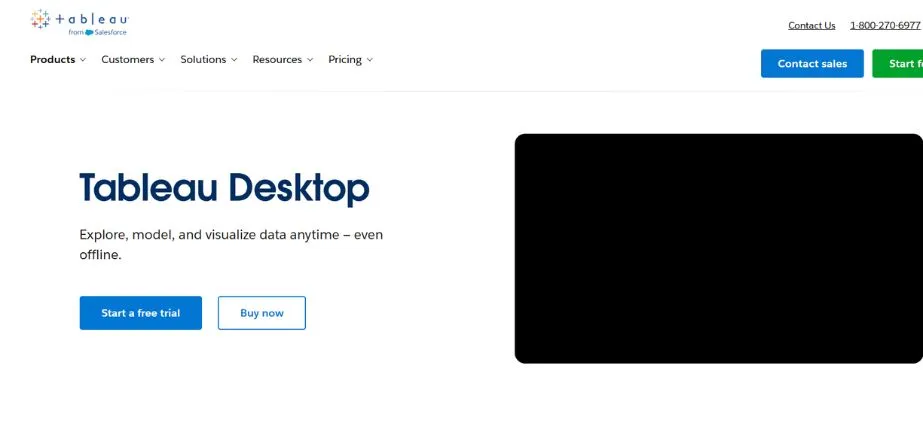
Tableau Desktop is an experienced Business Intelligence Tool and data analytics tool. It is known for designing gorgeous, intricate visualizations. Its flexibility and power are highly appreciated by the data scientists and analysts. The tool is able to integrate information across several databases without any difficulty. It has gone through years, and it has gained a huge number of users. Tableau has unlimited possibilities for customization of charts and graphs.
But it is not that simple to get acquainted with beginners. Tableau has one or two experts who manage all in most companies. The tool is strong and not that agile. It is believed to be one of the most appropriate BI software to use with visualization.
Key Features
- Combines various sources of databases.
- Ample visualization variety capability.
- Elastic data manipulation applications.
Pros
- Superior community support services.
- The ability to visualize strongly always.
- Most flexible and adaptable.
Cons
- Extremely challenging for newcomers.
- Always limited access by the teams.
- Lacking some of the elements of modernity.
Best For: Analysts
Pricing: Starts at $70/user/month; free trial available
Website: https://www.tableau.com
4. Google Data Studio
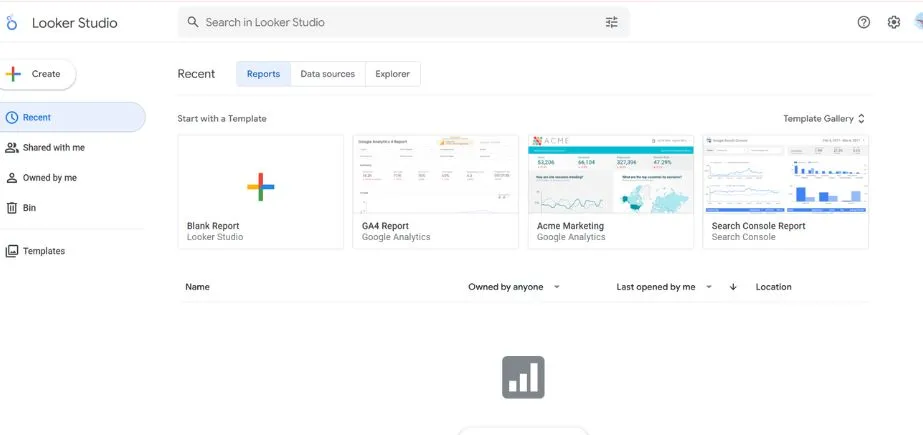
Google Data Studio is a free Business Intelligence Tool that is offered by Google. It is integrated well with Google Analytics, Sheets, and BigQuery. This is the ideal tool to be used by individuals who are already users of Google products. It can be used with your Google account instantly. It has numerous templates that are free in order to work fast. Its community support is also great due to the huge number of users.
Nevertheless, it is only effective when used with Google products. Integrating third parties may be complicated. The layout features are somewhat minimal compared to the tools of payment. Nevertheless, it is excellent when one has a fast need to visualise data.
Key Features
- Free with Ga Google account
- Relates to the Google ecosystem.
- Recombinant template library in large quantities.
Pros
- Completely free to use
- Easy to get started
- Always a big neighborhood backing.
Cons
- Limited to Google products
- Troubled format at times.
- Naked third-party integrations.
Best For: Beginners
Pricing: Free
Website: https://lookerstudio.google.com/
5. Looker
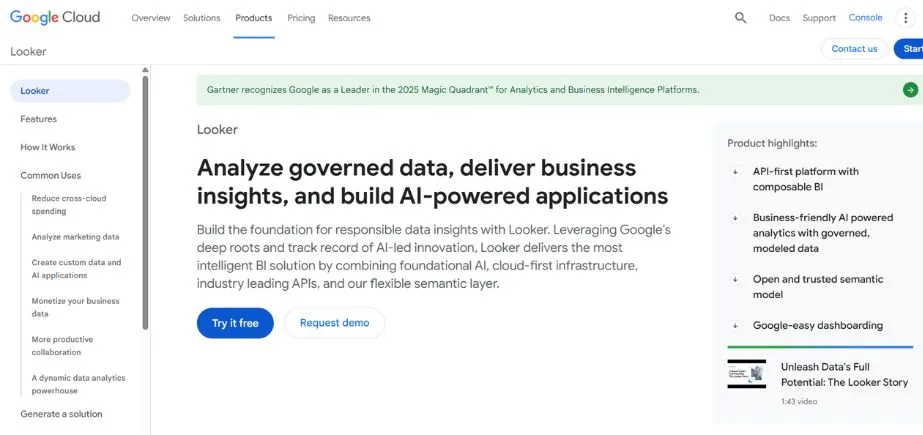
Looker is an excellent Business Intelligence Program that belongs to Google Cloud. It is constructed to meet the requirements of data teams that require sophisticated modeling. The tool has its own proprietary language called LookML. Looker Blocks include a pre-written code of common tasks. Once you know the system, this increases the workflow.
The tool is also good for developing reusable data models. Nevertheless, it is not very effective in data visualization as others. Using Looker requires knowledge of SQL. In 2019, Google bought Looker and admitted it to its platform. It is not meant for the casual business user.
Key Features
- Available LookML modeling language.
- Looker Blocks are pre-built.
- The data approach used was object-oriented.
Pros
- An available, powerful modeling layer.
- Code blocks reusability.
- Good for technical teams
Cons
- Poor visualization ability in general.
- As such that needs data preparation software.
- A steep learning curve exists
Best For: Developers
Pricing: Custom pricing; contact sales team
Website: https://www.looker.com
6. Sisense for Cloud Data Teams
Sisense Cloud Datateam is among the Business Intelligence Tools designed to build SQL expertise. It was known as Periscope Data, and it assists teams in operating much faster with data previously. The tool supports SQL, Python, and R languages. It is made for the companies that have advanced data teams. Ad-hoc analysis enables you to make reports on command.
SQL queries are simplified using macros. But when you are not conversant with SQL, this tool is of very little use. It is not at all appropriate amongst casual business users. The tool is most suitable when dealing with large data teams in an enterprise. It is an exclusive BI tool of technical use.
Key Features
- Supports SQL, Python, R
- Ad-hoc analysis abilities encompassed
- Helpful macros for queries
Pros
- Speeds up SQL workflows
- Good for technical users
- Faster with large sets of data.
Cons
- Always needs knowledge of SQL.
- Not for casual users
- Can overwhelm smaller teams
Best For: Experts
Pricing: Custom pricing; contact sales team
Website: https://www.sisense.com
Also Explore This: Best All SMO Tools
7. Domo
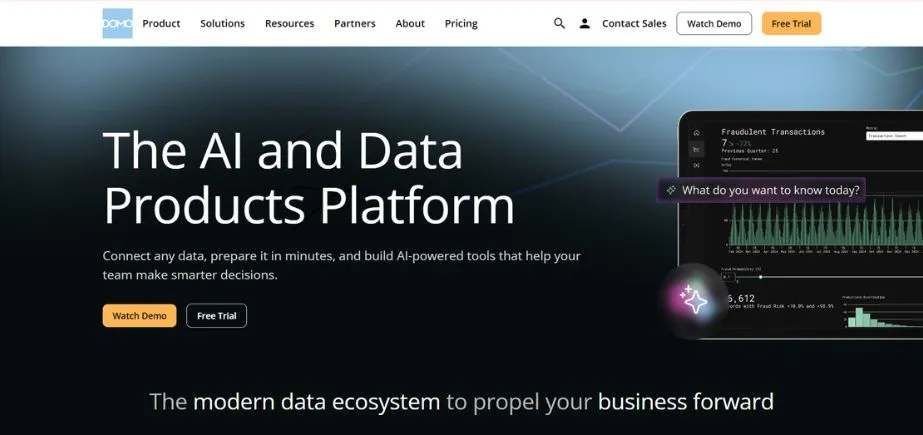
Domo is an enterprise level Business Intelligence Tool that found its unicorn status very early. It pays attention to the mobile-first philosophy linking BI data to phones. The tool divides the features into team modules. Domo serves well in large organizations that would require the distribution of data. Its range of integrations in terms of its plugins is vast.
Data accessed through this module system is easily aaccessibleby different departments. Declining customer service quality is also cited in recent reviews, though. Installation is very resource-consuming. Compared to the competitors, the prices are very high. After it is established, it is effective in the executive-level monitoring.
Key Features
- Mobile-first design principles.
- Modular team-based features
- Wide integrations of the plugins.
Pros
- Exceptional integration skills, on the whole.
- Flexible for multiple teams
- Good for executive watchers.
Cons
- Decreasing the quality of customer support.
- High service fees are charged
- A bad onboarding experience was reported.
Best For: Executives
Pricing: Custom pricing; starts around $750/month minimum
Website: https://www.domo.com
8. Mode Analytics
Mode analytics is a data science application that includes BI. Its main target is Fortune 500 companies, chiefly, data science practitioners. The tool provides Notebooks to analyze R and Python. Its engine is Helix, which takes SQL, R, Python, HTML, and CSS. Mode is also flexible when it comes to data scientists who require advanced capabilities. It is easy to combine data of several MySQL databases.
Nonetheless, it is not targeted at end users of business. It can be too complicated even in the case of lower-level analysts. Each of the reports will need custom code used in data visualization. It is one of the business analytics solutions for technical professionals.
Key Features
- Notebooks for R Python
- Helix data engine included
- Several database consolidations are possible.
Pros
- Extremely flexible to the scientist.
- Extensive capabilities of deep data science.
- Python integration is acceptable.
Cons
- Not for business users
- Challenged process of dashboard building.
- Poor visualization without coding.
Best For: Scientists
Pricing: Starts at $50/user/month; free trial available
Website: https://mode.com
9. Klipfolio
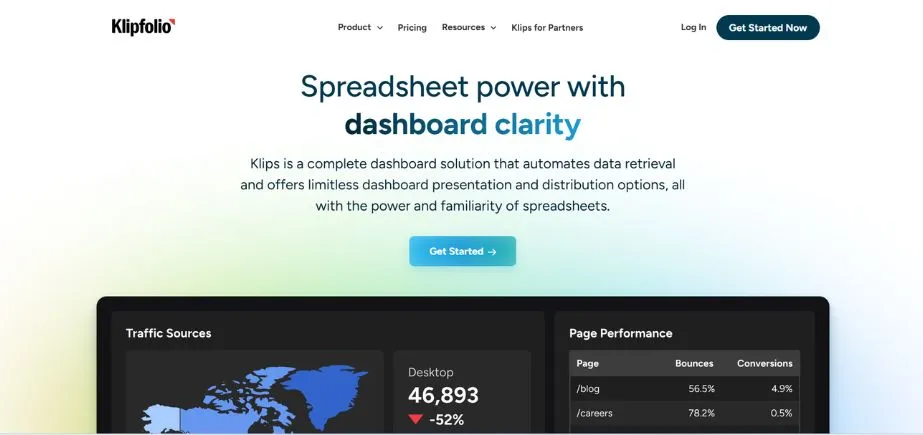
Klipfolio is a Business Intelligence Tool that concentrates on dashboards only. It provides quick dashboard report creation to users. The tool comes with assembled Klips (XML files). Its mobile application allows one to check dashboards anywhere. Klipfolio is very efficient at presenting real-time data from different sources. It works well with simple to advanced data visualization.
Nevertheless, the tool is not a complete-fledged BI tool in general. Although it has easy user-friendliness, it is very hard to set up. It requires coding or Excel experience to be properly set up. Companies that already have a data infrastructure are the best to use it.
Key Features
- Klips’ library is provided
- entering pre-built.
- Mobile app for access
- Live capabilities of data display.
Pros
- Excellent for live data
- Flexible Klips library in place.
- Good team motivation tool
Cons
- Less than ideal BI capabilities in general. A painful installation procedure is needed.
- Not robust like others
Best For: Dashboards
Pricing: Starts at $49/user/month; free trial available
Website: https://www.klipfolio.com
10. Metabase
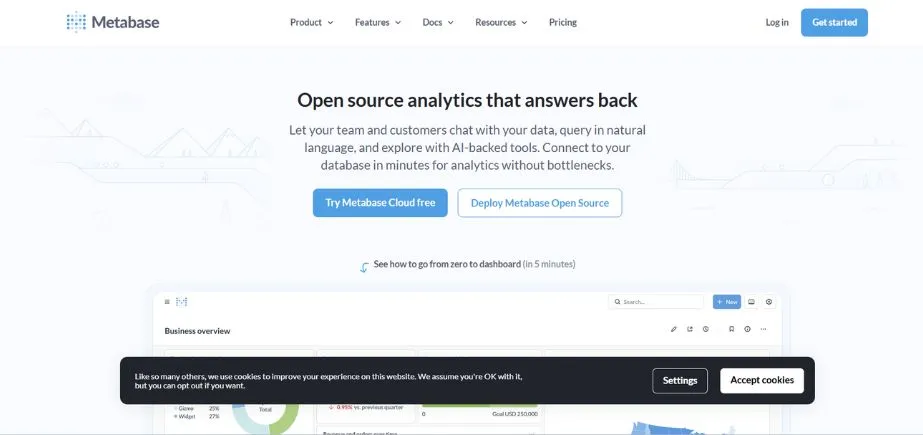
Metabase is an open-source Business Intelligence Analytics tool, which is free. It is associated with providing answers to daily running business questions. It is open-source and hence can be hosted entirely. This renders it very safe and completely customizable. The instrument is an inexpensive and powerful one. But customer support is not much or none at all.
You information must be clear as to what you want, how to get it. Setting up etechnicalis sometimes is a challenge even to technical users. The interface can be confusing to advanced SQL users. Teams that feel fine using self-service BI tools and technical installation are most at ease using it.
Key Features
- Purefree open-source software.
- Self-hosted to gain control of security.
- Customizable to your needs
Pros
- Totally free to use
- Most customizable and highly secure.
- Full control over data
Cons
- Not user-friendly among the non-technical.
- None offered in terms of customer support.
- Can confuse power users
Best For: Budget-conscious
Pricing: Free (open-source)
Website: https://www.metabase.com
Comparison Table: Best Business Intelligence Tools
| Tool | Best For | Starting Price | Ease of Use | Key Strength |
| Power BI | Enterprises | $10/user/month | Medium | Microsoft integration |
| Atlassian Analytics | Everyone | $10/user/month | Very Easy | Visual SQL |
| Tableau Desktop | Analysts | $70/user/month | Hard | Visualizations |
| Google Data Studio | Beginners | Free | Easy | Google ecosystem |
| Looker | Developers | Custom | Hard | Data modeling |
| Sisense | Experts | Custom | Medium | SQL power |
| Domo | Executives | $750/month | Medium | Mobile-first |
| Mode Analytics | Scientists | $50/user/month | Hard | Data science |
| Klipfolio | Dashboards | $49/user/month | Medium | Live data |
| Metabase | Budget-conscious | Free | Medium | Open-source |
Common Use Cases of Business Intelligence Tools
- Sales Tracking: This allows tracking of the real-time revenue, leads, and individual team performance metrics.
- Marketing Analytics: Use metrics to determine the success of campaigns and customer interactions across all channels.
- Financial Reporting: Monitor the cost, earnings, and the budget to make improved financial plans.
- Customer Insights: Learn their behavior and preferences based on the analysis of the data patterns.
- Operations Management: Check efficiency, productivity, and use of resources in different departments daily.
How to Choose the Right Business Intelligence Tool
- Learn your personnel: Find the technical abilities of individuals who will utilize the tools.
- Set Specific Budget: Learn the amount of money you can commit to spend every month.
- List Must-Have Features: List Major features you need in your business.
- Try Before Buy: Test free trials using actual data.
- Think Long-Term: Select those tools that are expandable in line with your business needs.
Conclusion
Making the appropriate selection of Business Intelligence Tools is capable of changing the way your business is run. The tools we have discussed have certain strengths where they fit very well, depending on their usage. Power BI is the best Microsoft product, whereas Atlassian Analytics is suitable for all.
Tableau is better than Google Data Studio in visualization, and the latter is free of charge. Keep in mind that the optimal BI software goes with your particular case. Think about the capabilities of your team, its budget, and needs. You do not need to hurry with your choice; test various tools on free trials. The appropriate Business Intelligence Tools will render data analysis natural.
Be small and progressively learn as you grow. A proper tool will allow you to make smarter decisions in less time. A wiser choice today is the first step to enhanced data insights.
FAQs
1. What are Business Intelligence Tools?
Business Intelligence Tools are computer programs that are called upon to aid companies in interrogating data, composing reports, and improving the perspectives of their company data.
2. Would I require any coding to use BI tools?
Not always. Contemporary self-service BI software, such as Atlassian Analytics and Google Data Studio, is non-coded. With that being said, more sophisticated software such as Looker needs technical expertise.
3. What is the cost of Business Intelligence Tools?
Prices vary widely. There are some, such as Google Data Studio and Metabase, which are free. Other ones go between 10-user/month to 750/month or higher regarding enterprise solutions.
4. Is it possible to utilize BI tools in small businesses?
Yes! Small business has many cheap alternatives. Smaller teams with low budgets can use tools such as AtlassianAnalyticss, Google Data Studio, and Metabase.
5. How do cloud-based and self-hosted BI tools differ?
Cloud-based tools are installed online, meaning they can be accessed everywhere in an easy manner. Self-hosted tools such as Metabase can be installed on your servers, and you can have full control and security.
Continue Exploring: Best Social Media Monitoring Tools