
The competitive position of a company is vital to the stakeholders, investors, and business enthusiasts in the dynamic world of e-commerce. The SWOT analysis of Flipkart offers a great deal of information about the largest homegrown online marketplace in India and how a simple start-up company became an e-commerce giant. Flipkart was started in 2007 by Sachin Bansal and Binny Bansal as a result of transforming how Indians shop online.
Conducting a swot analysis of Flipkart today, we may comprehend how this billion-dollar business could retain its position on the market in spite of the strong competition from global and domestic companies. This detailed analysis brings out the strengths and weaknesses of Flipkart internally and the opportunities and threats of the environment that inform strategic decision-making at Flipkart and its future path in the fast-changing Indian digital commerce environment.
What is SWOT Analysis?
SWOT Analysis is a strategic planning model that assesses four important aspects of any business: Strengths, Weaknesses, Opportunities, and Threats. This is a strong tool that can aid organisations in evaluating their internal capacities (strengths and weaknesses) as well as the external environment (opportunities and threats). Strengths are those areas in which the firm excels, and this provides it with competitive advantages.
Weaknesses refer to internal constraints that act as hampering factors. Opportunities are positive external factors that a business can utilise to grow, whereas threats are external factors that could affect the operations negatively. Through conducting an in-depth analysis of these four aspects, businesses are able to have a comprehensive picture of their market stance, and they can make wise decisions and plan strategically to achieve success and sustainability.
Brief Overview of Flipkart
Flipkart is one of the trending apps in India and began as an online bookstore in Bangalore, and has evolved to be the most successful e-commerce marketplace in India, offering millions of products across an array of categories. The company set a number of e-commerce innovations in India, such as cash-on-delivery, easy returns, and customer-focused policies, creating trust in online shopping. In 2018, Walmart bought a majority of Flipkart after investing $16 billion, which is one of the biggest e-commerce transactions in the world.
Today, Flipkart has a variety of businesses such as Flipkart Wholesale, Flipkart Health+, and Myntra (fashion), having a registered customer base of over 500 million and serving more than 19,000 pin codes in India. Thousands of sellers are on the platform, and the company is constantly advancing with initiatives in quick commerce, social commerce, and sustainable packaging.
Key Highlights as Per 2026:
- FY25 revenue: ₹20,493 crore, with ~14% year-on-year growth
- Net losses reduced by 37%, showing better cost control
- Backed by Walmart, providing financial and strategic support
- Strong verticals like Myntra, which reported ~₹548 crore profit in FY25
- Advertising revenue up ~27%, emerging as a high-margin income stream
- Preparing for a potential IPO by late 2026
Why SWOT Analysis is Essential for Understanding Flipkart’s Business
- Offers detailed market positioning information in the Indian e-commerce competitive market.
- Determines the key competitive benefits: distinguishing Flipkart among its competitors, Amazon, and Meesho.
- Uncovers weaknesses of operations, which must be addressed expeditiously and through strategic intervention.
- Emphasises expansion prospects: in new markets, product lines, and new technologies.
- Expects threats in the market: competitors, regulations, and economic fluctuations.
- Aids in strategic decision-making: to expand, invest, and allocate resources.
- Helps stakeholders know: the potential of long-term sustainability and profitability of the company.
- Allows for managing risks proactively: preventing the development of potential challenges.
- leads product development and service development: in accordance with market demands and expectations.
- Enhances improved investor communication through open business evaluation.
SWOT Analysis of Flipkart
Strengths of Flipkart
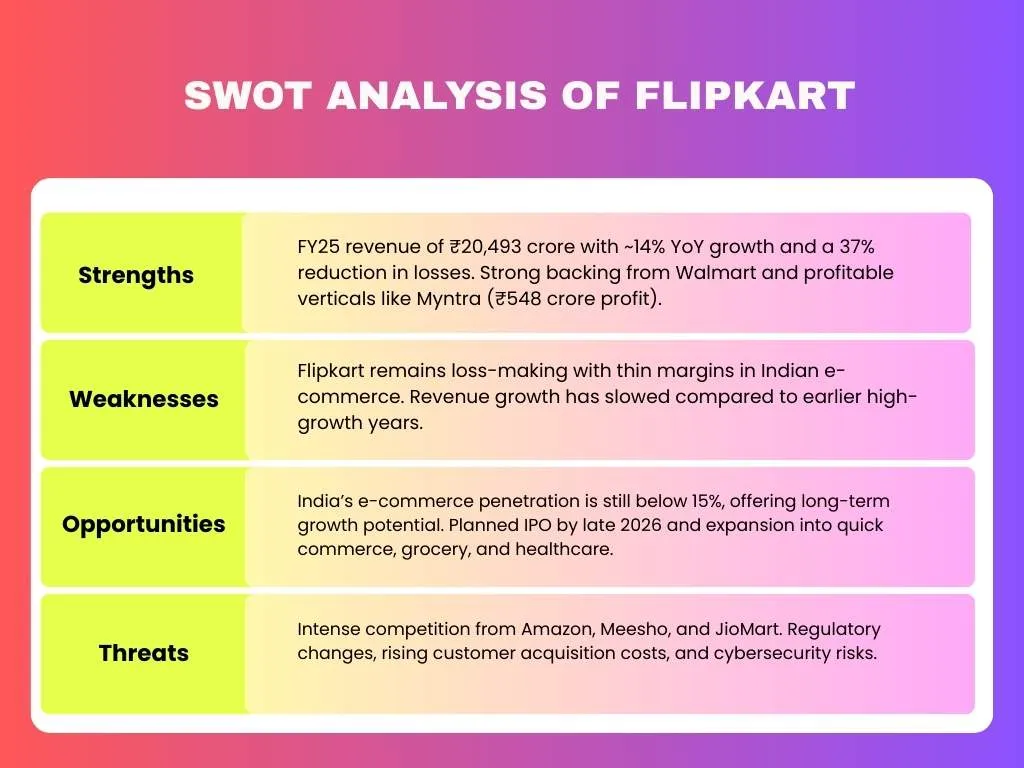
Flipkart’s main marketplace business earned ₹20,493 crore in FY25, growing 14% compared to the previous year. At the same time, the company cut its losses by 37%, showing better control over costs and operations as it prepares for a possible IPO by the end of 2026.
The Flipkart group is also supported by strong businesses like Myntra, which reported a profit of around ₹548 crore in FY25. This helps make the overall business more stable and less dependent on just one platform.
Flipkart’s advertising business is growing fast, with ad revenue increasing by about 27% in FY25. Like many e-commerce companies, Flipkart is focusing more on ads because they offer higher profit margins.
- Good brand awareness and confidence throughout the Indian market, and therefore the preferred choice of millions of online buyers.
- Large logistic system with thousands of warehouses and delivery service providers who guarantee a quick and secure delivery.
- First-mover in the Indian e-commerce market with more than 15 years of operation.
- The support of Walmart comes with huge financial strengths, international experience, and a supply chain.
- Varied product lines in electronics, fashion, groceries, furniture, and digital services.
- New customer-focused policies, such as the return of items easily, EMI, and exchange programs.
- Strong technology platform featuring advanced AI, machine learning and analytics.
- Massive seller base consisting of millions of registered merchants, craftsmen, and small businesses.
- Popular sales such as Big Billion Days generate huge traffic and revenue surges.
- Market positioning: Strategic takeovers of Myntra, Jabong, and PhonePe.
- Local language support that will make the platform available to customers who do not speak English.
- Flipkart Plus customer loyalty plus repeat purchase.
- Good mobile applications presence with an easy-to-use interface and customized suggestions.
- Customer support 24/7 on a variety of channels.
Weaknesses of Flipkart
Flipkart’s revenue growth slowed to around 14% in FY25, which is lower than the faster growth it saw in earlier years. This suggests that the market may be becoming more crowded, and customers may be spending more cautiously.
Although the company has reduced its losses, Flipkart is still not profitable and continues to face losses in FY25. This is mainly because profit margins in Indian e-commerce are very low.
- Losses in heavy operations and cash burning even on the high revenue generation.
- Relying on promotions and discounts to appeal to customers affects the profit margins.
- Lack of international presence as compared to international competition, such as Amazon.
- Difficulties in tier-3 and level-4 cities are having problems with logistics infrastructure and internet penetration.
- Complaints of delayed delivery of products, quality, and response time of customer care.
- Logistics and delivery expenses are proving detrimental to profit, particularly where low-value orders are involved.
- Seller complaints and issues to do with commission structure, delays in payments, and policy of the platform.
- The issue of product authenticity relates to the appearance of fake products on the site at times.
- High use of apps may end up locking out other customers who may want to shop on desktops or offline.
- Reliance on third-party logistics in some areas lessens the ability to regulate the quality of the delivery.
- Difficult procedures involving the return of goods and the refunding of money are irking some clients, even in easy-refund policies.
- Weak presence in terms of the range of their own label in comparison to the large number of Amazon-owned brands.
- Revenue changes seasonally with major reliance on festive sales and special events.
- Technology crashes during high sales, resulting in crashes of the website and a bad user experience.
Opportunities for Flipkart
Flipkart’s expected IPO in late 2026 gives the company a big chance to raise fresh funds, which can be used to grow the business, invest in new ideas, and reduce debt.
At the same time, India’s e-commerce market is still growing. Online shopping usage is much lower than in countries like the U.S. and China, and with more people coming online and cities expanding, there is strong long-term growth potential.
- New customer segments being opened by expansion of internet penetration in rural and semi-urban India.
- Expanding use of smartphones that is exposing online shopping to millions of first-time customers.
- Speedy commerce development with Flipkart Quick delivering grocery and essentials in minutes.
- Video shopping, live streaming, influencer integration Social commerce integration.
- Development of own label with exclusive brands that have greater margins in all categories.
- The expansion of digital payments with the integration of PhonePe that facilitates a smooth transaction.
- Fresh produce and grocery market with huge untapped opportunities in the daily necessities.
- Online healthcare market being taken over by Flipkart Health+ through healthcare and pharmacy services.
- B2B business growth through Flipkart Wholesale to kirana shops and small merchants.
- Eco-friendly and sustainable products that would appeal to the environmentally conscious consumers.
- Voice commerce and vernacular content simplifies the shopping process of non-technical customers.
- The partnership with brands and manufacturers as well as logistics to improve what is offered.
- Export possibilities that assist the Indian sellers to access the international markets by exchanging cross-border trade.
- Insurance, credit and investment products to customers.
- Technology advancements such as AR/VR virtual shopping, drone deliveries and AI based personalization.
Threats to Flipkart
- Increased competition with Amazon, Meesho, JioMart: Competitors like Amazon India and Meesho are rapidly expanding. Meesho’s strong IPO performance and user growth show competitive pressure in price-sensitive segments.
- Regulatory issues: together with e-commerce regulations, FDI regulations, seller relations regulations.
- Offline retailer pressure: and pressure by the associations of traders against the supremacy of e-commerce.
- Economic recessions and inflation: cutting back on consumer expenditure on discretionary items.
- Increasing costs of customer acquisition: it turns out to be costly to acquire and keep new clients.
- Threats to cybersecurity: data breaches, payment fraud, and theft of customer information.
- Reliance on third party sellers: establishment of quality and consistency problems.
- Infrastructure blockages in logistics: at season times that have an impact on the delivery schedules.
- Shifting consumer tastes: towards fast business, social business, and omnichannel customer experiences.
- Talent recruiting and retaining: rivalry in the competitive technological marketplace and e-business.
SWOT Analysis Summary Table
| Strengths | Weaknesses |
| Strong brand recognition and customer trust | Heavy operational losses and cash burn |
| Extensive logistics and delivery network | High dependence on discounts for sales |
| Walmart’s financial backing and expertise | Limited international market presence |
| Diverse product portfolio and categories | Customer service and logistics challenges |
| Innovative customer-centric policies | Seller relationship and dispute issues |
| Opportunities | Threats |
| Expanding internet and smartphone penetration | Intense competition from Amazon and regional players |
| Quick commerce and grocery segment growth | Regulatory challenges and policy changes |
| Social commerce and video shopping trends | Pressure from offline retail associations |
| Private label and exclusive brand development | Economic downturns affecting consumer spending |
| Healthcare services and B2B commerce expansion | Cybersecurity threats and data privacy concerns |
Strategic Insights from Flipkart’s SWOT Analysis
- Capitalize on brand equity: to grow into underserved tier-2, tier-3 and tier-4 cities with customized marketing.
- Efficiencies in cost structure: by eliminating reliance on heavy discounting and enhancing operational efficiency.
- Fast track the expansion of own brand: to increase the profit margin and decrease the threat of the competition with the third-party brands.
- Invest in logistics infrastructure: to overcome the problems of last-mile delivery and enhance customer satisfaction.
- Enhance the relationship with sellers: by offering clear policy, punctual deliveries, and expansion assistance schemes.
- Cash in on fast business: by making Flipkart Quick available in additional cities and products.
- Improve technological solutions: through AIs to personalize, voice-based shopping, and AR/VR-based shopping.
- Expand the range of revenue: B2B business, financial services, and online advertising opportunities.
- Form strategic alliances: with local brands, manufacturers and government projects such as Digital India.
- Get green: through adopting environmentally-friendly packaging, carbon-neutral delivery and circular economy practices.
- Enhance customer service: with a quicker response rate, enhanced communication and preventative action.
- Manage regulatory environment: through remaining compliant and contacting policymakers in a productive manner.
- Enhance cybersecurity: strengthening cybersecurity to ensure the protection of customer data and portraying trust in the platform.
- Build omnichannel opportunities: the ability to combine online and offline shopping.
Suggested Read: Digital Marketing Agencies for Startups
Conclusion
Swot analysis of Flipkart shows a firm with enormous strengths and good opportunities, and equal weaknesses and threats. Since it is the first e-commerce site in India, Flipkart has developed a strong brand, a large base of infrastructure, and a following of loyal customers. Nevertheless, the journey to sustainable profitability should include solving operational losses, improving customer service, and overcoming the competition.
The SWOT analysis of Flipkart shows that the company can be successful in the future in the context of using the resources of Walmart, technological innovations, and penetrating the growing markets such as quick commerce and the medical sector. As long as it is able to capitalize on the digital transformation of India, handle regulatory challenges and competition, Flipkart can continue to lead the market and attain long-term profitability in the fastest-growing e-commerce market in the world, supported by its evolving Flipkart business model.
FAQs
What are the key competitive strengths of Flipkart?
The major strengths of Flipkart are its good brand name, a strong logistics network, the support of Walmart, its initial step in the Indian e-commerce market, and its innovative customer-oriented policies that create confidence and trust towards the company.
What are the largest issues of Flipkart?
The key issues are profitability despite the losses in operations, high competition with Amazon and local competitors, compliance with regulations, logistics, and ensuring the quality of services without deterioration during the expansion of operations.
What is the difference between Flipkart and Amazon India?
Flipkart knows more about Indian consumer behavior, has more local brand connections, has exclusive relationships with Indian sellers, and offers other customizable features such as support in the local language and payment systems.
What are the growth opportunities for Flipkart?
The major opportunities are to grow into tier-2/3 cities, to create quick commerce and grocery segments, create own labels, enter healthcare services, and the increasing internet penetration of India.
Is Flipkart profitable?
At present, Flipkart is losing because of the high investments in infrastructure, technology, and competitive discounts. The company, however, is geared towards dominating the market in the long run and is anticipating profitability in the market in the long run.