
Small businesses continue to rely on email marketing as one of the most effective tools and reach their customers, make a sale, and establish relationships with them. Although Mailchimp has been a popular option since time immemorial, small business owners are finding that it is not always the right fit in their particular requirements. No matter the reason, prices are on the increase, you need more automation options, or just more value on your investment, the Mailchimp alternatives for small businesses may open the door to a more fitting platform.
In this overall guide, we will discuss the top 10 email marketing tools like mailchimp which will be providing competitive features at a good price and with easy-to-use interfaces that can specifically serve the growing business in 2026.
What to Look for in a Mailchimp Alternative
- Pricing discretion: No gaming the system, so it won’t come as a shock when your business expands – in fact, the cost is easy to understand and simple to manage, based on your budget and subscriber base.
- Automation abilities: Time features that foster leads successfully using automated processes, drip campaigns, and triggered emails depending on subscriber activity.
- Deliverability rates: Good inbox placement with a guarantee that your well-crafted emails get to your subscribers and not in their spam inboxes.
- Customer care: Fast response when you need it the most, be it live-chat, email, telephone assistance, or in-depth documentation and tutorials.
Why Small Businesses Look Beyond Mailchimp
The alternative to Mailchimp is becoming popular among small businesses because of a number of convincing factors:
- Increase in cost: Pricing is rapidly increasing as the number of subscribers increases, which frequently is expensive to the point that it causes small operations to be prohibitive.
- Multifaceted pricing: The dissimilar level frameworks along with several add-ons complicate the forecast of the true costs per month and make it impossible to plan the budget.
- Cutting edge features on lower levels: The basic plans limit access to the necessary marketing technology, such as automation, sophisticated segmentation, and multivariate testing.
- Deliverability issues: Delivery of emails to inboxes is problematic to some users, which influences campaign performance and the ROI.
Top 10 Mailchimp Alternatives for Small Businesses (2026)
1. Brevo (Formerly Sendinblue)
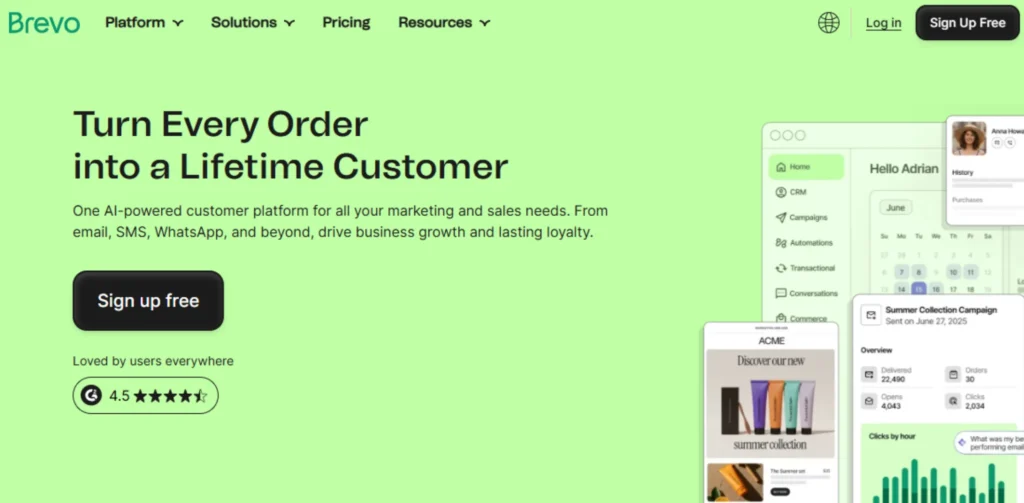
Brevo is one of the most popular replacements of Mailchimp to use among small businesses, and it has an amazing free plan where unlimited contacts and 300 emails per day are provided. The product is an email marketing, SMS campaigns, chat, and marketing automation platform that integrates into a simple interface. The pay-as-you-go pricing structure of Brevo enables it to be extremely cost-effective when it comes to businesses with inconsistent sending habits, and offers advanced segmentation and personalization capabilities to build targeted campaigns that are proven to achieve outcomes.
Key Features:
- Unlimited contact storage
- SMS marketing integration
- Automated processes of marketing.
- Email transaction capability
- Live analytics of reporting.
Pros:
- Generous free plan
- Low cost pricing system.
- Very good email delivery.
- Built-in CRM functionality
Cons:
- Limited template designs
- Branding on free plan
- Learning curve initially
- Less integration with third parties.
Pricing:
- Free: Up to 300 emails/day, unlimited contacts
- Starter: $25/month for 20,000 emails
- Business: $65/month with marketing automation
- Enterprise: Custom pricing with dedicated support
Best Use Case: Budget-conscious businesses needing unlimited contacts
Website: http://brevo.com
2. Moosend
Moosend provides high-performance email marketing services at highly competitive rates, which makes it an appealing option among Mailchimp alternatives for small businesses. The platform also does well on automation through the visual workflow builder, which makes the complex customer journeys easy.
The drag-and-drop editor based on Moosend allows companies to develop professional campaigns within a short time frame with the help of a huge template library and sophisticated segmentation features. Its artificial intelligence-based product suggestions and real-time analytics contribute to optimizing performance and increasing conversions.
Key Features:
- Graphical process automation.
- High-tech email segmentation.
- Landing page builder
- AI product recommendations
- Real-time analytics of the campaign.
Pros:
- Affordable pricing tiers
- Unlimited emails included
- Intuitive user interface
- Superior automation capabilities.
Cons:
- Smaller template library
- Limited mobile app
- Fewer integration options
- Basic reporting features
Pricing:
- Free: 30-day trial with full features
- Pro: $9/month for 500 subscribers
- Enterprise: Custom pricing with priority support
- Pricing scales with subscriber count
Best Use Case: E-commerce businesses requiring automation
Website: http://moosend.com
3. MailerLite
MailerLite has gained the trust of being among the most user-friendly Mailchimp alternatives for small businesses, with a clean interface that amateurs simply adore, without losing access to powerful features. The platform includes an attractive free plan with limits, advanced automation builders, and attractive email templates that are presentable irrespective of devices.
The simplicity of MailerLite, which is mixed with sophisticated functions such as dynamic content, built-in photo editing tools, and custom HTML editing, is something that makes it the perfect choice for solopreneurs and small businesses.
Key Features:
- Drag-and-drop email editor
- Landing page creation
- Website builder included
- Pop-up form designer
- Digital product selling
Pros:
- Clean, intuitive interface
- Generous free plan
- Excellent template designs
- Well-developed automation.
Cons:
- Limited advanced features
- Basic reporting dashboard
- Less integrations are offered.
- Minimal functionality of survey
Pricing:
- Free: Up to 1,000 subscribers, 12,000 emails/month
- Growing Business: $9/month for 1,000 subscribers
- Advanced: $18/month with additional features
- Enterprise: Custom pricing available
Best Use Case: Beginners wanting simple yet powerful
Website: http://mailerlite.com
4. ActiveCampaign
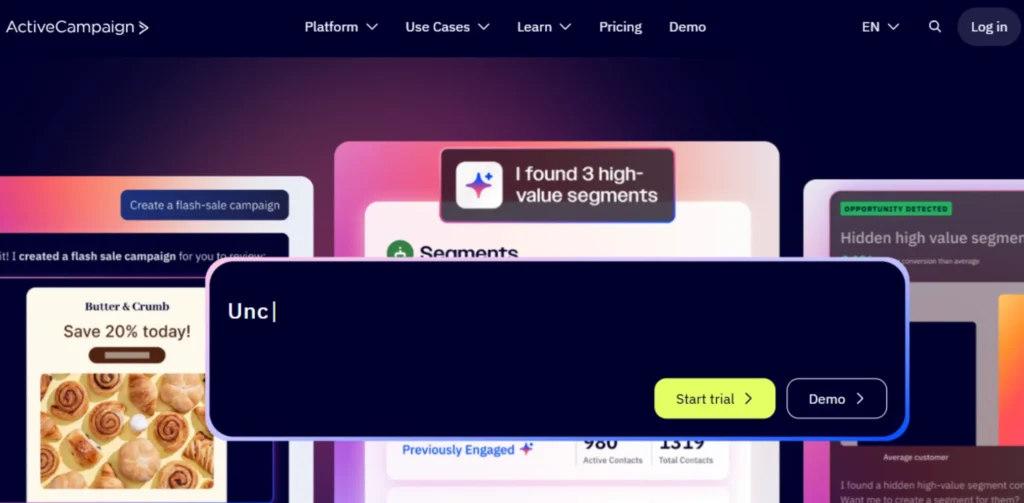
ActiveCampaign differentiates itself as a high-end product in targeting market for the Mailchimp alternatives for small businesses, integrating email marketing and strong CRM and sales automation capabilities. Although a bit more expensive than the rivals, it offers high-value features by the use of advanced automation cycles, forecasting delivery, and machine learning.
The conditional content of the platform, divided actions, and sophisticated segmentation allow the creation of highly personalized customer experiences. ActiveCampaign is more appropriate with businesses that are willing to execute intricate, data-driven marketing initiatives that grow as the business grows.
Key Features:
- CRM with sales automation
- Predictive optimisation of sending.
- Conditional content blocks
- Machine learning functionality.
- Site and event tracking
Pros:
- Powerful automation engine
- Holistic CRM integration.
- High-end segmentation services.
- High levels of deliverability.
Cons:
- Steeper learning curve
- Higher pricing tiers
- Complex for beginners
- Setup time required
Pricing:
- Lite: $15/month for 1,000 contacts
- Plus: $49/month with CRM and automation
- Professional: $79/month with advanced features
- Enterprise: Custom pricing with dedicated account rep
Best Use Case: Advanced automation and CRM needs
Website: http://activecampaign.com
5. GetResponse
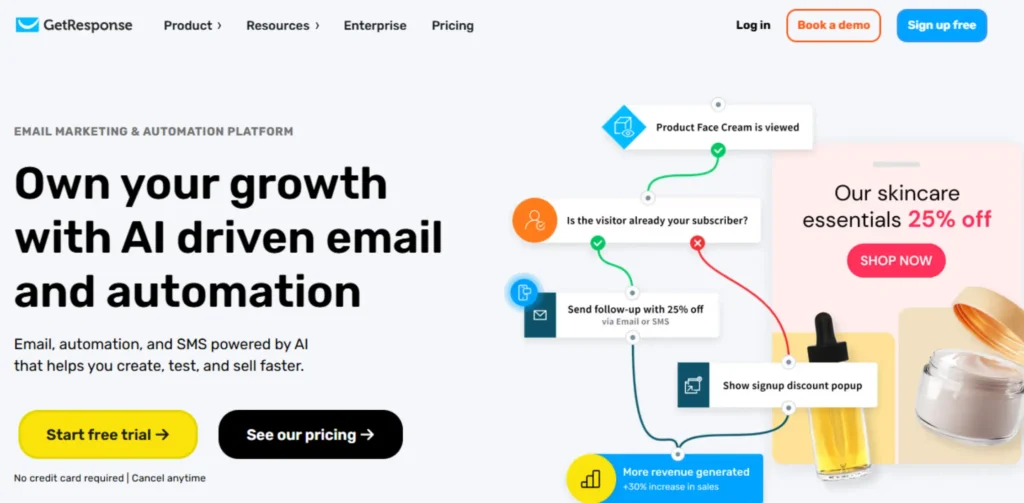
GetResponse provides a single platform of marketing, which is rated as one of the best Mailchimp substitutes in small enterprises that require a full package of digital marketing. In addition to email marketing, it has webinar hosting services, a conversion funnel, and e-commerce functionalities that help negate the necessity of several subscriptions.
The autoresponders, autofunnel technolog,y and perfect timing feature of the platform enable businesses to engage the audiences. The company has a wide range of templates and responsive design features that keep the campaigns on different devices looking just as beautiful as possible.
Key Features:
- Webinar hosting included
- Conversion funnel builder
- Optimization of perfect timing.
- E-commerce integration devices.
- Higher order autoresponder codes.
Pros:
- One-stop shop marketing solution.
- The webinar functionality was provided.
- Strong automation features
- Excellent template variety
Cons:
- Interface feels cluttered
- Limited free plan
- Higher pricing structure
- Webinar limits apply
Pricing:
- Free: Up to 500 contacts, basic features
- Email Marketing: $19/month for 1,000 contacts
- Marketing Automation: $59/month with advanced features
- E-commerce Marketing: $119/month with full suite
Best Use Case: Businesses hosting webinars regularly
Website: http://getresponse.com
6. ConvertKit
Compared to other Mailchimp alternatives for small businesses, ConvertKit focuses on creators, bloggers, and online entrepreneurs, which makes it a special choice among small businesses in content-oriented sectors. Its strong emphasis on seo automation and content-driven growth further supports businesses that rely heavily on organic traffic and audience engagement. The platform focuses on subscriber management, which is tag-based and not in the conventional list, which has the capability of making diverse groupings of the audience.
The visual automation editor, customizable landing pages, and smooth commerce integration of ConvertKit make creators able to monetize their audiences. Its emphasis on ease of use and deliverability has found favor among the content developers of the world, although its template selection is limited.
Key Features:
- Tag-based management of subscribers.
- Graphical methods of automation.
- Customizable landing pages
- Digital product selling
- Subscriber scoring system
Pros:
- Creator-focused features
- Good deliverability rates.
- Simple automation builder
- Assistance given in migration.
Cons:
- Limited template selection
- Basic design options
- Higher cost per subscriber
- Minimal reporting features
Pricing:
- Free: Up to 1,000 subscribers, limited features
- Creator: $33/month for 1,000 subscribers
- Creator Pro: $66/month with advanced reporting
- Pricing increases with subscriber count
Best Use Case: Content creators and bloggers
Website: http://convertkit.com
7. Omnisend
Omnisend focuses on online marketing, and it is one of the best Mailchimp alternatives in e-commerce marketing among small business owners who offer products online. The platform allows the integration of email, SMS, push notifications, and social media in a smooth manner to enhance sales through unified campaigns.
Ready-made cart abandonment, welcome series, and product recommendations automation workflows are time-saving and revenue-maximizing. The product picker, dynamic discount code, and purchase-based campaigns of Omisend make use of unique functions to transform the increasingly popular browsers into buyers in an efficient manner.
Key Features:
- Campaign management in the omnichannel.
- Ready-made automation procedures.
- Recommendation engine product.
- SMS marketing integration
- Cart abandonment recovery
Pros:
- E-commerce focused features
- Multi-channel campaigns
- Strong Shopify integration
- Superior automation templates.
Cons:
- Poor non-ecommerce capabilities.
- SMS costs extra
- Smaller email limits
- Learning curve initially
Pricing:
- Free: Up to 250 contacts, 500 emails/month
- Standard: $11.20/month for 500 contacts
- Pro: $41.30/month with advanced automation
- Enterprise: Custom pricing available
Best Use Case: Online stores needing omnichannel marketing
Website: http://omnisend.com
8. Constant Contact
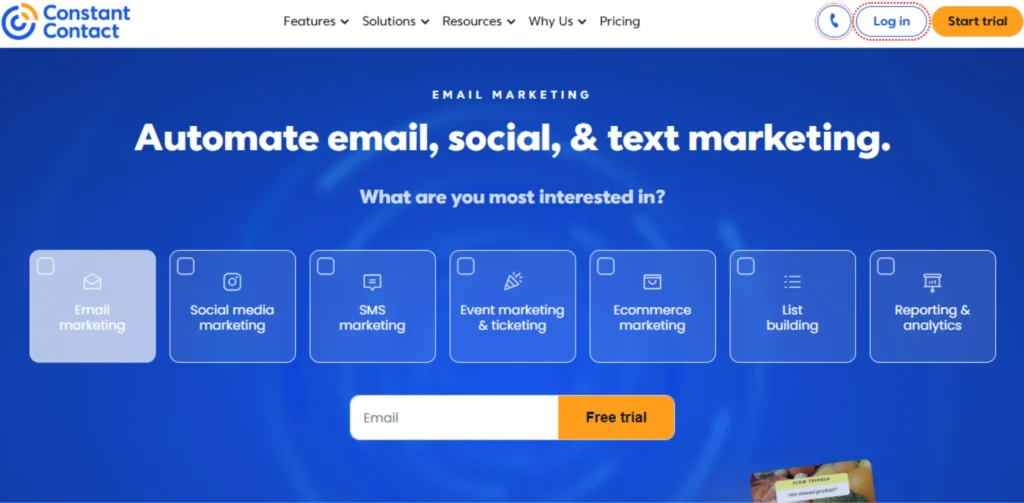
Constant Contact is a decades-old email marketing company, and it is a solid option when choosing between Mailchimp and other Mailchimp alternatives for small businesses because it offers the reliability and wide-ranging support that businesses need. The platform provides great customer care by providing live chat, phone support, and a vast amount of education that can enable beginners to succeed.
Although it is not the most affordable, the event management tools, social media connection, and a broad selection of templates offered by Constant Contact are solid enough. The local marketing aspects of it are especially advantageous to brick-and-mortar businesses.
Key Features:
- Event management tools
- Social media posting
- Extensive template library
- List segmentation options
- Website builder included
Pros:
- Excellent customer support
- User-friendly interface
- Event management features
- Strong deliverability rates
Cons:
- Higher pricing tiers
- Basic automation features
- Limited A/B testing
- Dated interface design
Pricing:
- Lite: $12/month for 500 contacts
- Standard: $35/month with automation
- Premium: $80/month with advanced features
- 60-day free trial available
Best Use Case: Local businesses needing event management
Website: http://constantcontact.com
9. SendPulse
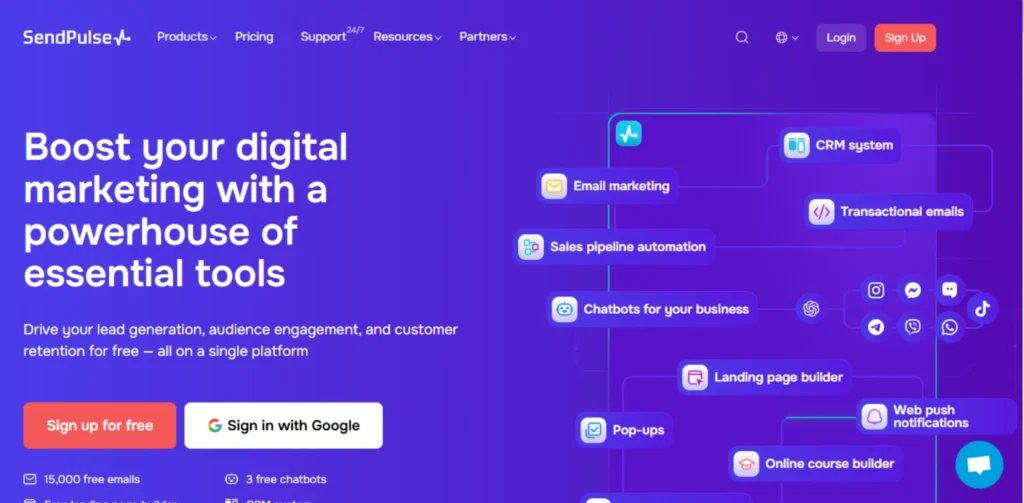
SendPulse stands out among the Mailchimp alternatives for small businesses because it provides indeed the multi-channel marketing opportunities at affordable costs. The site is a web of email, SMS, web push notification, chatbots, and even Instagram and Facebook chatbots under a single platform.
The free plan offered by sendpulse with its AI-based optimization of sending time and subscription forms is incredibly valuable. Its drag-and-drop constructors in all channels remain consistent and streamline the process of building campaigns among busy entrepreneurs.
Key Features:
- Four-channel selling platform.
- Chatbot builder included
- Web push notifications
- SMS campaign management
- AI send time optimization
Pros:
- Generous free plan
- Multi-channel capabilities
- Text chatbot functionality was provided.
- Low cost pricing system.
Cons:
- Interface can confuse
- Limited template designs
- Automation complexity
- Periodic problems with deliverability.
Pricing:
- Free: Up to 500 subscribers, 15,000 emails/month
- Standard: $8/month for 500 subscribers
- Pro: $9.60/month with additional features
- Enterprise: Custom pricing with dedicated support
Best Use Case: Multi-channel marketing on budget
Website: http://sendpulse.com
10. Benchmark Email
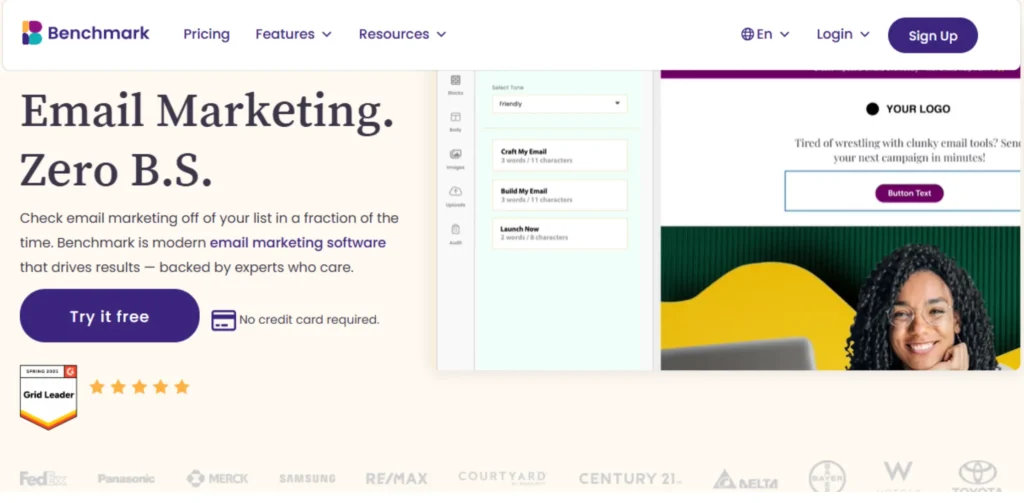
Benchmark Email completes our list of the best Mailchimp Alternatives for Small Businesses to use when operating a small business because this email marketing option has a simple way of doing things that focuses on simplicity and low cost. The platform will include unlimited email transmissions in all the paid plans and this means that one will not be concerned with the frequency of the campaign.
The photo editing tools and the drag and drop editor incorporated in the responsive templates of Benchmark do assist in building professional campaigns fast. Although it does not have all the sophisticated functions of competitors, it is very simple and reliable, which is ideal when a business wants hassle-free email marketing.
Key Features:
- Unlimited email sends
- Responsive email templates
- Built-in photo editor
- A/B testing capabilities
- List management tools
Pros:
- Simple, intuitive interface
- Unlimited sends included
- No setup fees
- Good template selection
Cons:
- Basic automation features
- Minimal integrations that are offered.
- Basic reporting options
- Fewer advanced features
Pricing:
- Free: Up to 500 contacts, 3,500 emails/month
- Pro: $37/month for 2500 contacts
- Enterprise: Custom pricing available
- Unlimited emails on all paid plans
Best Use Case: Simple email marketing needs
Website: http://benchmarkemail.com
Mailchimp Free Alternative (User Reviews + Reddit Insights)
| Platform | User Rating | Reddit Sentiment | Free Plan Highlights | Best For |
| Brevo | 4.5/5 | Highly Positive | Unlimited contacts, 300 emails/day | Budget-conscious startups |
| MailerLite | 4.6/5 | Very Positive | 1,000 subscribers, 12,000 emails/month | Beginners and creators |
| SendPulse | 4.3/5 | Positive | 500 subscribers, 15,000 emails/month | Multi-channel marketers |
| Moosend | 4.4/5 | Positive | 30-day full feature trial | Testing before committing |
| Benchmark | 4.2/5 | Mixed-Positive | 500 contacts, 3,500 emails/month | Simple needs |
Brevo vs Mailchimp (Side-by-Side Comparison)
| Feature | Brevo | Mailchimp |
| Free Plan Contacts | Unlimited | 500 |
| Free Plan Emails | 300/day (9,000/month) | 1,000/month total |
| Starting Paid Plan | $25/month | $13/month |
| Automation | Available on all plans | Limited on free |
| SMS Marketing | Integrated | Separate add-on |
| Deliverability | 95%+ average | 93-95% average |
| Template Variety | Moderate (200+) | Extensive (300+) |
| CRM Features | Built-in included | Limited/paid add-on |
| Customer Support | Email support free plan | Email only free plan |
| Best For | Budget + unlimited contacts | Brand recognition + integrations |
How to Choose the Right Email Marketing Tool
There are many Mailchimp alternatives for small businesses, but it is important to choose based on your needs:
- Be realistic with your budget: Take into account the number of subscribers now and the projected growth within 6-12 months to prevent unforeseen cost-increases.
- Look at key features: Customize on what you are going to be able to use on a regular basis rather than on fancy features that add nothing but high costs.
- Deliverability of a test in trials: Run test campaigns to different email providers in trial periods, to ensure a high level of inbox rates.
- Check integration compatibility: Make sure that the platform can integrate effectively with your existing tools, CRM, web site and other vital business systems.
- Scalability choices: Have your platform have the ability to expand with your business without compelling it to make disruptive migrations or radical price increases at critical levels.
Conclusion
The search for the most suitable one among Mailchimp alternatives for small businesses does not necessarily have to be cumbersome. The platforms presented in this guide have their own advantages specific to the business needs, financial possibilities, and marketing plans. You want to focus on being cheap such as Brevo, you want to focus on being simple such as MailerLite, or you need to focus on being advanced such as ActiveCampaign, there is an option that fits your objective.
What counts, as far as your business is concerned, is what you want to see in your business most, be it unlimited contacts, multi-channel marketing, e-commerce facilities, or unique support. Use free trials, experiment with several platforms and settle on one that will enable your marketing without putting the bank to the test. The appropriate email marketing system must seem like a growth partner, and not a cost liability.
FAQs
Which is the least expensive Mailchimp substitute?
Brevo can have the best free plan, where every contact and 300 emails each day are included. Both SendPulse and MailerLite have great free plans that can be used by cost-conscious companies.
What is the best Mailchimp alternative to use in e-commerce?
Omnisend is an e-commerce cart abandonment, product recommendation and SMS integration company. Moosend also has good e-commerce functionality at cheap rates.
Are these alternatives providing migration assistance?
The vast majority of services such as ConvertKit, ActiveCampaign, and GetResponse provide free migration support to have the chance to transfer contacts, templates, and campaigns in Mailchimp with ease.
What platform is the most automated one?
ActiveCampaign is most advanced in the field of automation with conditional workflow and predictive emailing. GetResponse and Moosend also have their strong automation but at cheaper rates.
Does it have superior free plans than Mailchimp?
Yes, a few of them also have better free plans. Brevo offers unlimited contacts, MailerLite has 1000 subscribers with 12000 monthly emails and send pulse has 500 subscribers with 15000 monthly emails.